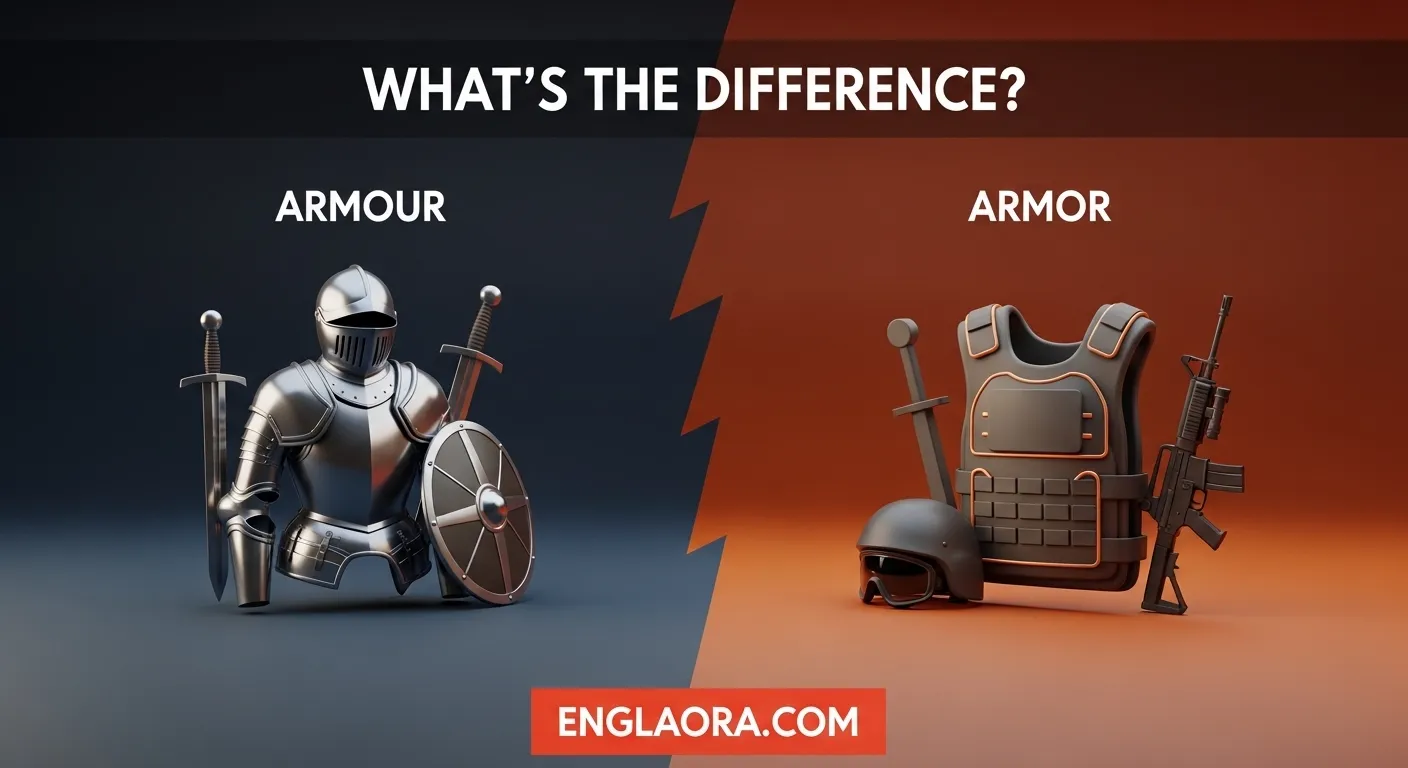
Hey, I want to share something that happened to me recently involving Armour or Armor.
I was chatting with a friend when this word suddenly popped up, and honestly, I wasn’t sure what it really meant — or which spelling was correct.
For a moment, I kept thinking, “Am I missing something here?” It felt confusing, and I didn’t want to reply the wrong way or sound clueless.
So, I decided to look into Armour or Armor to understand the correct meaning and proper usage.
Once I figured it out, everything made sense.
I realized that sometimes the difference isn’t about meaning at all — it’s about spelling variations and knowing when to use each one.
Now, whenever I see Armour or Armor in chats, articles, or on social media, I feel confident responding the right way without second-guessing myself.
Armour or Armor – Quick Answer
Quick Answer:
Both spellings are correct.
- “Armour” → British English, used in the UK, Canada, Australia, and other Commonwealth countries.
- “Armor” → American English, used in the US.
Example:
- British English: The knight wore shining armour.
- American English: The knight wore shining armor.
The Origin of Armour or Armor
The word comes from the Old French “armure”, meaning “arms or defensive gear,” and was adopted into Middle English. The spelling difference arose over time as English evolved in different regions. American English simplified many words, removing the “u” from words like colour → color, favour → favor, and armour → armor.
British English vs American English Spelling
Comparison:
| Feature | British English | American English |
| Spelling | armour | armor |
| Usage Countries | UK, Canada, Australia | USA |
| Example Sentence | The soldier polished his armour before battle. | The soldier polished his armor before battle. |
Key Tip: British English keeps the “u” in many words, whereas American English prefers simplified forms.
Which Spelling Should You Use?
- Use “armour” if your audience is British, Canadian, Australian, or prefers British English.
- Use “armor” if your audience is American or your content is for the US market.
- For global content, consider your main audience, but American English is widely understood online.
Common Mistakes with Armour or Armor
- Writing “armor” in UK-targeted content → looks incorrect to local readers.
- Writing “armour” in US content → may confuse readers or look outdated.
- Mixing both spellings in the same document → always stay consistent.
- Incorrect pluralization → “armors” is acceptable in American English, “armour” usually stays singular in British English unless talking about types.
Correction Example:
- ❌ The knight’s armor gleamed in London.
- ✅ The knight’s armour gleamed in London.
Armour or Armor in Everyday Examples
- Email/Business: Please ensure all equipment is checked for armor integrity.
- News Article: Medieval armour is displayed at the British Museum.
- Social Media: Check out this epic cosplay in full armor!
- Formal Writing: The research focused on the protective armour used in medieval battles.
Vallies or Valleys: Meaning, Grammar and Correct Usage(2026)
Armour or Armor – Google Trends & Usage Data
- Google Trends shows “armor” dominates in the US, while “armour” is more popular in the UK, Canada, and Australia.
- Context: The word often appears in historical, gaming, and military content.
Regional Popularity Table:
| Country | Popular Spelling | Notes |
| USA | Armor | Preferred for books, games, articles |
| UK | Armour | Traditional spelling |
| Canada | Armour | Common in formal writing |
| Australia | Armour | Standard usage |
Keyword Variations Comparison
| Variation | Region | Example |
| Armour | UK, Canada, Australia | The knight’s armour shone. |
| Armor | USA | The knight’s armor shone. |
| Armored | US | An armored vehicle arrived. |
| Armoured | UK | An armoured vehicle arrived. |
FAQs
1. Is “armour” wrong?
No, it’s correct in British English.
2. Is “armor” wrong?
No, it’s correct in American English.
3. Can I mix both spellings?
No, keep your spelling consistent.
4. Which spelling is more popular online?
“Armor” is more common due to US-based content online.
5. Should I use “armoured” or “armored”?
Use “armoured” in UK English and “armored” in US English.
6. Does it matter in historical writing?
Yes, use “armour” for British historical contexts.
7. Are there other words like this?
Yes, e.g., colour/color, honour/honor, favourite/favorite.
Conclusion
Choosing between armour or armor is simple once you know your audience. Use armour for British English and armor for American English. Consistency matters in professional, academic, and online writing. Understanding the origin, trends, and common mistakes helps you make the right choice every time. Whether you’re writing a medieval novel, a game review, or a historical article, applying the correct spelling will make your work polished and professional. Always check your audience, stay consistent, and your writing will shine just like a knight’s armour—or armor!

Hi, I’m Ethan Hawkes, writing for Englaora.com. I provide clear, reliable content to help users understand the differences between commonly confused words.