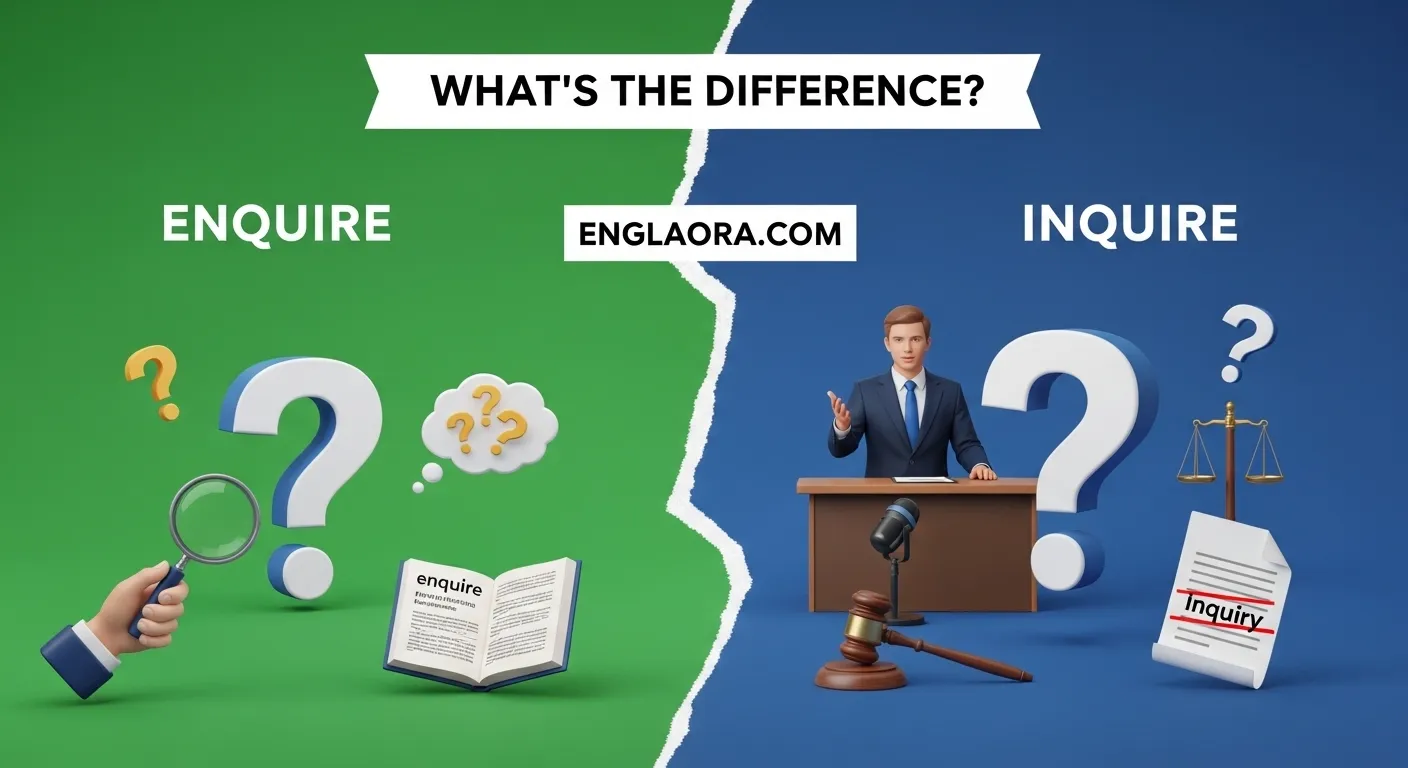
Hey, I want to share something that happened to me recently involving Enquire or Inquire.
I was chatting with a friend when this term suddenly popped up, and honestly, I wasn’t sure what it really meant or which one was correct.
For a moment, I kept thinking, “Am I missing something here?” It was confusing, and I didn’t want to reply the wrong way or sound clueless.So, I decided to look into Enquire or Inquire to understand the correct meaning and proper usage.
Once I figured it out, everything started to make sense, and I realized how important it is to know the difference to avoid awkward moments in conversations.
Now, whenever I see Enquire or Inquire in chats or on social media, I feel confident responding the right way.
Enquire or Inquire – Quick Answer
Quick Answer: Both enquire and inquire mean the same thing – to ask for information.
- Enquire → More common in British English, used in general or informal questions.
- Inquire → Preferred in American English and formal contexts.
Examples:
- I will enquire about the train schedule. (UK style)
- The lawyer will inquire into the case details. (US/formal)
The Origin of Enquire or Inquire
Both words come from the Latin “inquirere”, which means “to seek or ask for.”
- In the Middle Ages, the words merged into English.
- Over time, spelling variations appeared: inquire became standard in formal and American usage, while enquire stayed popular in Britain.
- Today, the difference is mostly regional, with meaning remaining identical.
British English vs American English Spelling
The key difference is regional preference:
| Aspect | British English | American English |
| Preferred spelling | Enquire | Inquire |
| Formality | Less formal, general use | Formal, legal, official use |
| Common example | Please enquire at the reception. | Please inquire with the administration. |
Tip: In UK business writing, both are acceptable, but inquire sounds more official. In US English, inquire is standard everywhere.
Which Spelling Should You Use?
- US audience → Always use inquire.
- UK/Commonwealth → Use enquire for casual contexts and inquire for formal writing.
- Global audience → If unsure, inquire is safer because it’s widely accepted internationally.
Common Mistakes with Enquire or Inquire
- ❌ Using enquire in formal American documents.
- ❌ Writing inqire or enqire (typos).
- ❌ Mixing them inconsistently in the same text.
Correct usage:
- She wanted to enquire about the workshop schedule.
- The committee will inquire into the issue thoroughly.
Enquire or Inquire in Everyday Examples
Emails:
- I would like to inquire about your services.
News articles:
- Police inquired into the missing documents.
Social media:
- DM me if you want to enquire about tickets!
Formal writing:
- The auditor will inquire about the financial statements.
Enquire or Inquire – Google Trends & Usage Data
- US → “Inquire” dominates searches and usage.
- UK → “Enquire” slightly more common in casual writing, but “inquire” used in legal/business contexts.
- Global → “Inquire” has higher recognition online due to US content prevalence.
Insight: Using “inquire” ensures wider understanding for international readers.
Comparison Table: Enquire vs Inquire
| Feature | Enquire | Inquire |
| Meaning | Ask for information | Ask for information |
| British English | ✅ Common | ✅ Formal/official |
| American English | ❌ Rare | ✅ Standard |
| Formality | Casual/general | Formal/official |
| Typical use | Everyday questions | Legal/business inquiries |
FAQs
- Are enquire and inquire interchangeable?
Yes, mostly. Choice depends on region and formality. - Which is more formal?
Inquire is generally considered more formal, especially in business or legal writing. - Can I use enquire in the US?
Technically yes, but it may appear unusual or outdated. - Is inquire the correct spelling in emails?
For US audiences, always use inquire. For UK audiences, either is acceptable depending on formality. - Why do Brits use ‘enquire’?
It’s a traditional British spelling that evolved separately from American English. - Is there a difference in pronunciation?
No, both are pronounced the same: /ɪnˈkwaɪər/. - Which should I use for global content?
Use inquire to ensure international readers understand clearly.
Conclusion
Choosing between enquire or inquire is simple once you understand regional preferences, formality, and context. In the UK, enquire suits casual communication while inquire works for formal writing. In the US, always use inquire. For global audiences, inquire ensures clarity and professionalism. Avoid common mistakes like inconsistent use or typos, and remember that both words mean “to ask for information.” By following these guidelines, you’ll write confidently in emails, news articles, social media posts, and formal documents, keeping your audience in mind. Knowing the subtle difference also makes your writing more polished and credible.
Discover More Article‘s:
Mustache or Moustache: Spelling Difference Explained(2026)
Persue vs Pursue: Meaning and Grammar Differences(2026)
Indexes or Indices: Grammar, Meaning and Usage(2026)

Hi, I’m Ethan Hawkes, writing for Englaora.com. I provide clear, reliable content to help users understand the differences between commonly confused words.