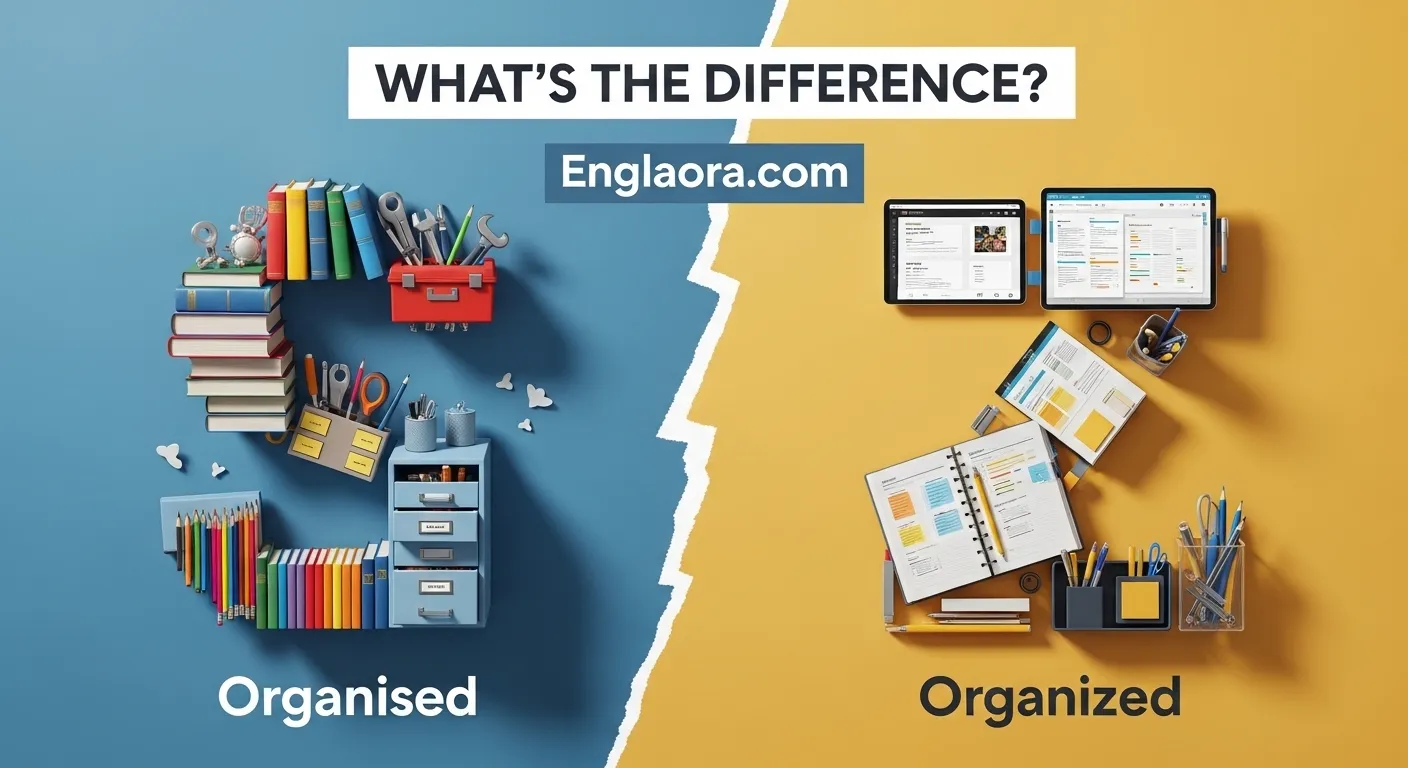
Hey, I want to share something that happened to me recently involving Organised or Organized.
I was chatting with a friend when this term suddenly popped up, and honestly, I had no idea which one was correct.
For a moment, I kept thinking, “Am I missing something here?” — it was confusing, and I didn’t want to reply the wrong way or sound clueless.
So, I decided to look into Organised or Organized to understand the correct meaning and proper usage.
Once I figured it out, everything made sense, and I realized how important it is to know the difference to avoid awkward moments in conversations.
Now, whenever I see Organised or Organized in chats or on social media, I feel confident using the right one
Organised or Organized – Quick Answer
- Organised → British English spelling.
- Organized → American English spelling.
Example:
- British: She is very organised and keeps her schedule neat.
- American: He is highly organized in his work tasks.
Both are correct depending on your audience.
The Origin of Organised / Organized
The word organize comes from the Greek word organon, meaning “tool” or “instrument,” and the Latin organizare, meaning “to form into a system.”
Spelling differences appear because British English often favors -ise, while American English prefers -ize. Both forms entered English through French influence in the 15th–16th centuries, but over time, the US standardized -ize endings.
British English vs American English Spelling
| Feature | British English | American English | Example |
| Verb ending | -ise | -ize | Organise / Organize |
| Common words | realise, recognise, organise | realize, recognize, organize | I organise my files. / I organize my files. |
| Usage tip | Used in UK, Australia, New Zealand | Used in US | Write according to your audience. |
Tip: In formal UK writing, organised is preferred. In the US, organized is standard.
Which Spelling Should You Use?
- Use “organised” if writing for a British, Australian, or Commonwealth audience.
- Use “organized” for American readers.
- Global writing: consider your primary audience or the platform’s standards.
Pro advice: Consistency matters more than the spelling itself. Don’t mix both in one document.
Common Mistakes with Organised / Organized
- Mixing spellings: He organised and organized the files. ❌
- Using British spelling in American contexts: She is very organised. ❌
- Forgetting the word’s proper usage as an adjective: The desk was organized. ✅
Always match the spelling style with your audience and stick to it throughout your writing.
Organised or Organized in Everyday Examples
- Emails: “I have organised the meeting agenda.” (UK) / “I have organized the meeting agenda.” (US)
- News: “The volunteers organized a cleanup drive last weekend.”
- Social media: “Stay organised with your tasks using this app!”
- Formal writing: “Our department is organized efficiently to meet deadlines.”
Organised or Organized – Google Trends & Usage Data
- US popularity: “organized” is searched 4x more than “organised.”
- UK & Commonwealth: “organised” dominates searches.
- Global trend: “organized” is more common internationally due to US internet influence.
Comparison Table – Keyword Variations
| Variation | Region | Correct Example |
| organised | UK, Australia | She is very organised. |
| organized | US | He is highly organized. |
FAQs
1. Is “organised” wrong?
No, it’s correct in British English.
2. Can I use “organized” in the UK?
It’s understandable but may look American.
3. Why do UK and US spellings differ?
Historical spelling reforms led to differences in suffixes like -ise vs -ize.
4. Which is more popular globally?
“Organized” is more common worldwide due to US influence.
5. Should I always stick to one spelling in a document?
Yes, consistency is key for professional writing.
6. Are there other words with the same -ise/-ize difference?
Yes, words like “realise/realize” and “recognise/recognize.”
7. Does it matter in informal writing?
Less so, but staying consistent looks better.
Conclusion
Deciding between organised and organized depends mainly on your audience. Use organised for British and Commonwealth readers and organized for American readers. Remember, consistency is more important than the spelling choice itself. By understanding the history, regional preferences, and proper usage in emails, social media, and formal writing, you can avoid confusion and communicate clearly. Whether writing for work, school, or social platforms, following these rules ensures your text looks polished and professional.
In short: pick your spelling, stick to it, and match your audience—your writing will always stay well-organised (or organized!).

Hi, I’m Ethan Hawkes, writing for Englaora.com. I provide clear, reliable content to help users understand the differences between commonly confused words.