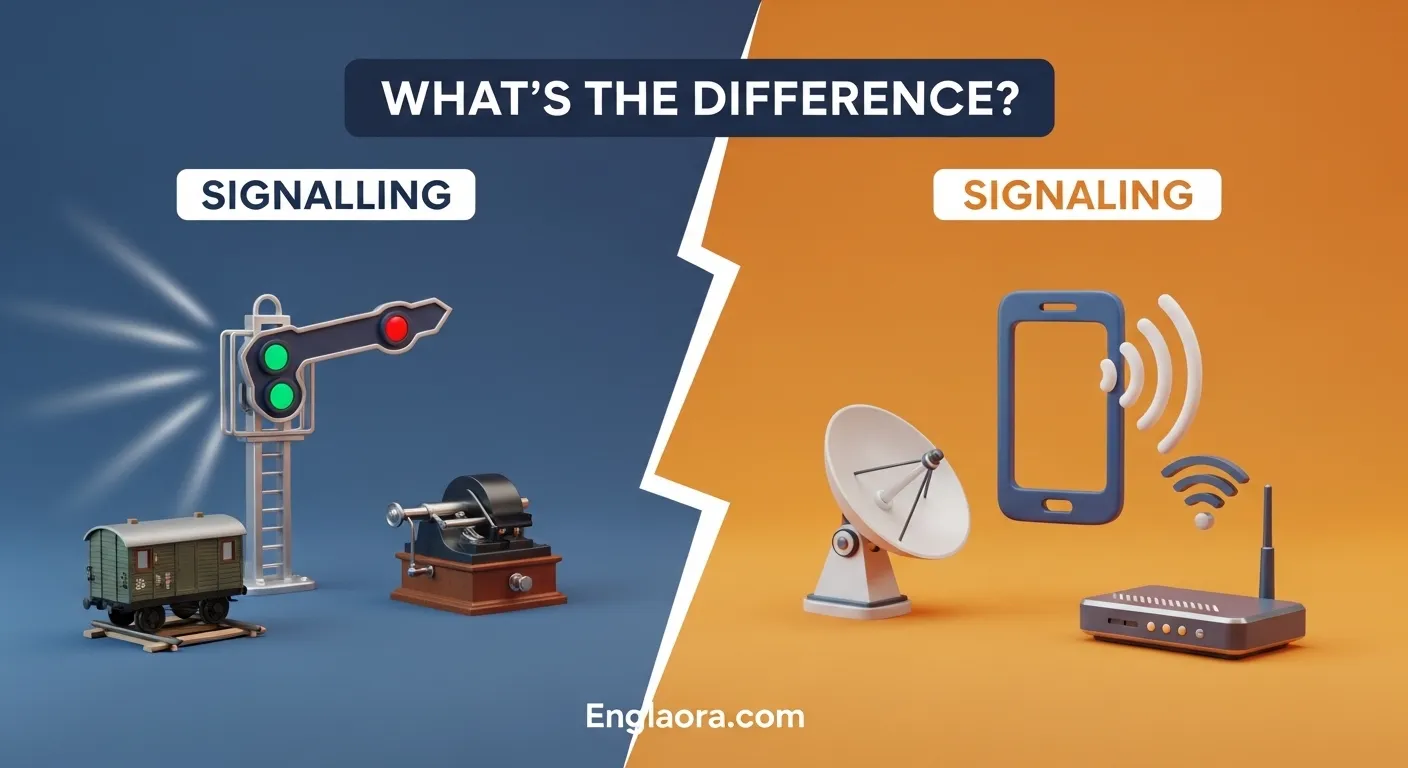
Hey, I want to share something that happened to me recently involving Signalling or Signaling.
I was chatting with a friend when this term suddenly popped up, and honestly, I had no idea what it really meant.
For a moment, I kept thinking, “Am I missing something here?” — it was confusing, and I didn’t want to reply the wrong way or sound clueless.
So, I decided to look into Signalling or Signaling to understand the correct meaning and proper usage.
Once I figured it out, everything made sense, and I realized how important it is to know the difference to avoid awkward moments in conversations.
Now, whenever I see Signalling or Signaling in chats or on social media, I feel confident responding the right way.
Signalling or Signaling – Quick Answer
Both signalling and signaling are correct spellings.
- Signalling → British English
- Signaling → American English
Example:
- UK: The traffic lights are signalling a stop.
- US: The traffic lights are signaling a stop.
The meaning is exactly the same.
The Origin of Signalling or Signaling
The word comes from the noun “signal,” which has Latin roots (signum, meaning sign or mark). When verbs were formed from nouns ending in -l, spelling rules developed differently over time.
British English kept the rule of doubling the “l” before adding -ing.
American English simplified spelling and dropped the extra l.
That is why both forms exist today.
British English vs American English Spelling
British and American English follow different spelling conventions for verbs ending in -l.
Key Differences
| Aspect | British English | American English |
| Spelling | signalling | signaling |
| Rule | Double the “l” | Single “l” |
| Used in | UK, Australia, Canada | United States |
| Meaning | Same | Same |
Both are grammatically correct—only the region changes.
Which Spelling Should You Use?
Your audience decides the spelling.
- US audience → Use signaling
- UK or Commonwealth audience → Use signalling
- Global or mixed audience → Pick one and stay consistent
Consistency matters more than the spelling itself.
Common Mistakes with Signalling or Signaling
Here are frequent errors writers make:
- ❌ Mixing both spellings in one article
- ❌ Assuming one spelling is “wrong”
- ❌ Changing spelling without changing audience
Correct approach:
- Choose one spelling
- Match it to your audience
- Use it consistently
Signalling or Signaling in Everyday Examples
Emails:
- She is signaling interest in the proposal.
News:
- Officials are signalling policy changes.
Social Media:
- That emoji is signaling sarcasm.
Formal Writing:
- The data is signalling a market shift.
The context stays the same. Only spelling changes.
Signalling or Signaling – Google Trends & Usage Data
Search trends show:
- Signaling is more popular in the United States
- Signalling dominates in the UK, Australia, and parts of Europe
- Global searches include both spellings
People usually search the version they learned first.
Comparison Table: Signalling vs Signaling
| Feature | Signalling | Signaling |
| English type | British | American |
| Spelling style | Double “l” | Single “l” |
| Meaning | Same | Same |
| Correct usage | Yes | Yes |
FAQs
1. Are signalling and signaling the same word?
Yes. They have the same meaning.
2. Is signalling incorrect in American English?
It’s not wrong, but uncommon.
3. Is signaling incorrect in British English?
It’s understood, but not standard.
4. Which spelling is better for SEO?
Use the version your audience searches for.
5. Can I use both spellings in one article?
No. Consistency is important.
6. Do style guides accept both spellings?
Yes, depending on region.
Conclusion
The confusion around signalling or signaling comes from regional spelling rules, not meaning or correctness. Both words are valid, professional, and widely accepted in English. The key difference lies in where your audience is located and which version of English they expect.
British English follows traditional spelling rules and uses signalling with a double “l.” American English simplifies spelling and prefers signaling with a single “l.” Neither version changes the definition, tone, or clarity of your message.
To write confidently, decide your target audience first. If you are writing for the US, choose signaling. For the UK or Commonwealth countries, use signalling. For global content, consistency matters more than the choice itself.
Once you understand this rule, you’ll never hesitate again when choosing between signalling or signaling.

Hi, I’m Emma Caldwell, an expert author at Englaora.com. I share clear insights on language differences and provide readers with reliable, easy-to-understand content.