Hey, I want to share something that happened to me recently involving whose or whos.
I was chatting with a friend when this term suddenly popped up, and honestly, I had no idea what it really meant.
For a moment, I kept thinking, “Am I missing something here?” — it was confusing, and I didn’t want to reply the wrong way or sound clueless.
So, I decided to look into whose or whos to understand the correct meaning and proper usage. Once I figured it out, everything made sense, and I realized how important it is to know the difference to avoid awkward moments in conversations.
Now, whenever I see whose or whos in chats or on social media, I feel confident responding the right way.
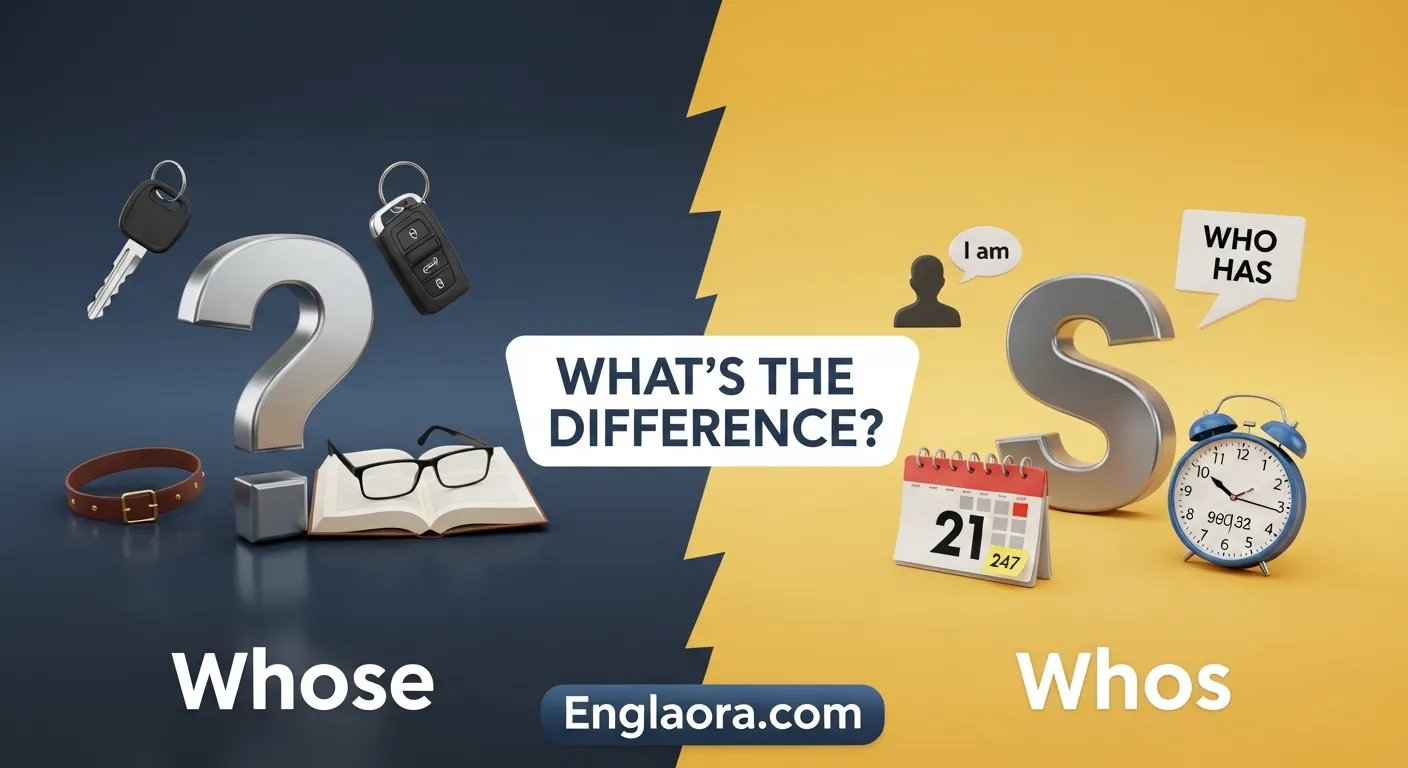
Whose or Whos – Quick Answer
Whose – a possessive pronoun.
- Example: Whose book is this?
- Meaning: “To whom does this book belong?”
Who’s – a contraction of who is or who has.
- Example: Who’s coming to the party tonight? (Who is coming…)
- Example: Who’s finished their homework? (Who has finished…)
Whos without an apostrophe is almost always incorrect in standard English. Remember: whose = possession, who’s = contraction.
The Origin of Whose or Whos
The word whose dates back to Old English hwæs, which was the genitive form of hwā (who). It was used to indicate ownership or relationship and has kept this grammatical function for centuries.
On the other hand, who’s comes from a combination of who + is or who + has, following a modern English trend of contractions that emerged in Middle English to simplify speech and writing.
The spelling difference exists because one is a standalone possessive pronoun (whose) and the other is a contraction that needs an apostrophe (who’s) to signal omitted letters.
British English vs American English Spelling
In general, both British and American English follow the same rules for whose and who’s. However, awareness of contractions and apostrophe usage may vary slightly in formal writing conventions:
| Variation | Type | Usage Example | Correct? |
|---|---|---|---|
| whose | Possessive pronoun | Whose bag is this? | ✅ |
| who’s | Contraction (who is / who has) | Who’s going to the store? | ✅ |
| whos | Misspelling | Whos coming to the meeting? | ❌ |
Tip: Both British and American English avoid “whos”. Always use whose or who’s depending on meaning.
Which Spelling Should You Use?
- Use “whose” when showing possession or ownership.
- Use “who’s” when contracting “who is” or “who has.”
Audience Advice:
- US writers: Standard rules apply; always use apostrophes for contractions.
- UK/Commonwealth writers: Same rules; ensure formal writing avoids contractions in formal documents if preferred.
- Global audiences: Apostrophe-based contractions like who’s are universally recognized; “whose” remains the standard possessive form.
Common Mistakes with Whose or Whos
- Writing whos instead of who’s.
- ❌ Whos coming to dinner?
- ✅ Who’s coming to dinner?
- Confusing whose with who’s in questions about possession.
- ❌ Who’s coat is this?
- ✅ Whose coat is this?
- Overusing contractions in formal writing.
- ❌ Who’s responsible for this report? (formal report style may prefer “Who is responsible…”)
- Forgetting the apostrophe entirely.
- ❌ Whos finished their work?
- ✅ Who’s finished their work?
Whose or Whos in Everyday Examples
- Emails:
- Whose report needs to be submitted by Friday?
- Who’s joining the meeting later?
- Social Media:
- Who’s your favorite actor?
- Whose shoes are these?
- Formal Writing:
- Whose research contributed to this study?
- Who’s responsible for the final submission?
Whose or Whos – Google Trends & Usage Data
Google search data shows “whose vs who’s” spikes among students, writers, and ESL learners. Searches are higher in US, UK, Canada, and Australia, often in March and September, likely due to school terms. The possessive whose generally has higher search volume than who’s, reflecting widespread confusion with possession questions.
Comparison Table: Whose vs Who’s
| Word | Type | Meaning | Example |
|---|---|---|---|
| whose | Possessive pronoun | Ownership/possession | Whose pen is this? |
| who’s | Contraction | Who is / Who has | Who’s going to the store? |
| whos | Incorrect | — | Whos coming? ❌ |
FAQs
1. Can I ever write “whos” without an apostrophe?
No. In standard English, “whos” is always a mistake.
2. How do I remember the difference?
If you can replace it with “who is” or who has, use who’s. Otherwise, use whose for possession.
3. Is “whose” only for people?
No. It can refer to people, animals, or objects: Whose idea was this?
4. Can “who’s” appear in formal writing?
Yes, but avoid contractions in highly formal documents; write “who is” instead.
5. Are there regional differences?
Minimal. Both US and UK follow the same rules for whose and who’s.
6. Why is this mistake so common?
Because “whose” and “who’s” are pronounced identically in speech, leading to spelling confusion.
7. Any trick to remember?
Think: whose = possession, who’s = who is / has. If in doubt, read aloud.
Conclusion
Understanding whose vs who’s is crucial for clear, professional, and error-free writing. Whose shows ownership, while who’s is a contraction for who is or who has. Avoid whos, as it’s always incorrect.
By following these rules, you can confidently write emails, posts, reports, and essays without confusing readers. Remember the quick trick: if you can expand it to who is/has, it’s who’s. Otherwise, it’s almost certainly whose. Clear, careful writing reflects credibility, and mastering this small but common difference can make your communication sharper and more professional.

Hi, I’m Ethan Hawkes, writing for Englaora.com. I provide clear, reliable content to help users understand the differences between commonly confused words.