Hey, I want to share something that happened to me recently involving Click or Clique.
I was chatting with a friend when this term suddenly popped up, and honestly, I had no idea what it really meant.
For a moment, I kept thinking, “Am I missing something here?” It was confusing, and I didn’t want to reply the wrong way or sound clueless.
So, I decided to look into Click or Clique to understand the correct meaning and proper usage.
Once I figured it out, everything made sense, and I realized how important it is to know the difference to avoid awkward moments in conversations.
Now, whenever I see Click or Clique in chats or on social media, I feel confident responding the right way.
Click or Clique – Quick Answer
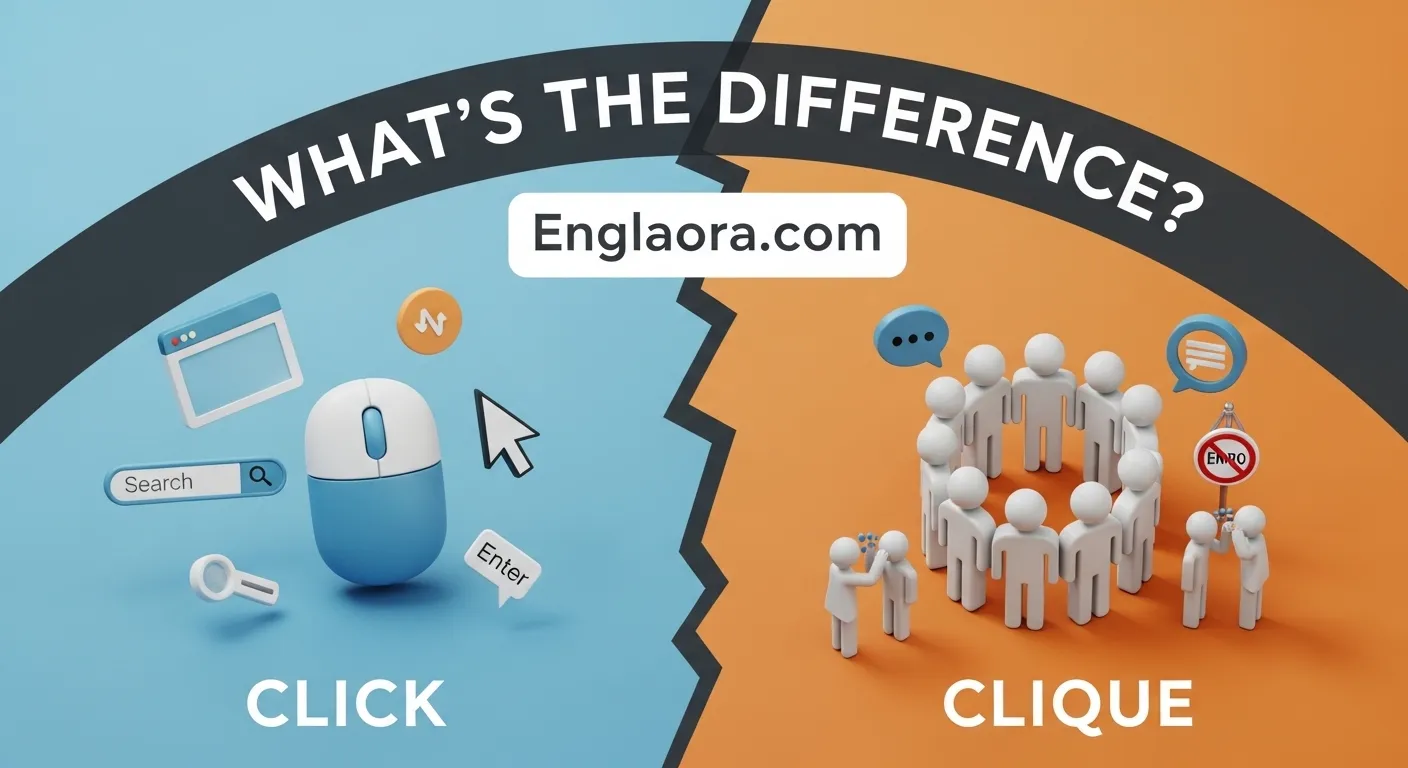
Click refers to a short, sharp sound, often made by a mouse or a latch. Example:
- “I heard a click when I closed the door.”
- “She gave the link a click to open the webpage.”
Clique refers to a small, exclusive group of people who share interests or activities. Example:
- “She belongs to a fashion clique at school.”
- “The office clique often eats lunch together.”
Quick tip: Sound doesn’t equal meaning—always check the spelling based on context.
The Origin of Click or Clique
- Click originates from the Middle Dutch word klicken, meaning a sharp sound. It has been used in English since the 1500s.
- Clique comes from French, meaning a “small faction or group,” adopted into English in the late 18th century.
The spelling differences exist because click developed in English, while clique retained its French origin. Their similar pronunciation leads to confusion in writing.
British English vs American English Spelling
Both words are spelled the same in UK and US English, but their meanings remain distinct. Other words of French origin, like technique or unique, often retain the “-que” spelling in both versions.
Comparison Table:
| Word | Meaning | US Spelling | UK Spelling |
| Click | Sharp sound, press a button | Click | Click |
| Clique | Exclusive group of people | Clique | Clique |
No variation exists between American and British English for these two words.
Which Spelling Should You Use?
- Use click when referring to sounds, buttons, or interactions online.
- Use clique when talking about groups of people, especially in social or professional contexts.
Audience advice:
- US & UK/Commonwealth audiences recognize both words the same way.
- Global English users should follow the same rule: click = sound/action, clique = group.
Common Mistakes with Click or Clique
| Mistake Example | Correct Usage | Why It’s Wrong |
| “I joined a click of friends.” | “I joined a clique of friends.” | Confuses sound (click) with social group |
| “Give the webpage a clique.” | “Give the webpage a click.” | Wrong word; action/sound needed |
| “She’s in a click at school.” | “She’s in a clique at school.” | Misused homophone |
Click or Clique in Everyday Examples
Emails:
- “Please click the link to confirm attendance.”
- “Our team clique meets every Friday for brainstorming.”
News Articles:
- “The new gadget makes a satisfying click when used.”
- “The political clique opposed the new policy.”
Social Media:
- “Click the photo for full view.”
- “This influencer clique dominates the fashion trends.”
Formal Writing:
- “Press the button until it clicks.”
- “The leadership clique influenced the company’s decisions.”
Click or Clique – Google Trends & Usage Data
- Click is far more commonly searched due to its relevance in tech, software, and online content.
- Clique spikes in searches around school, social dynamics, or celebrity news.
- Popularity by country: US, UK, India, Canada show high interest in distinguishing these words.
Keyword Variations Table:
| Variation | Monthly Searches (Est.) | Context |
| Click | 90,000+ | Tech, online interactions |
| Clique | 12,000+ | Social groups, schools |
| Click vs Clique | 5,000+ | Clarification, education |
FAQs
- Is “click” ever spelled “clique”?
No. Click always refers to sound or action. - Can “clique” refer to online communities?
Yes, any exclusive group, online or offline. - Do Brits and Americans use these words differently?
No, meanings and spellings are the same. - What’s the easiest way to remember the difference?
Think: Click = sound/action, Clique = group of people. - Are there other words confused like click/clique?
Yes, examples include peak/peek, their/there/they’re, and affect/effect. - Can “click” be a verb for relationships?
Informally, yes: “They really clicked during the meeting,” but it doesn’t mean clique. - Is “clique” negative?
Sometimes, as it can imply exclusivity or elitism, but context matters.
Conclusion
Understanding the difference between click and clique is simple once you focus on meaning rather than sound. Click refers to a sharp sound or action, especially online, while clique describes a small, exclusive social group. Remembering their origins—Middle Dutch for click and French for clique—can help avoid mistakes. Both words have identical spellings in US and UK English, so context is the only deciding factor. By following this guide, you can confidently use click and clique in emails, social media, formal writing, or casual conversation without confusion. Correct usage enhances clarity, professionalism, and the reader’s understanding, ensuring your writing is always precise.

I’m Liam Prescott, writing for Englaora.com. I explain the nuances of commonly confused words, making complex topics simple and engaging for readers.