Hey, I want to share something that happened to me recently involving Icey or Icy.
I was chatting with a friend when this word suddenly popped up, and honestly, I had no idea which one was actually correct.
For a moment, I kept thinking, “Am I missing something here?” It was confusing, and I didn’t want to reply the wrong way or sound clueless.So, I decided to look into Icey or Icy to understand the correct meaning and proper usage.
Once I figured it out, everything started to make sense, and I realized how important it is to know the difference to avoid awkward moments in conversations.
Now, whenever I see Icey or Icy in chats or on social media, I feel confident responding the right way.
Icey or Icy – Quick Answer
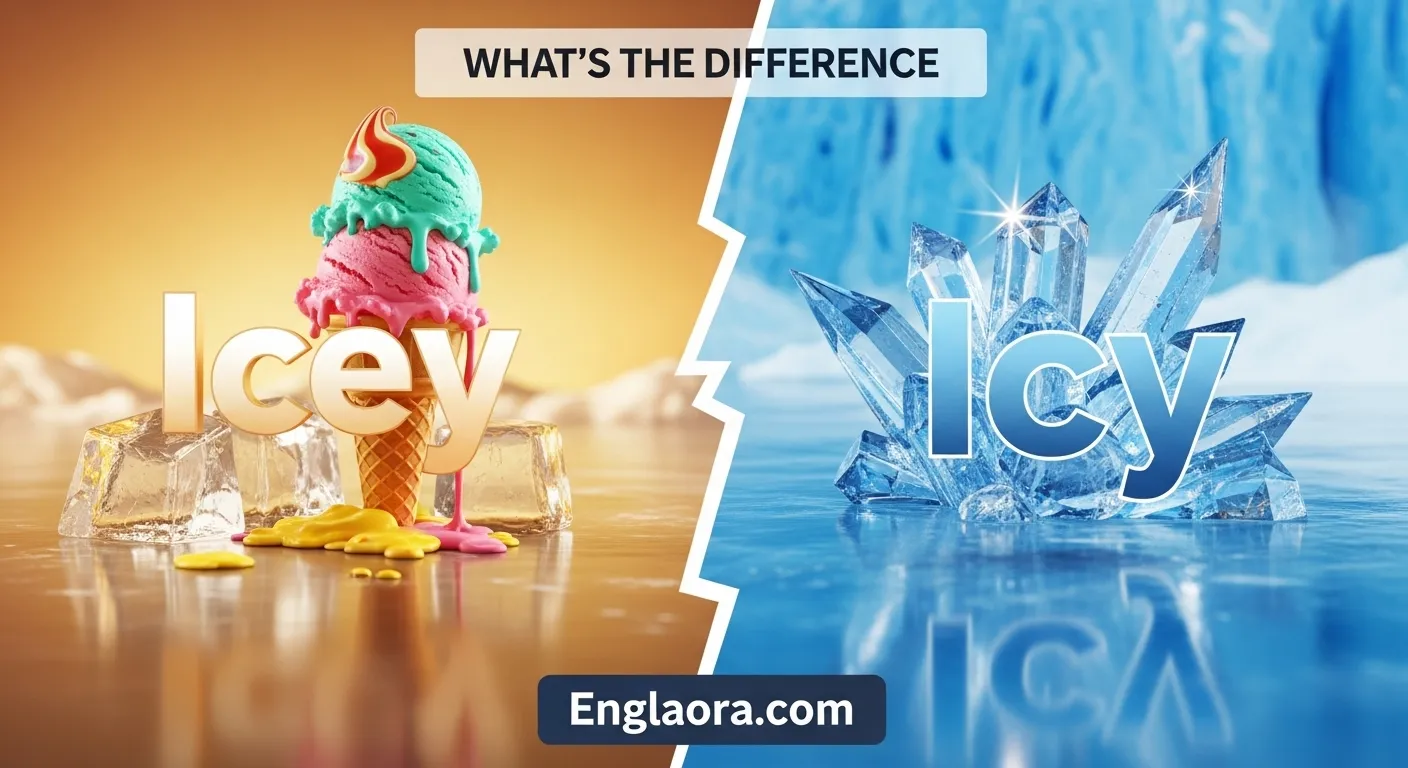
The correct spelling is “icy.”
Example usage:
- The road was icy after the snowstorm.
- She gave him an icy glare.
While some people mistakenly write “icey,” it is considered incorrect in modern English. Always use “icy” for clarity and correctness.
The Origin of Icey or Icy
The word “icy” comes from the noun “ice” with the suffix “-y,” meaning “covered with or consisting of ice.” The suffix “-y” turns nouns into adjectives.
The spelling “icey” likely arose because people assume “ice” + “y” must be written literally as icey, but English spelling rules often drop certain letters or simplify combinations. Historically, dictionaries and literary texts only recognized “icy” as standard.
British English vs American English Spelling
Both British English and American English agree that the correct spelling is “icy.” There is no variation like in other words (e.g., “color” vs “colour”).
| Variant | Correct Spelling | Example Sentence |
| US English | icy | The icy wind made us shiver. |
| UK English | icy | Watch your step on the icy pavement. |
As seen, icey is not recognized in formal writing in either variant.
Which Spelling Should You Use?
Use “icy” in all cases.
- US audience: icy
- UK & Commonwealth audience: icy
- Global English audience: icy
Even informal writing, social media posts, and casual emails should stick with “icy” to avoid confusion.
Common Mistakes with Icey or Icy
- Incorrect: The lake was icey.
Correct: The lake was icy. - Incorrect: She gave me an icey look.
Correct: She gave me an icy look. - Avoid unnecessary doubling of letters after a vowel. Icy follows standard English adjective formation rules.
Icey or Icy in Everyday Examples
Emails:
- “Please be careful while walking on the icy steps.”
News Headlines:
- “Icy conditions expected across the Midwest.”
Social Media:
- “Enjoying my morning coffee on this icy winter morning!”
Formal Writing:
- “The icy climate of the Arctic presents challenges for researchers.”
Icey or Icy – Google Trends & Usage Data
According to Google Trends:
- Icy is searched far more than icey globally.
- Popular in countries with cold winters (US, Canada, UK, Russia).
- Icey searches are often spelling mistakes or informal slang.
| Keyword | Popularity (Worldwide) | Notes |
| icy | High | Correct and standard spelling |
| icey | Low | Considered incorrect; rare |
FAQs
1. Is “icey” ever correct?
No. “Icey” is a common misspelling. Use “icy.”
2. Can “icy” be used metaphorically?
Yes. Example: She gave him an icy stare.
3. Is “icy” only for cold weather?
No. It can describe anything resembling ice, including emotions or appearance.
4. Why do people write “icey”?
Because of literal thinking: “ice + y” seems correct visually, but English rules simplify it to “icy.”
5. Does spelling differ in UK and US English?
No. Both use icy.
6. How do you pronounce “icy”?
It’s pronounced /ˈaɪsi/.
7. Can I use “icey” in informal texts?
Even in texts, it’s better to use icy to appear correct and professional.
Conclusion
The correct spelling is “icy.” “Icey” is a common mistake but should be avoided in all forms of writing. Whether you are writing emails, social media posts, school assignments, or professional documents, using icy ensures clarity and correctness. Both British and American English recognize only icy as standard, and Google Trends confirm that it is the most searched form worldwide.
Always remember: when describing frozen surfaces, cold temperatures, or metaphorical coolness, stick with icy. Avoid adding extra letters or following instinctive spelling patterns. With this knowledge, your writing will look polished, professional, and mistake-free.

Hi, I’m Emma Caldwell, an expert author at Englaora.com. I share clear insights on language differences and provide readers with reliable, easy-to-understand content.