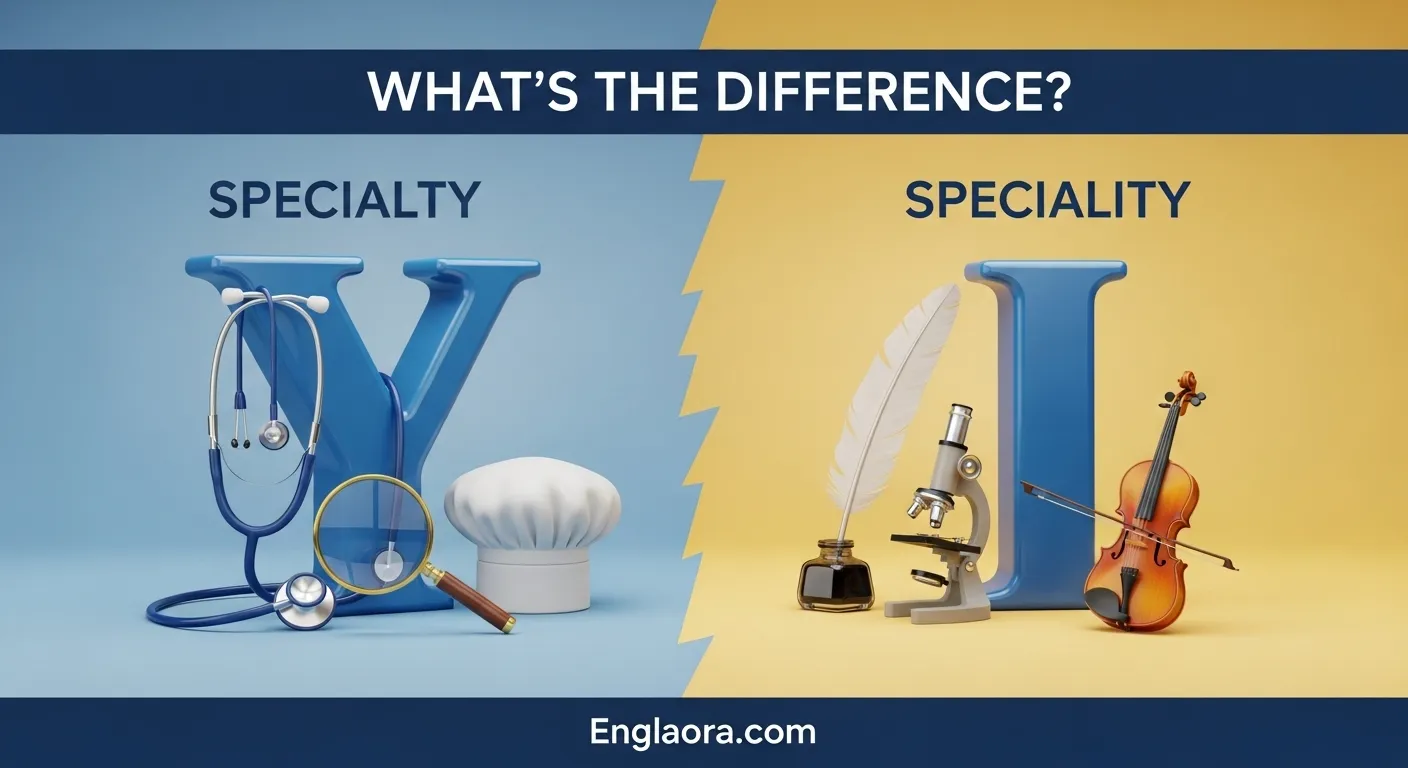
Hey, I want to share something that happened to me recently about Specialty or Speciality.
I was chatting with a friend when this term suddenly popped up, and honestly, I had no clue what it meant at first.
I kept wondering, “Am I missing something here?” It felt a bit confusing, and I didn’t want to respond the wrong way or sound unsure.
So, I decided to look into Specialty or Speciality to understand its real meaning and proper usage.
Once I dug a little deeper, I realized how important it is to know the difference between such similar-looking words to avoid awkward moments in conversations.
Now that I understand Specialty vs Speciality, I can respond confidently whenever I see this term again in chats, comments, or on social media.
Specialty or Speciality – Quick Answer
Quick answer:
- Specialty → Preferred in American English. Example: Her specialty is Italian cuisine.
- Speciality → Preferred in British English and other Commonwealth countries. Example: Cheddar cheese is a local speciality.
Both words mean the same: a particular skill, area of expertise, or product a person or business is known for.
The Origin of Specialty or Speciality
The word comes from the Latin “specialis”, meaning “particular” or “individual.” Over time, English adopted the word in the 15th century as “specialite”, which later evolved into both specialty and speciality.
- Specialty → Became the standard American spelling.
- Speciality → Retained in British English and Commonwealth countries like Canada, Australia, and India.
The spelling difference reflects historical variations in American and British English as each developed independently in the 18th–19th centuries.
British English vs American English Spelling
| Feature | American English (US) | British English (UK, Commonwealth) |
| Word Spelling | Specialty | Speciality |
| Common Use | Restaurants, medical fields, personal skills | Food items, regional products, professions |
| Example Sentence | Her specialty is neurology. | Scone is their bakery speciality. |
Rule of thumb: If you are writing for a US audience, use specialty. For UK or Commonwealth audiences, use speciality.
Which Spelling Should You Use?
- US Audience: Use specialty in professional documents, emails, or marketing materials.
- UK/Commonwealth Audience: Use speciality for formal writing, menus, and local products.
- Global Audience: Either is understood, but specialty is slightly more recognized internationally, especially online.
Common Mistakes with Specialty or Speciality
- Mixing the two spellings in the same document. ✅ Correct: Her specialty is French pastries. ❌ Incorrect: Her speciality is French pastries.
- Using specialty for British-targeted writing.
- Forgetting plural forms: specialties (US) vs specialities (UK).
- Using “speciality” in informal American writing—it looks outdated.
Specialty or Speciality in Everyday Examples
- Email: Our company’s specialty is cloud computing solutions.
- News: The city is known for its cheese speciality.
- Social Media: Pizza is my ultimate specialty! 🍕
- Formal Writing: Her medical specialty is cardiology.
Specialty or Speciality – Google Trends & Usage Data
- US: “Specialty” is overwhelmingly more popular.
- UK & Commonwealth: “Speciality” dominates in Google searches.
- Global Trend: “Specialty” shows higher international online usage, likely due to American media influence.
| Country | Most Popular Spelling |
| USA | Specialty |
| UK | Speciality |
| Canada | Speciality |
| Australia | Speciality |
| India | Speciality |
| International | Specialty |
FAQs
1. Are specialty and speciality the same?
Yes, both mean a specific skill, field, or product, but spelling differs by region.
2. Which is correct in American English?
Use specialty in the US.
3. Which is correct in British English?
Use speciality in the UK and Commonwealth countries.
4. Can I use either spelling globally?
Yes, both are understood, but specialty is slightly more recognized internationally.
5. How do I make it plural?
- US: specialties
- UK: specialities
6. Can it refer to food?
Yes. In British English, speciality often refers to a local dish or product.
7. Is specialty used in medicine?
Yes, in American English, it refers to a professional field or area of expertise.
Conclusion
In summary, specialty and speciality mean the same but differ by region. Americans almost always use specialty, while Brits and Commonwealth countries use speciality. When writing, consider your audience: using the correct spelling improves readability and professionalism. Remember to be consistent throughout your text and pay attention to context—food, professions, or global communication may influence which version feels more natural. Ultimately, knowing the difference saves confusion and keeps your writing polished, whether for emails, articles, or social media.
Read More Articles:
Loss or Lost: A Complete Guide for English Learners(2026)
Bellies vs Bellys: Meaning,Grammar and Correct Usage(2026)
Which or Wich: Spelling and Meaning Explained Simply(2026)

Hi, I’m Emma Caldwell, an expert author at Englaora.com. I share clear insights on language differences and provide readers with reliable, easy-to-understand content.