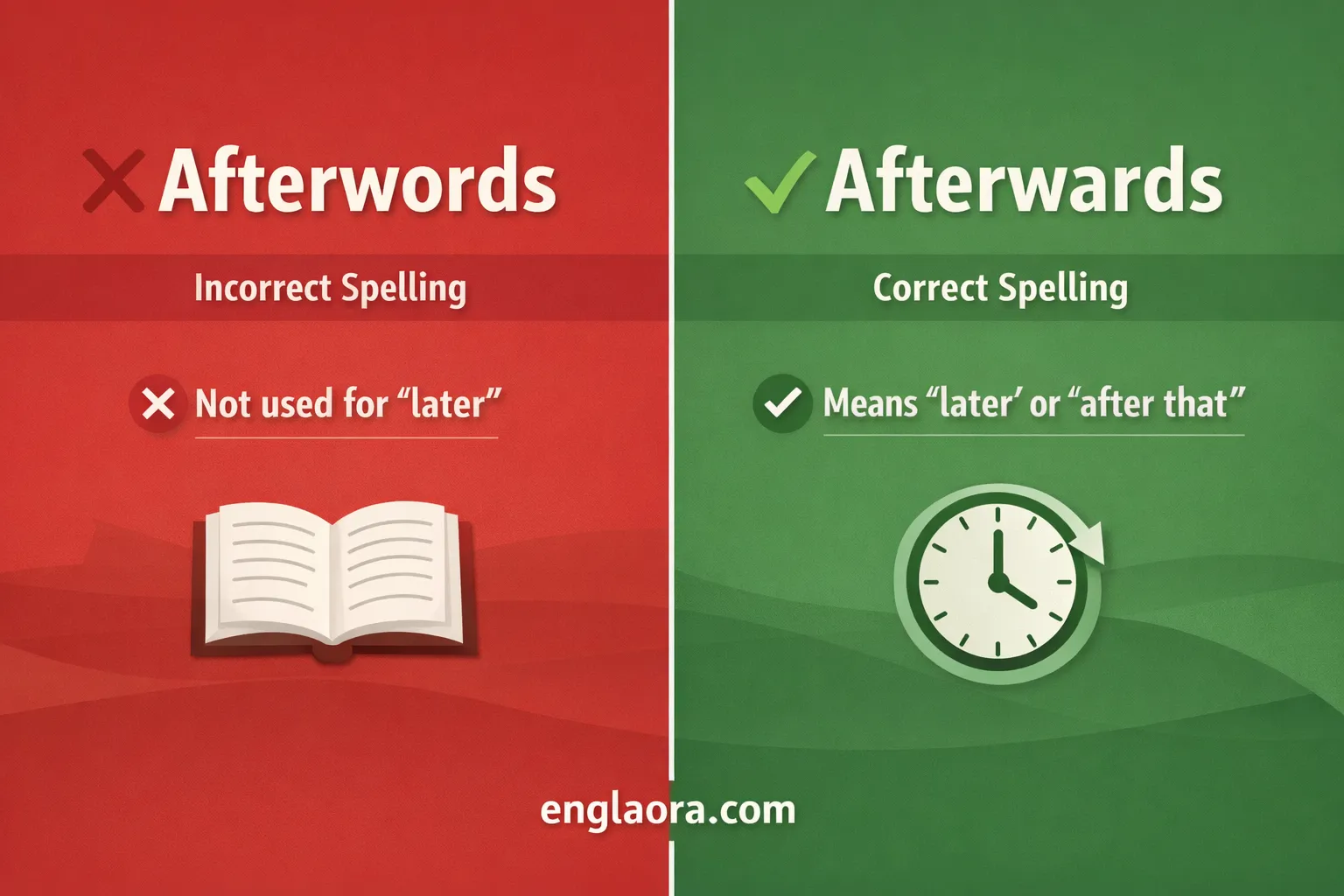
Hey, I want to share something that happened to me recently about Afterwords or Afterwards.
I was chatting with a friend when I suddenly saw one of these words pop up, and honestly, I got confused for a moment.
I kept thinking, “Am I missing something here?” Both words looked similar, but I wasn’t sure if they meant the same thing or if one was incorrect.
I didn’t want to reply the wrong way and make things awkward, so I decided to look into the difference between afterwords and afterwards.
Once I understood their meanings and proper usage, everything became clear.
I realized how important it is to know these small grammar differences, especially in everyday conversations, chats, and social media posts.
Now, whenever I see Afterwords or Afterwards, I feel confident using the correct one—and you will too after understanding the difference.
Afterwords or Afterwards – Quick Answer
The correct word is “afterwards”.
- Afterwards (adverb) means “at a later time” or “after something has happened.”
- Example: “We went to the park and afterwards had ice cream.”
- Afterwords is rarely used and often considered incorrect. It may appear mistakenly when people confuse it with “afterward” (American English singular form).
Quick Tip: Always use “afterwards” for British English and “afterward” for American English. Avoid afterwords unless referring to a written afterword in a book.
The Origin of Afterwords or Afterwards
The term comes from the combination of “after” + “words”/“ward(s)” in Middle English.
- Afterward(s) appeared around the 14th century to indicate time following an event.
- The spelling “afterwards” became standard in British English, while American English often drops the s and prefers “afterward.”
Spelling differences exist because English evolved differently in Britain and America, and both forms remain grammatically acceptable depending on location.
British English vs American English Spelling
| Variant | Region | Example Sentence |
| Afterwards | British English | “We finished our homework and afterwards played football.” |
| Afterward | American English | “She studied all day and afterward went to the library.” |
| Afterwords | Rare / Incorrect | Usually a typo; correct as afterward(s) |
Key Points:
- British English uses afterwards with an s.
- American English prefers afterward without s.
- Afterwords is not standard for time-related usage.
Which Spelling Should You Use?
- Use “afterwards” if writing in UK English or for a global audience familiar with British standards.
- Use “afterward” for US English.
- Avoid afterwords unless you mean the final section of a book (plural: afterwords).
Audience-Based Advice:
- Emails, formal documents, and academic writing: follow the region’s standard.
- Social media: stick to what your readers expect; both forms may be understood.
Inbalance or Imbalance:Common Spelling Confusion Clear(2026)
Common Mistakes with Afterwords or Afterwards
| Mistake | Correction | Explanation |
| “We will discuss this afterwords.” | “We will discuss this afterwards.” | Incorrect spelling; the correct adverb is afterwards. |
| Confusing afterword (book section) with afterward(s) | Keep afterword for books, afterward(s) for time | They have different meanings. |
| Using afterwards in US formal writing | Consider afterward | American English prefers singular form. |
Afterwords or Afterwards in Everyday Examples
- Emails: “Please complete the report and, afterwards, send it to me.”
- News: “The committee met on Tuesday and afterwards released a statement.”
- Social Media: “We went hiking and afterwards grabbed coffee.”
- Formal Writing: “The experiment concluded at noon, and afterwards, data was analyzed.”
Afterwords or Afterwards – Google Trends & Usage Data
- UK & Commonwealth: “Afterwards” is overwhelmingly more common.
- US: “Afterward” dominates, while “afterwards” is understood but less frequent.
- Global trend: “Afterwards” appears slightly more often on international websites due to UK English influence.
This shows that context, audience, and region play a major role in usage.
Keyword Variations Comparison Table
| Keyword Variation | Correct Usage | Region/Notes |
| Afterwards | ✔ Adverb for time | British English / International |
| Afterward | ✔ Adverb for time | American English |
| Afterwords | ✖ Rare/Incorrect | Only correct when referring to book afterwords |
FAQs
- Is “afterwords” correct?
- Usually not; the correct adverb is afterwards or afterward.
- Can I use “afterward” in the UK?
- Yes, but afterwards is preferred for British English audiences.
- What is the difference between “afterword” and “afterwards”?
- Afterword: a book’s closing section.
- Afterwards: an adverb meaning later in time.
- Is “afterwards” formal or informal?
- It works in both formal and informal writing.
- Why do Americans drop the ‘s’?
- American English often simplifies British spellings.
- Which is more common online?
- Globally, afterwards appears slightly more due to UK influence.
- Can I use “afterwords” in casual writing?
- Only if you specifically mean the ending part of a book.
Conclusion
Understanding the difference between afterwords and afterwards can save you from embarrassing mistakes. The safe rule: use afterwards in British English or international contexts, afterward in American English, and reserve afterword/afterwords for books. With these guidelines, you can confidently write emails, reports, social media posts, or academic work without confusion. Paying attention to your audience and region ensures your writing is clear, professional, and grammatically correct. Whether in everyday conversation or formal writing, this small detail can enhance clarity and credibility.

Hi, I’m Ethan Hawkes, writing for Englaora.com. I provide clear, reliable content to help users understand the differences between commonly confused words.