Hey, I want to share something that happened to me recently involving excepting or accepting.
I was typing a formal email at work. I wanted to say that everyone was invited — but one person was left out.
I’m paused and thought: should I write ‘accepting’ or ‘excepting’? Honestly, my brain froze. I typed both. Then deleted both. Then Googled it in a panic.
Sound familiar? You are not alone. Thousands of people search ‘excepting or accepting’ every single month. These two words look similar. They even sound a little alike.
But they mean completely different things — and mixing them up can change the entire meaning of your sentence.
People search for this topic in many different ways. Some ask: ‘What is the difference between accepting and excepting?’ Others look for ‘accept and except in a sentence’ or ‘excepting or accepting grammar.
Some even search for ‘excepting or accepting IRS extensions only’ — because yes, this confusion shows up in legal and tax writing too!
In this article, I will clear up the confusion once and for all. You will learn the correct meaning of each word, see real examples, and never mix them up again.
Whether you are a student, a professional, or just someone who wants to write better — this guide is for you.
Let us dive in.
Excepting or accepting – Quick answer
Here is the short and simple answer:
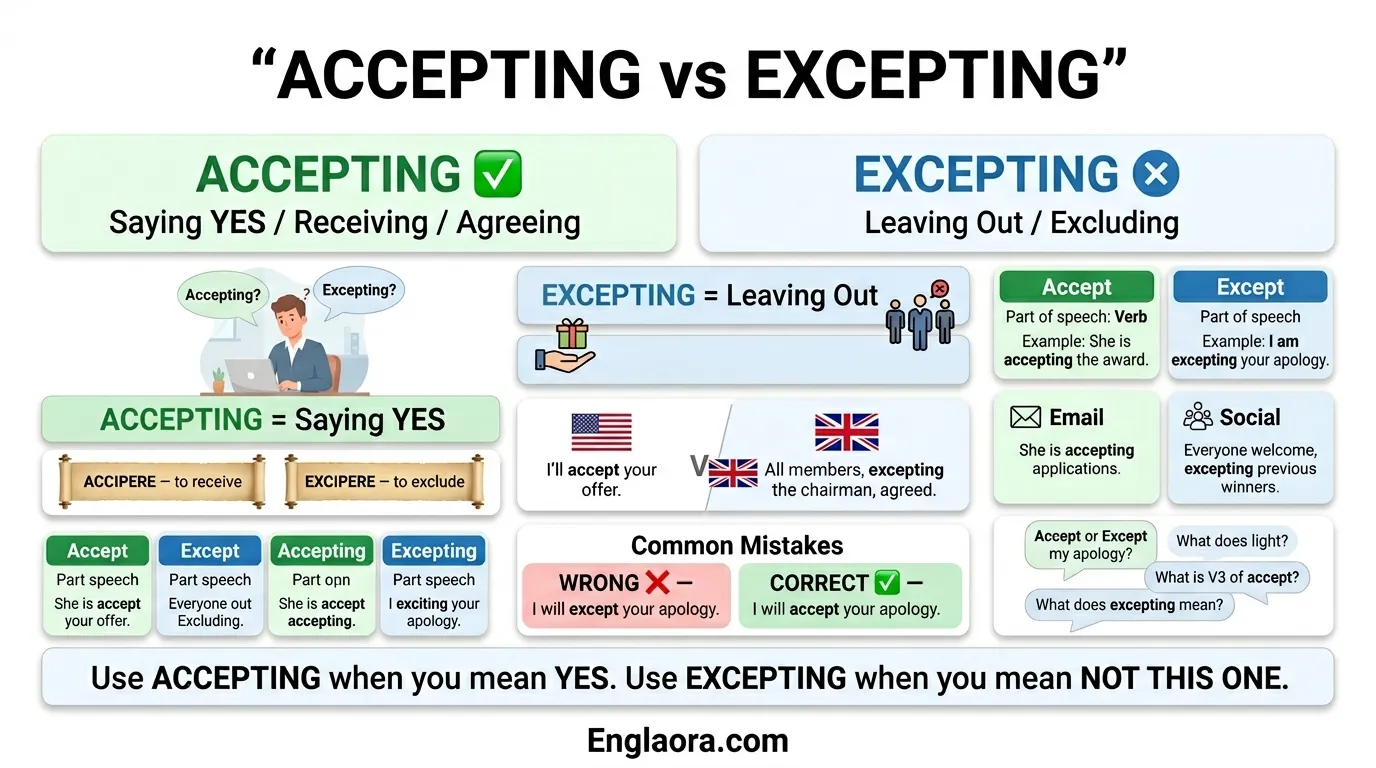
- Accepting = a verb. It means receiving, agreeing to, or taking something.
- Excepting = a preposition. It means excluding or leaving something out.
Think of it this way:
Accepting is about saying YES.
Excepting is about saying NOT THIS ONE.
Examples:
She is accepting applications for the new job.
All students passed the test, excepting two.
He is accepting the award on behalf of his team.
Everyone came to the party, excepting Mark.
If you want to include something → use accepting. If you want to leave something out → use excepting.
The origin of excepting or accepting
Both words come from Latin — but from different root words.
Accept comes from the Latin word accipere, which means ‘to receive’ or ‘to take something willingly.’ It entered English in the 14th century through Old French accepter.
Except comes from the Latin word excipere, which means ‘to take out’ or ‘to exclude.’ It also entered English in the 14th century.
So from the very beginning, these two words had completely opposite meanings — one about taking in, the other about leaving out. Yet because they both start with ‘ex’ (or ‘ac’ in accept) and end similarly, writers have confused them for centuries.
The -ing forms ‘accepting’ and ‘excepting’ followed naturally from their base words. ‘Accepting’ became common in everyday speech. ‘Excepting’ became more formal and is mostly found in legal, official, and academic writing today.
This is also why people search for ‘excepting or accepting worksheet’ — teachers often use these two words to teach homophones and near-homophones in grammar class.
British English vs American English spelling
Good news: there is no spelling difference between British and American English for these two words. Both ‘accept’ and ‘except’ are spelled the same way on both sides of the Atlantic.
However, there is a difference in how often each form is used:
- In American English, ‘excepting’ is very rare in everyday speech. Americans almost always say ‘except’ instead.
- In British English, ‘excepting’ appears slightly more often, especially in formal or older texts.
Examples by region:
American: Everyone was invited except Sarah.
British (formal): All members, excepting the chairman, were present.
Global/neutral: She accepted the terms of the contract.
As for pronunciation, ‘accept’ and ‘except’ are NOT true homophones — they sound different. ‘Accept’ starts with the ‘ak’ sound. ‘Except’ starts with the ‘ek’ sound. This is something students often mix up when searching for ‘accept and except homophones’ or ‘accept and except pronunciation.’
They are NOT homophones. They only look similar.
Comparison Table: Accepting vs Excepting
| Word | Region | Frequency | Best Used In |
| Accepting | Global | Very High | Everyday writing & speech |
| Excepting | Formal/Legal | Low | Legal, academic, formal text |
| Accept | Global | Very High | All writing contexts |
| Except | Global | High | All writing contexts |
Which spelling should you use?
Here is a simple rule to follow:
Use ‘accepting’ when you mean:
- Receiving something (She is accepting gifts.)
- Agreeing to something (He accepted the deal.)
- Being open or tolerant (She is so accepting of others.)
- Taking on a role (The CEO is accepting responsibility.)
Use ‘excepting’ when you mean:
- Leaving something out (All rules apply, excepting this one.)
- Excluding someone (Everyone, excepting the manager, left early.)
- In formal or legal writing (Used in contracts, legal documents, tax filings.)
For most people, in most situations — use ‘accepting’ or ‘except’. The word ‘excepting’ is quite formal and rarely needed in daily conversation.
If you are writing for IRS documents or legal filings and you see ‘excepting or accepting IRS extensions only,’ remember: ‘excepting’ in that context means the IRS is excluding certain types of extensions — not accepting them.
Globally: ‘Accept/accepting’ is understood everywhere. ‘Excepting’ may confuse non-native speakers, so stick to ‘except’ in international writing.
Common mistakes with excepting or accepting
These two words cause real confusion. Here are the most common errors people make — and how to fix them:
Mistake Table: Wrong vs Right Usage
| Mistake Type | Wrong Usage ❌ | Correct Usage ✅ |
| Wrong word choice | I will except your apology. | I will accept your apology. |
| Confusion in negation | No one, accepting John, failed. | No one, excepting John, failed. |
| IRS context | The IRS is accepting extensions only. | The IRS is excepting extensions only. |
| V3 misuse | She has excepted the offer. | She has accepted the offer. |
The most classic error is: ‘Is it accept or except my apology?’ The answer: It is ALWAYS ‘accept my apology.’ You accept an apology. You never ‘except’ one.
Another common mistake: saying ‘accepting’ when you mean ‘excluding.’ For example: ‘No one, accepting John, came to the meeting.’ This is wrong. It should be ‘excepting John’ — meaning John is excluded.
And when people ask ‘What is V3 of accept?’ — the answer is: accepted (V2 and V3 are the same). Excepted is the V3 of except, but it is rarely used.
Excepting or accepting in everyday examples
Let us see how these words are used in real life.
Email Example (using ‘accepting’):
Subject: Job Application – Open Positions
Dear Hiring Manager, I am currently accepting applications for the Marketing Manager role. Please submit your resume by Friday.
Email Example (using ‘excepting’):
All employees, excepting those on medical leave, are required to attend the mandatory training on Monday.
Social Media Example:
Posted on LinkedIn: ‘We are now accepting entries for our 2025 design competition! Everyone is welcome, excepting previous winners.’
News/Formal Writing Example:
The committee voted in favor of the proposal, with all members excepting the chairperson casting a ‘yes’ vote.
Formal Writing Example (contract language):
The borrower agrees to accept all terms and conditions, excepting Clause 7, which shall be reviewed separately.
These examples show how ‘accepting’ is used in normal communication, while ‘excepting’ appears mainly in formal or semi-formal settings. When people on Reddit search ‘excepting or accepting’ trying to understand which one to use, real-world examples like these are the most helpful.
Accepting vs excepting – Google Trends and usage data
When we look at search data and language usage patterns, a clear picture emerges.
- ‘Accepting’ is searched and used far more than ‘excepting’ in everyday language worldwide.
- The phrase ‘accept and except in a sentence’ is one of the most searched grammar queries globally — showing how common this confusion is.
- In the United States, ‘excepting’ is almost never used in spoken language. ‘Except’ is the standard choice.
- In the United Kingdom and Commonwealth countries, ‘excepting’ still appears in formal texts, but rarely in casual speech.
- Google Trends shows that searches for ‘excepting or accepting’ spike during school examination seasons — confirming that this is a top grammar question for students.
- Legal and tax searches like ‘excepting or accepting IRS extensions only’ show that this confusion extends into professional and financial writing.
The word ‘accepting’ appears in many more contexts: emotional acceptance, job acceptance, social acceptance. The query ‘What does so accepting mean?’ usually refers to someone being open-minded or tolerant — a completely different context from the grammatical one.
Meanwhile, ‘excepting’ is a niche word — useful when you need it, but not a daily-use term for most writers.
Complete comparison table – Accept, except, accepting, excepting
| Word | Part of Speech | Meaning | Example Sentence |
| Accept | Verb | To receive or agree to something | She accepted the job offer. |
| Except | Preposition / Conj. | To exclude or leave out | Everyone passed except Tom. |
| Accepting | Verb (present) | Currently receiving or agreeing | He is accepting applications now. |
| Excepting | Preposition | Excluding; leaving out | All students, excepting John, passed. |
FAQs
Q1. What is the difference between accepting and excepting?
Accepting means receiving or agreeing to something (a verb). Excepting means excluding or leaving out (a preposition). Example: She is accepting the award. | All members, excepting one, agreed.
Q2. What does excepting something mean?
Excepting means to exclude or make an exception of something. Example: ‘All rules apply, excepting Rule 5’ means Rule 5 is excluded.
Q3. What is the difference between accept, expect, and except?
Accept = to receive or agree. Except = to exclude. Expect = to anticipate or believe something will happen. Example: I accept the deal. I except him from the list. I expect results by Monday.
Q4. Is it ‘accept’ or ‘except’ my apology?
Always: ‘accept my apology.’ You accept an apology — you receive it. You never ‘except’ an apology. This is one of the most common mistakes in English.
Q5. What is a word for excepting? What can I say instead of accepting?
Excepting synonyms: excluding, barring, omitting, save for, apart from. Accepting synonyms: receiving, agreeing to, taking on, welcoming, approving.
Q6. Is it better to use ‘except’ or ‘excepting’?
In most cases, use ‘except.’ It is simpler, more natural, and understood worldwide. ‘Excepting’ is correct but formal — use it mainly in legal or academic writing.
Q7. What is V3 of accept?
V1: accept | V2: accepted | V3: accepted. The past participle is ‘accepted.’ Example: She has accepted the invitation.
Q8. Does accepting mean agreeing?
Yes. Accepting can mean agreeing, but it also means receiving, tolerating, or acknowledging. Context matters. Example: He is accepting the terms = he agrees. She is an accepting person = she is open-minded.
Q9. What is the meaning of ‘so accepting’?
‘So accepting’ describes a person who is very open, tolerant, and non-judgmental. Example: ‘Her parents are so accepting of her choices.’
Q10. What does ‘excepting or accepting IRS extensions only’ mean?
In IRS or tax language, ‘excepting extensions only’ means the IRS is making an exception only for extensions — i.e., excluding all other filings from a particular rule or deadline.
Q11. How do you use accepting in a sentence?
The library is now accepting book donations. | She is not yet accepting visitors. | He had a hard time accepting the news.
Q12. What is the meaning of ‘excpt’?
‘Excpt’ is just an informal abbreviation of ‘except.’ It is not a standard word. In formal writing, always spell it out: ‘except.’
Conclusion
Let us bring it all together. The confusion around excepting or accepting is completely understandable — these two words look similar, and both are grammatically correct. But they mean very different things and are used in very different contexts.
Accepting is a common, everyday verb. You use it when someone receives a gift, agrees to an offer, tolerates a situation, or takes on a responsibility. It is used in emails, social media, formal writing, and daily speech. The key question to ask is: is someone saying yes to something?
Excepting is a formal preposition. You use it when you want to leave something or someone out. It is most common in legal documents, contracts, academic writing, and formal official language. In everyday writing and speech, most people use ‘except’ instead.
Remember: ‘Is it accept or except my apology?’ — always accept. You never except an apology.
If you are a student, a word for excepting you might see in exercises is ‘barring,’ ‘excluding,’ or ‘save for.’ And if you are looking for accepting synonyms, try ‘welcoming,’ ‘agreeing to,’ or ‘taking on.’
Whether you are writing a casual message, a formal email, a grammar worksheet, or even an IRS filing — now you know exactly which word to use. No more second-guessing.
Use ‘accepting’ when you mean YES. Use ‘excepting’ when you mean NOT THIS ONE. And when in doubt, just use ‘except’ — it is always safe, clear, and correct.
Bookmark this article and share it with anyone who gets confused between accept and except. Good writing starts with choosing the right word!

Hi, I’m Emma Caldwell, an expert author at Englaora.com. I share clear insights on language differences and provide readers with reliable, easy-to-understand content.