Hey, I want to share something that happened to me recently involving Flair or Flare.
I was chatting with a friend when this term suddenly popped up, and honestly, I had no idea what it really meant.
For a moment, I kept thinking, “Am I missing something here?” — it was confusing, and I didn’t want to reply the wrong way or sound clueless.So, I decided to look into Flair or Flare to understand the correct meaning and proper usage.
Once I figured it out, everything made sense, and I realized how important it is to know the difference to avoid awkward moments in conversations.
Now, whenever I see Flair or Flare in chats or on social media, I feel confident responding the right way.
Flair or Flare – Quick Answer
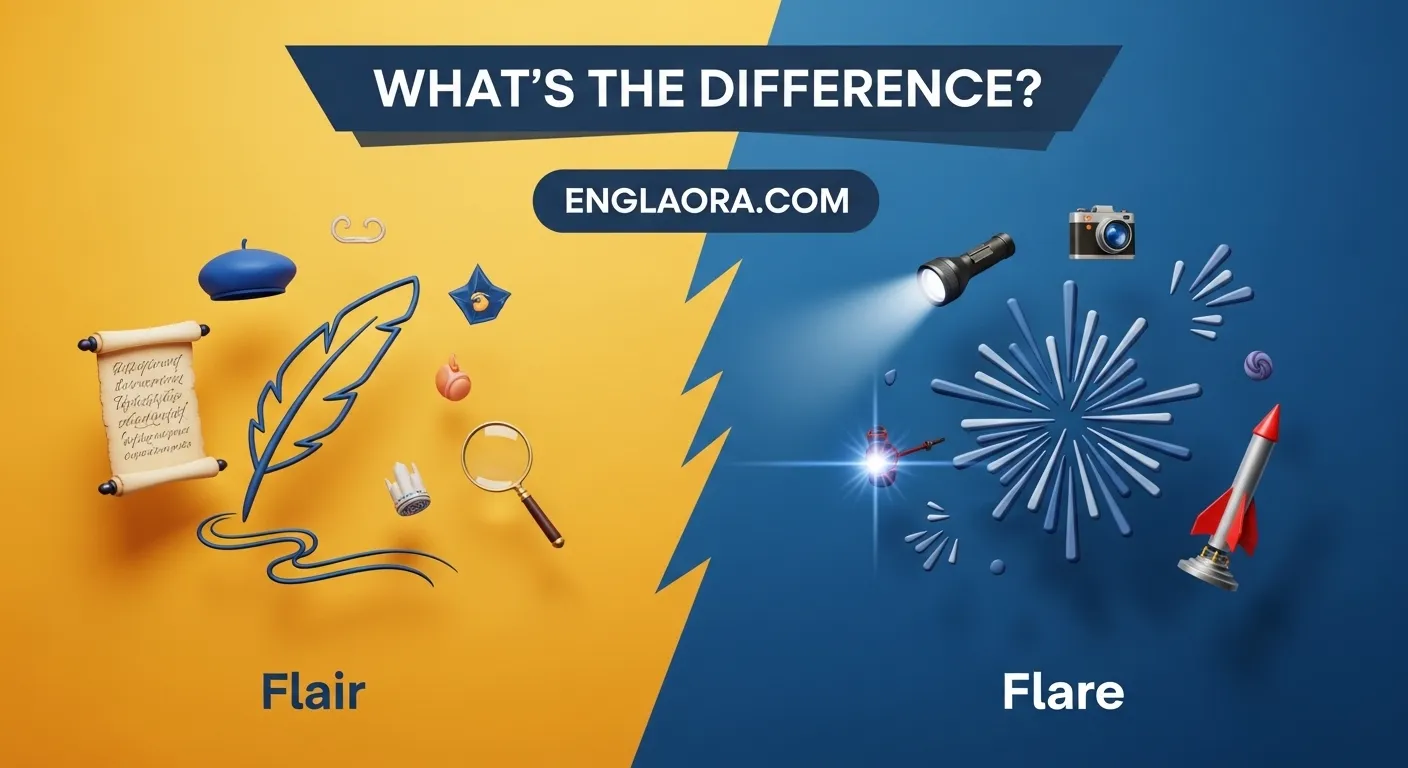
Flair refers to a natural talent or stylish ability.
- Example: She has a flair for design.
Flare refers to a sudden burst, flame, or outward spreading.
- Example: The campfire sent a bright flare into the sky.
Quick tip: Flair = talent or style, Flare = sudden burst or light.
The Origin of Flair or Flare
The word flair comes from French, meaning “to smell” or “keen sense,” later evolving to mean talent or style.
The word flare comes from Old English flær, meaning flame or blaze.
The spelling difference exists because English adopted flair from French and flare from Old English. While they sound the same, their meanings developed separately.
British English vs American English Spelling
Both flair and flare are spelled the same in British and American English, but confusion arises due to pronunciation and context.
| Word | Meaning | Example UK | Example US |
| Flair | Talent, style | She has a flair for fashion. | He showed flair in his speech. |
| Flare | Burst, flame, spread outward | A flare lit up the night sky. | The signal flare was visible. |
Tip: Context matters more than geography here.
Which Spelling Should You Use?
- Use flair when talking about talent, style, or originality.
- Use flare when describing light, fire, or sudden increases (like anger, pain, or signals).
Audience-based advice:
- US writers: Same as global rules.
- UK/Commonwealth: Same. Avoid confusion by focusing on meaning.
- Global writers: Always check context.
Common Mistakes with Flair or Flare
- Wrong: She has a flare for music. ✅ Correct: She has a flair for music.
- Wrong: The artist showed great flair when lighting the flare. ✅ Correct: The artist showed great flair while setting off the flare.
- Using flare for style or talent is a common error.
Always think: talent = flair, burst = flare.
Flair or Flare in Everyday Examples
- Emails: “She has a flair for creative solutions.”
- News: “The rocket flare was visible from miles away.”
- Social Media: “Add some flair to your outfit today!”
- Formal Writing: “The musician’s performance demonstrated exceptional flair.”
Flair or Flare – Google Trends & Usage Data
According to Google Trends:
- Flair peaks in searches related to talent, design, and fashion.
- Flare peaks in searches related to fire, flares, emergencies, and visual signals.
- Popularity is global, but flare is more common in technical or safety contexts, while flair dominates lifestyle and entertainment contexts.
| Keyword Variation | Popularity Context | Typical Search Intent |
| Flair | Talent, fashion, style | How to describe skill |
| Flare | Fire, light, sudden increase | Signal, explosion, flare-ups |
FAQs
1. Is flair or flare correct for talent?
- Flair is correct for talent or style.
2. Can flare mean talent?
- No, flare refers to light, fire, or sudden bursts.
3. Are flair and flare pronounced the same?
- Yes, they are homophones but have different meanings.
4. Is flair used more in the US or UK?
- Both, but mainly in lifestyle, fashion, and creative contexts.
5. Can I use flare in a metaphorical sense?
- Yes, e.g., “His anger flared up,” but not for style or skill.
6. Which is easier to confuse?
- Flare is often incorrectly used when flair is meant.
7. Does spelling depend on American vs British English?
- No, the spelling remains the same; context matters.
Conclusion
Understanding flair vs flare is easy once you remember their meanings: flair = talent or style, flare = light, fire, or sudden burst. These homophones cause confusion mainly because they sound identical but serve different contexts. British and American English spellings are consistent, so focus on the meaning rather than location. Use flair in creative, professional, and stylish contexts, and flare in physical, visual, or emotional scenarios. By paying attention to context, you can avoid common mistakes and write confidently. Always check your usage in emails, social media, or formal writing, and refer to the quick comparison table if unsure. With these simple rules, your writing will appear polished, accurate, and professional.
Discover More Article:
Armour or Armor: Meaning, Grammar and Usage(2026)
Parentheses or Parenthesis: Meaning, Grammar and Usage(2026)
Fav or Fave: Meaning Differences with Examples(2026)

Hi, I’m Ethan Hawkes, writing for Englaora.com. I provide clear, reliable content to help users understand the differences between commonly confused words.