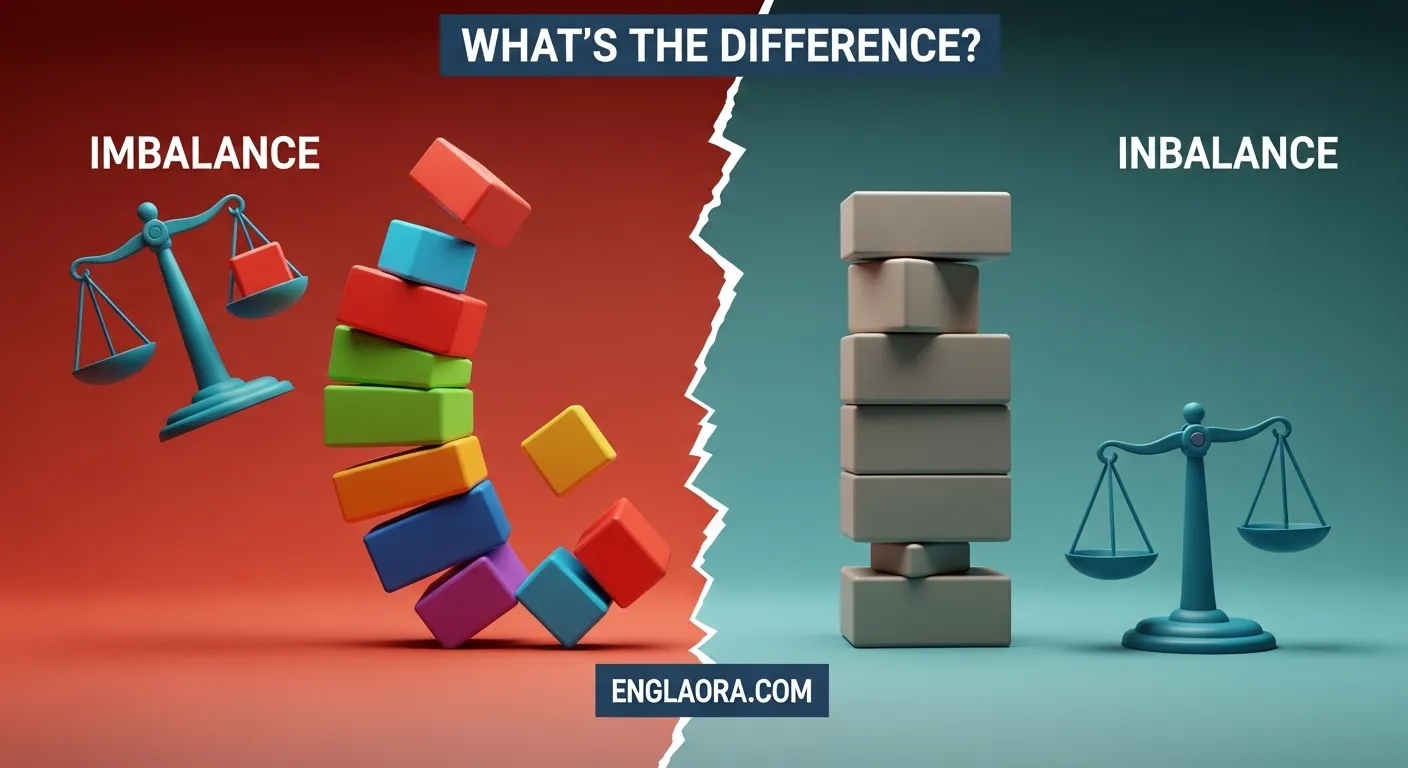
Hey, I want to share something that happened to me recently about inbalance or imbalance. I was chatting with a friend when this term suddenly popped up, and honestly, it caught me off guard.
I paused for a moment, thinking, “Wait… is that even correct?” I didn’t want to reply the wrong way or sound confused, so I decided to look deeper into inbalance or imbalance to understand what it really means and how it’s used.
As I researched, I realized how common this confusion is and how important it is to know the correct form—especially in everyday conversations, writing, and social media.
Once I understood the difference, everything clicked. Now, whenever I see inbalance or imbalance, I feel confident responding correctly without hesitation.
Inbalance or Imbalance – Quick Answer
The correct spelling is “imbalance.”
- Example: There is an imbalance in the team’s workload.
- Incorrect: There is an inbalance in the team’s workload.
The prefix “im-” is standard for forming words that mean “not” or “opposite of.” Using “inbalance” is considered a spelling error in all English dialects.
The Origin of Imbalance
The word imbalance comes from the prefix “im-” (meaning “not”) + balance (from Latin bilanx, meaning “two-scaled”).
Historically, the “im-” prefix replaced “in-” in certain words before specific letters (like b, m, p) to make pronunciation easier. That’s why imbalance is correct, not inbalance.
British English vs American English Spelling
In this case, both British and American English agree: the correct spelling is imbalance.
| Variant | Status | Example Sentence |
| imbalance | Correct | The team has an imbalance of skills. |
| inbalance | Incorrect | The team has an inbalance of skills. |
✅ Tip: Unlike words like “color/colour,” there is no British vs. American difference here—imbalance is universal.
Which Spelling Should You Use?
- For US audiences: Always use imbalance.
- For UK/Commonwealth audiences: Also imbalance.
- Global usage: “Imbalance” is standard in dictionaries worldwide.
Avoid “inbalance” in all formal and informal writing. It will always appear as an error in spell-checkers.
Common Mistakes with Imbalance
- Writing “inbalance” instead of “imbalance.”
- Using “imbalanced” incorrectly as a noun. (It’s an adjective; e.g., “imbalanced data.”)
- Confusing imbalance with unrelated words like unbalanced (slightly different meaning).
Correction Examples:
- ❌ The inbalance of the budget is worrying.
- ✅ The imbalance of the budget is worrying.
Imbalance in Everyday Examples
- Emails: We need to fix the imbalance in team assignments.
- News articles: Experts warn about the imbalance of resources across regions.
- Social media: The imbalance of memes vs. serious content is real!
- Formal writing: Economic studies highlight the imbalance in trade patterns.
Imbalance – Google Trends & Usage Data
Google Trends shows that “imbalance” is searched more frequently than “inbalance”, especially in:
- US, UK, Canada, Australia
- Academic articles, business reports, and health studies
The incorrect variant “inbalance” rarely appears, confirming it’s a common mistake rather than an accepted spelling.
| Keyword | Global Popularity | Trend Example |
| imbalance | High | 1M+ monthly searches |
| inbalance | Low | Rare, mostly misspellings |
FAQs
1. Is “inbalance” ever correct?
No. “Inbalance” is always considered a spelling mistake.
2. Can I use “imbalanced” as a noun?
No. “Imbalanced” is an adjective. Use “imbalance” as the noun.
3. Why do people write “inbalance”?
It’s due to confusion with other “in-” words like inaccurate or incomplete.
4. Is “imbalance” used in technical writing?
Yes, especially in medicine, economics, and sports.
5. Are there any British vs American differences for this word?
No, both agree on “imbalance.”
6. Can spell-checkers catch “inbalance”?
Yes, most modern tools mark it as incorrect.
7. How do I remember the correct spelling?
Think of the prefix “im-” before b, m, p words: imbalance, impossible, impartial.
Conclusion
The correct spelling is imbalance, not inbalance. This word is universally accepted in both British and American English, and using the wrong version can confuse readers or trigger spell-check alerts. Remember, the prefix “im-” is standard for words meaning “not” or “opposite of,” so it applies here.
Understanding imbalance is not just about spelling—it’s also about using it correctly in context, whether in emails, news, academic papers, or social media posts. By following the tips above, avoiding common mistakes, and referring to usage data, you can confidently write this word correctly every time.
Read More Article’s:
Weiner or Wiener: Which One Is Correct in Grammar(2026)
Demasculate or Emasculate: What’s the Correct Meaning(2026)
Busyness vs Business: Learn the Difference Easily(2026)

Hi, I’m Toby Kellan, writing for Englaora.com. I provide clear, reliable content to help users understand the differences between commonly confused words.