Hey, I want to share something that happened to me recently involving affective or effective. I was writing a short message for work, and I wanted to say that a new plan was very effective. But then I suddenly paused and thought, “Wait… is it effective or affective?”
For a moment, I kept staring at the screen. Both words looked almost the same, and I wasn’t sure which one was correct.
I didn’t want to send the wrong word and sound careless. It felt like one of those small grammar moments that can make a big difference in professional writing.
So, I decided to look into affective or effective to understand the correct meaning and proper usage.
Once I explored the difference, everything became clear. I realized these two words may look similar, but they have completely different meanings.
Now whenever I see affective or effective in emails, articles, or social media posts, I feel confident choosing the right one.
If you’ve ever felt confused about these words too, this guide will help you understand the difference quickly and use them correctly in everyday writing.
Affective Or Effective – Quick Answer
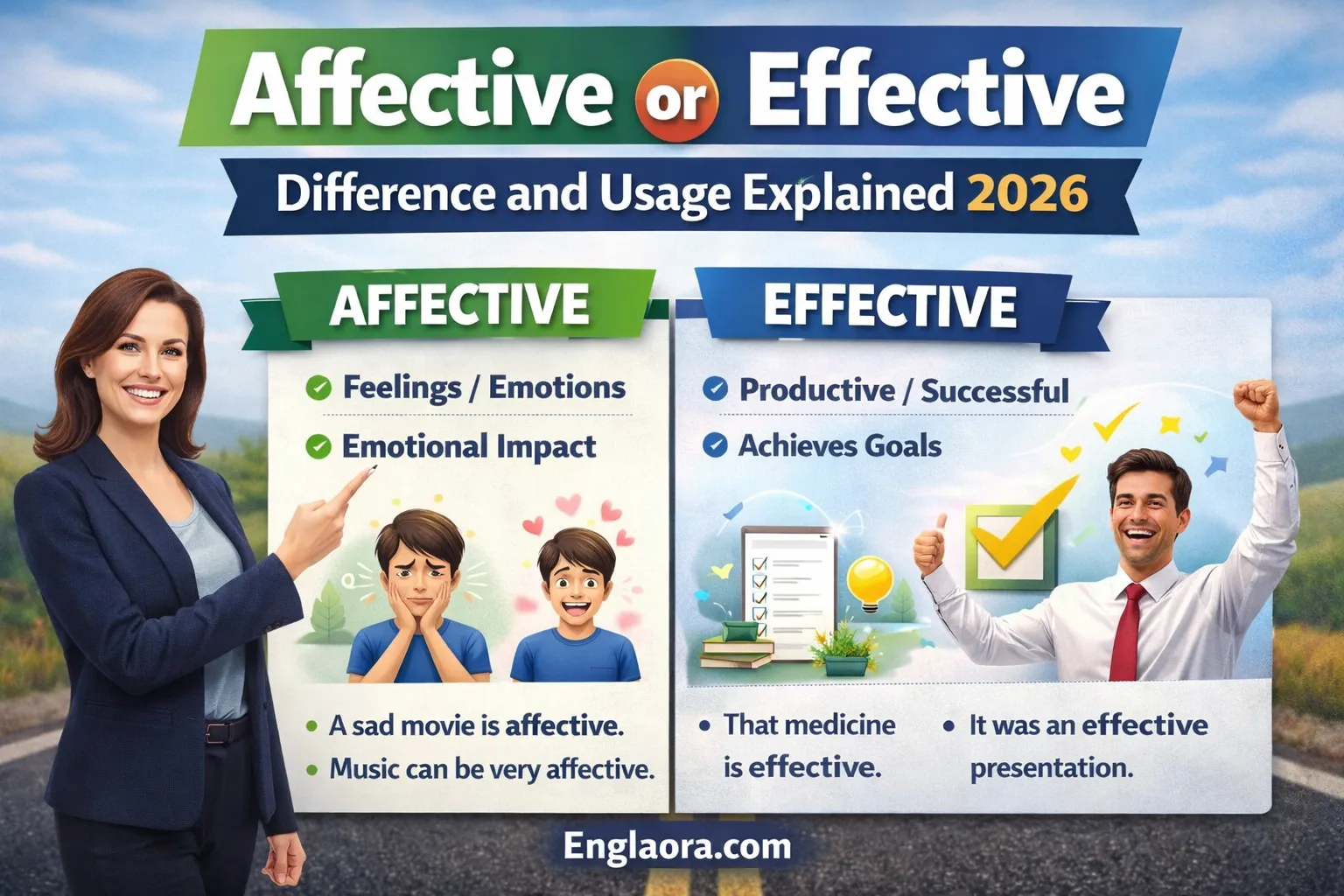
The difference between affective and effective is simple once you know their meanings.
- Affective relates to emotions or feelings.
- Effective means something works well or produces the desired result.
Examples:
- The therapy focuses on affective responses in patients.
- The new marketing strategy was effective in increasing sales.
So remember:
| Word | Meaning | Example |
|---|---|---|
| Affective | Related to emotions | Affective behavior |
| Effective | Produces a good result | Effective solution |
Most people actually mean effective, which is why confusion happens.
What Is The Difference Between Conative And Affective?
In psychology, conative and affective describe two different parts of human behavior.
- Affective refers to emotions and feelings.
- Conative refers to actions, intentions, or motivation.
Example:
- Feeling happy or sad → Affective
- Deciding to study harder → Conative
Psychologists often study both to understand how emotions influence behavior.
Is It Effective Today Or Affective Today?
The correct phrase is almost always effective today.
Effective Today:
This means something starts working or becomes active from today.
Example:
- The new policy is effective today.
Affective Today:
This phrase is rarely used. It would only make sense when talking about emotional states.
Example:
- The patient showed affective changes today.
So in normal communication, effective today is correct.
What Is An Example Of Affective?
An affective example usually describes emotions or feelings.
Examples:
- Affective learning focuses on emotions in education.
- The patient showed strong affective reactions.
- Music can create powerful affective responses.
In psychology, affective responses are emotional reactions to events or experiences.
How To Use Affective In A Sentence?
Here are simple sentences using affective.
- The therapy studies affective behavior in children.
- Emotional memories create strong affective reactions.
- Teachers sometimes focus on affective learning.
In most cases, this word appears in psychology, education, or research writing.
Affective Vs Effective Examples
| Sentence | Correct Word |
|---|---|
| The new medicine worked well. | Effective |
| The child showed emotional responses. | Affective |
| The plan improved our results. | Effective |
| Therapy focuses on emotional expression. | Affective |
This table shows how different their meanings really are.
Affective Or Effective Meaning
Let’s look at both meanings clearly.
Affective Meaning
Connected to emotions, mood, or feelings.
Example:
- Affective disorder affects emotional health.
Effective Meaning
Successful in producing the intended result.
Example:
- The new training method is very effective.
Affective Or Effective Synonym
Synonyms For Affective
- Emotional
- Feeling-based
- Sentimental
- Psychological
Synonyms For Effective
- Successful
- Powerful
- Productive
- Efficient
Affective Or Effective In A Sentence
Examples with affective:
- The psychologist studied affective responses.
- Children learn empathy through affective experiences.
Examples with effective:
- The new treatment was effective.
- This strategy is effective for saving time.
Effective Or Affective Immediately
The correct phrase is effective immediately.
This means something starts right away.
Example:
- The rule is effective immediately.
Using affective immediately would not make sense in most situations.
Effective Meaning
The word effective means something works successfully.
Examples
- Exercise is effective for stress relief.
- The new system is very effective.
- Good communication is effective in solving problems.
Because this word is common in business, health, and daily communication, people search it frequently.
Affective Or Effective Psychology
In psychology, affective is widely used.
Examples
- Affective disorders involve emotional problems.
- Affective neuroscience studies emotions in the brain.
Meanwhile effective appears in treatment results.
Example:
- Cognitive therapy is effective for anxiety.
Affective Or Effective Examples
Affective Examples
- Affective learning in schools
- Affective disorder treatment
- Affective emotional response
Effective Examples
- Effective communication
- Effective leadership
- Effective marketing strategy
The Origin Of Affective Or Effective
Both words come from the Latin root “facere”, meaning to do or make.
- Effective comes from effectivus, meaning producing a result.
- Affective comes from affectus, meaning emotional state or feeling.
Over time, English adopted both words. Although they look similar, their meanings developed differently.
This shared origin explains why people often mix them up today.
British English Vs American English Spelling
Unlike many English words, affective and effective have the same spelling in both British and American English.
| Word | British English | American English |
|---|---|---|
| Affective | Affective | Affective |
| Effective | Effective | Effective |
So the confusion is not about spelling differences but about meaning.
Which Spelling Should You Use?
The answer depends on the meaning you want.
Use Affective When
- Talking about emotions
- Writing about psychology
- Discussing emotional responses
Use Effective When
- Talking about results
- Describing something successful
- Writing business or academic content
For global audiences, effective is the word used most often.
Common Mistakes With Affective Or Effective
Mistake 1
❌ The plan was very affective.
✔ The plan was very effective.
Mistake 2
❌ The therapy studies effective responses.
✔ The therapy studies affective responses.
Mistake 3
❌ The policy becomes affective tomorrow.
✔ The policy becomes effective tomorrow.
These mistakes happen because the words look similar.
Affective Or Effective In Everyday Examples
Emails
- This update will be effective tomorrow.
News
- The law becomes effective next year.
Social Media
- This workout is very effective.
Academic Writing
- Researchers studied affective responses to music.
These examples show how each word appears in different contexts.
Affective Or Effective – Google Trends & Usage Data
Search data shows that effective is far more common than affective.
Why People Search This Keyword
- The words look similar.
- Writers want to avoid grammar mistakes.
- Students study these words in psychology or English classes.
Popular Regions
- United States
- United Kingdom
- Canada
- Australia
In most searches, people want to know which spelling fits their sentence.
FAQs
What Is The Main Difference Between Affective And Effective?
Affective relates to emotions, while effective describes something that works successfully.
Is Effective Or Affective More Common?
Effective is much more common in everyday language.
Can Affective Mean Effective?
No. They have completely different meanings.
When Should I Use Affective?
Use affective when talking about emotions or psychological responses.
What Does Effective Immediately Mean?
It means something starts working or becomes active right away.
Why Do People Confuse Affective And Effective?
Because the words look very similar and share a Latin origin.
Is Affective Used In Psychology?
Yes. It is often used to describe emotional processes or affective disorders.
Conclusion
Understanding the difference between affective or effective may seem tricky at first, but once you know the meanings, it becomes very easy to choose the correct word. The key idea is simple. Affective relates to emotions, feelings, and psychological responses. Effective, on the other hand, describes something that works well and produces the desired result.
In everyday communication, the word effective is far more common. You will see it in emails, news reports, business writing, and casual conversations. For example, people often say a plan is effective, a strategy is effective, or a medicine is effective. Meanwhile, affective usually appears in psychology, education, and research where emotional behavior is discussed.
Knowing the difference can help you avoid embarrassing grammar mistakes in professional writing or online conversations. When you are unsure, simply ask yourself one question: Am I talking about emotions or results? If the topic is emotions, choose affective. If the topic is success or impact, choose effective.
By remembering this simple rule, you will feel more confident using both words correctly in any situation.

Hi, I’m Ethan Hawkes, writing for Englaora.com. I provide clear, reliable content to help users understand the differences between commonly confused words.