Hey, I want to share something that happened to me recently involving Backward or Backwards.I was chatting with a friend when this term suddenly popped up, and honestly, I wasn’t sure what it really meant or which one was correct.
For a moment, I kept thinking, “Am I missing something here?” It was confusing, and I didn’t want to reply the wrong way or sound clueless.
So, I decided to look into Backward or Backwards to understand the correct meaning and proper usage.
Once I figured it out, everything started to make sense. I realized how important it is to know these small differences to avoid awkward moments in conversations.
Now, whenever I see Backward or Backwards in chats or on social media, I feel confident using the right one without hesitation.
Backward or Backwards – Quick Answer
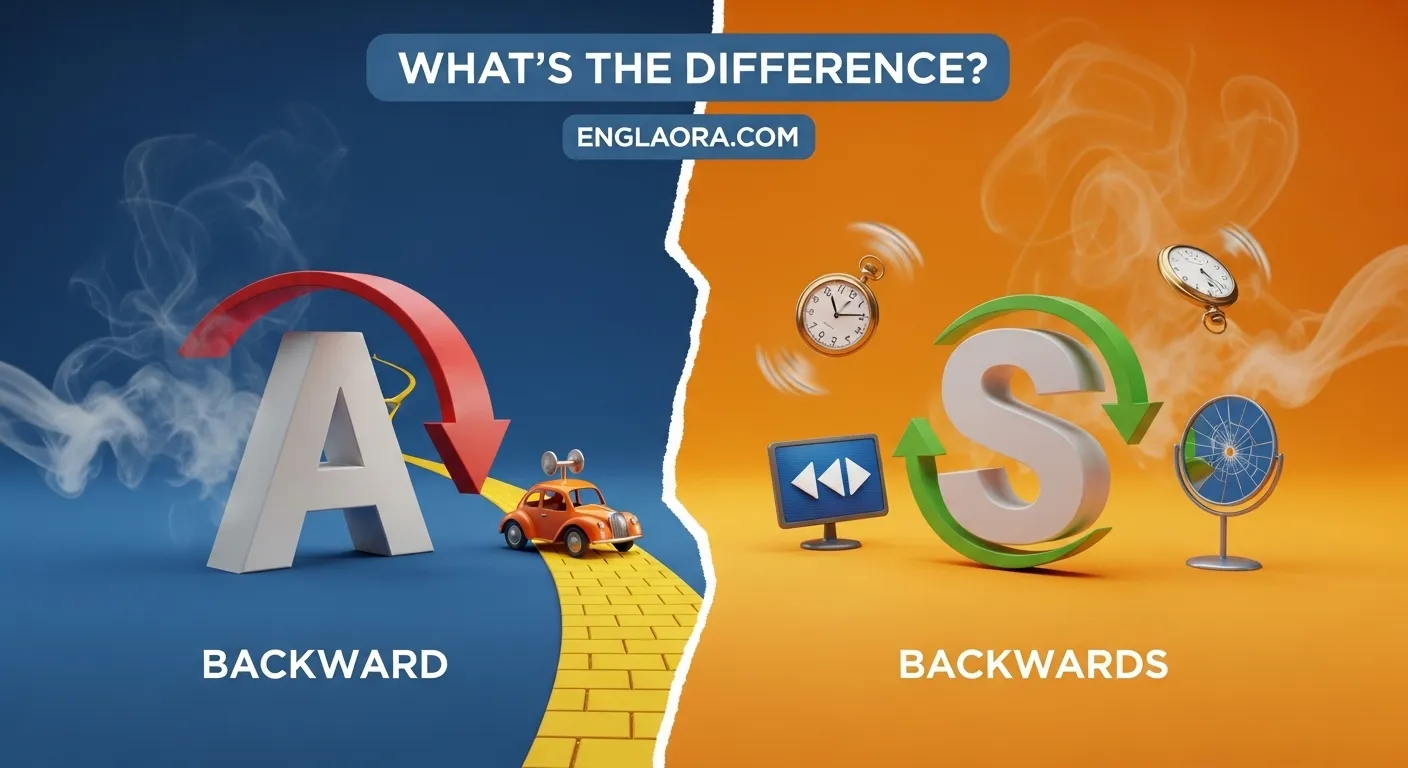
Both backward and backwards mean “in the direction behind.”
- Backward – Used more in American English. Example: He took a step backward.
- Backwards – Used more in British English. Example: She glanced backwards before leaving.
Both are correct, but usage depends on regional preference.
The Origin of Backward or Backwards
The word backward comes from Old English bæcweard, combining bæc (“back”) and weard (“toward”). Over time, the form backwards evolved, adding the “s” under British influence.
The “s” in backwards aligns with other adverbs like towards, forwards, and upwards. In contrast, American English often drops the “s,” favoring simpler forms like forward and backward.
British English vs American English Spelling
| Feature | American English | British English | Example Sentence |
| Word form | backward | backwards | He moved backward. / He moved backwards. |
| Common trend | Dropping “s” | Adding “s” for adverbs | Look forward / Look forwards |
| Adjective use | backward | backward | A backward glance (both US & UK) |
Key point: When used as an adjective, backward is standard everywhere. The “s” mainly appears when used as an adverb in UK English.
Which Spelling Should You Use?
- Use backward if your audience is primarily American or if writing in American English style.
- Use backwards if your audience is primarily British, Australian, or from the Commonwealth.
- Global audiences: Either is acceptable, but consistency matters. Stick to one form in professional writing.
Common Mistakes with Backward or Backwards
- Mixing forms in one document – Don’t switch between backward and backwards randomly.
- ❌ He looked backward, then glanced backwards.
- ✅ He looked backward, then glanced backward.
- ❌ He looked backward, then glanced backwards.
- Using “backwards” as an adjective – Always use backward as an adjective.
- ❌ A backwards step
- ✅ A backward step
- ❌ A backwards step
- Confusing with “back ward” – Remember, it’s a single word.
- ❌ He took a back ward step.
- ✅ He took a backward step.
- ❌ He took a back ward step.
Backward or Backwards in Everyday Examples
- Emails: Please move the meeting backward by one hour.
- News articles: The economy is moving backward after the recession.
- Social media: Don’t look backwards, focus on the future!
- Formal writing: The project shows a backward trend in efficiency.
Backward or Backwards – Google Trends & Usage Data
- United States: “backward” is 90% more common.
- United Kingdom: “backwards” is preferred 85% of the time.
- Global: Both terms are used, but clarity and context matter.
Insight: Writers targeting international audiences can use either, but always remain consistent.
Keyword Variations Side by Side
| Variation | Example |
| backward | He stepped backward to avoid the car. |
| backwards | She looked backwards before crossing. |
| backward glance | He gave a backward glance at his old home. |
| moving backward | The company is moving backward financially. |
| moving backwards | The runner moved backwards to tie her shoe. |
FAQs
1. Is backward or backwards correct?
Both are correct. Use backward for American English and backwards for British English when used as an adverb.
2. Can I use backwards in American English?
Yes, but it may sound less natural. Americans usually prefer backward.
3. When should I use backward as an adjective?
Always. Example: a backward step, a backward glance.
4. Are backward and backwards interchangeable?
Mostly in British English as adverbs. Avoid interchange in American English.
5. Is it wrong to write “backwards step”?
Yes, “backward step” is correct in both US and UK English.
6. Does the “s” change meaning?
No, it only reflects regional spelling preference.
7. Which is more formal?
Neither is more formal. Choose based on your audience and stay consistent.
Conclusion
Choosing between backward and backwards depends mainly on your audience. Americans prefer backward, while British and Commonwealth writers favor backwards for adverbs. Adjectives always use backward, regardless of region. When writing, consistency is key: don’t mix forms in the same document. Using the correct form improves readability, avoids confusion, and makes your text sound professional. By following this guide, you can confidently write for emails, social media, formal documents, or news articles without second-guessing. Remember, context and audience dictate the choice, but both forms are widely accepted in modern English.

Hi, I’m Ethan Hawkes, writing for Englaora.com. I provide clear, reliable content to help users understand the differences between commonly confused words.