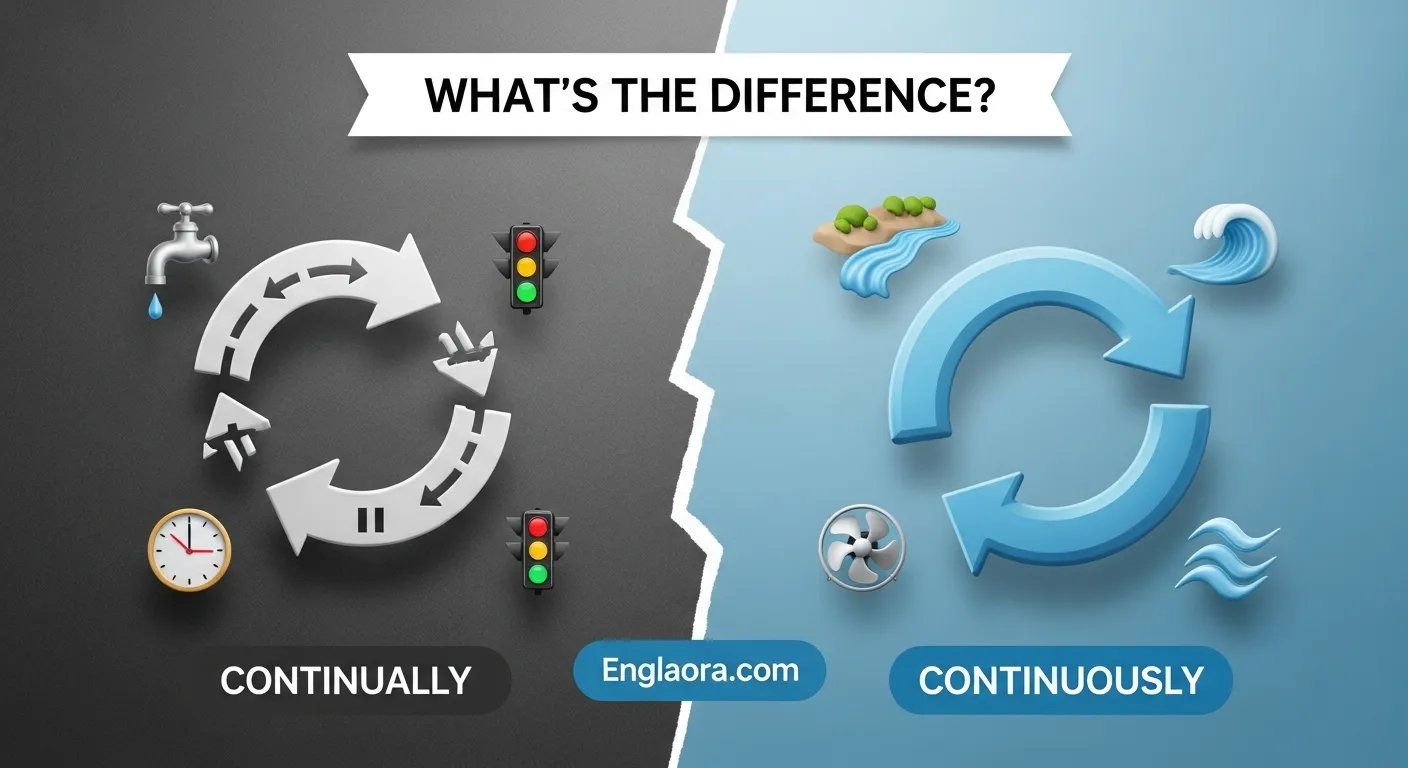
Hey, I want to share something that happened to me recently involving Continually or Continuously.
I was chatting with a friend when this phrase suddenly popped up, and honestly, I wasn’t sure what it really meant—or which one was correct.
For a moment, I kept thinking, “Am I missing something here?” It felt confusing, and I didn’t want to reply the wrong way or sound clueless.So, I decided to look into Continually or Continuously to understand the correct meaning and proper usage.
Once I figured it out, everything started to make sense, and I realized how important it is to know the difference to avoid awkward moments in everyday conversations.
Now, whenever I see Continually or Continuously in chats or on social media, I feel confident responding the right way.
Continually or Continuously – Quick Answer
- Continually: Refers to actions that happen repeatedly but with pauses.
Example: The team continually checks the website for errors. (There are breaks between checks.) - Continuously: Refers to actions that happen without interruption.
Example: The river flowed continuously through the valley. (No pauses at all.)
| Word | Meaning | Example |
| Continually | Repeated, with pauses | She continually reminds me about deadlines. |
| Continuously | Uninterrupted, ongoing | The machine ran continuously for 24 hours. |
The Origin of Continually or Continuously
Both words come from the Latin root continuus, meaning “uninterrupted.” Over time, English adopted slightly different meanings for nuanced contexts:
- Continually evolved to indicate repeated actions that may stop and start.
- Continuously retained the sense of “without interruption” from Latin.
The subtle difference helps writers convey either repeated occurrence or unbroken duration.
British English vs American English Spelling
In both British and American English, the spelling of “continually” and “continuously” is the same. The difference is more about usage preference than spelling:
| Feature | British English | American English |
| Continually | Often used for repeated events | Same usage |
| Continuously | Often emphasizes unbroken actions | Same usage |
| Preference | Slightly more formal in British writing | Neutral in American writing |
Spelling doesn’t change, but context matters.
Which Spelling Should You Use?
- US Audience: Either word works; focus on the meaning.
- UK/Commonwealth Audience: Same guidance; readers may prefer continually for repeated actions.
- Global Writing: Always choose the word that matches the intended meaning—continually for repeated, continuously for unbroken.
Common Mistakes with Continually or Continuously
- Using continually for something unbroken.
❌ Wrong: The engine ran continually for 48 hours.
✅ Correct: The engine ran continuously for 48 hours. - Using continuously for repeated but interrupted actions.
❌ Wrong: She continuously called her friend every week.
✅ Correct: She continually called her friend every week. - Confusing the words in formal writing or reports.
Tip: Always ask, “Is there a pause?” If yes → continually; if no → continuously.
Continually or Continuously in Everyday Examples
Emails:
- “We will continually update you on project progress.”
News:
- “Floodwaters flowed continuously for several hours.”
Social Media:
- “He continually shares memes every day.”
Formal Writing:
- “The system monitored the data continuously without downtime.”
Continually or Continuously – Google Trends & Usage Data
Google Trends shows:
- Continually is searched slightly more often in the UK and Canada.
- Continuously is more popular in US technical and scientific writing.
- Overall interest spikes when people are editing writing or checking grammar.
| Keyword | Popularity | Typical Use |
| Continually | UK > US | Everyday writing, emails |
| Continuously | US > UK | Technical, scientific, formal |
FAQs
1. Can I use continually and continuously interchangeably?
No, use continually for repeated actions with breaks and continuously for uninterrupted actions.
2. Is one word more formal than the other?
No, both are neutral; formality depends on context.
3. Which is more common in American English?
Both are common; continuously is often used in technical contexts.
4. Can “continually” mean “constantly”?
Yes, but only if the action stops and starts repeatedly.
5. How do I remember the difference?
Think: “Pause → continually, No pause → continuously.”
6. Can I use them in social media captions?
Yes, but pick the one that fits the timing or flow of events.
7. Do British and American English differ in meaning?
Slightly in nuance, but the main meaning is consistent.
Conclusion
Understanding continually or continuously can save you from subtle miscommunication. Remember: continually implies repeated actions with breaks, while continuously suggests unbroken activity. British and American English spellings are identical, but context matters more than geography. Always consider your audience—emails, news articles, social media, and formal writing can use both words correctly if you focus on the action’s timing. By mastering this distinction, your writing becomes more precise, professional, and polished.

Hi, I’m Emma Caldwell, an expert author at Englaora.com. I share clear insights on language differences and provide readers with reliable, easy-to-understand content.