Hey, I want to share something that happened to me recently involving Fewer or Less.
I was chatting with a friend when this term suddenly popped up, and honestly, I had no idea which one was actually correct.
For a moment, I kept thinking, “Am I missing something here?” It was confusing, and I didn’t want to reply the wrong way or sound clueless.
So, I decided to look into Fewer or Less to understand the correct meaning and proper usage. Once I figured it out, everything made sense, and I realized how important it is to know the difference to avoid awkward moments in conversations.
Now, whenever I see Fewer or Less in chats or on social media, I feel confident responding the right way.
Fewer or Less – Quick Answer
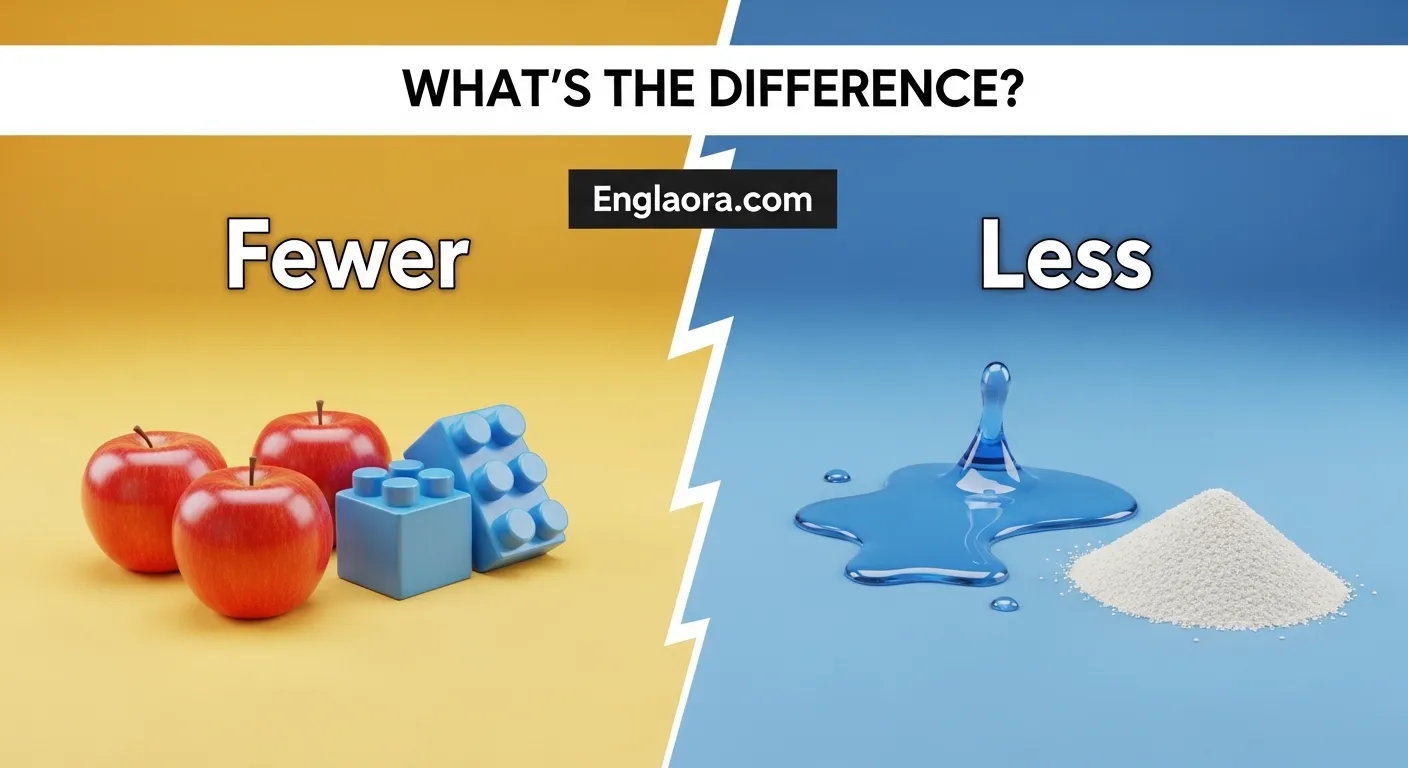
Fewer is used with countable nouns (things you can count).
Less is used with uncountable nouns (things you cannot count).
Examples:
- ✅ Fewer apples, fewer cars, fewer mistakes
- ✅ Less water, less sugar, less noise
Quick Tip: If you can put a number in front of the noun, use fewer. If not, use less.
The Origin of Fewer or Less
The words fewer and less both come from Old English.
- Less comes from “læs,” meaning “not as much.”
- Fewer comes from “fēawa,” meaning “few.”
Historically, less was often used for both countable and uncountable nouns, but modern grammar prefers fewer for countable nouns. Understanding this history helps explain why some older texts may use less in ways that feel unusual today.
British English vs American English Spelling
The rules for fewer or less are mostly the same in both British and American English. However, style guides differ slightly:
| Feature | British English | American English |
| Countable nouns | Fewer apples, fewer mistakes | Fewer apples, fewer mistakes |
| Uncountable nouns | Less water, less sugar | Less water, less sugar |
| Time, money, distance | Often less (e.g., less than 5 miles) | Often less (same) |
Note: Both versions agree on the grammar rule—use fewer for countable and less for uncountable nouns.
Which Spelling Should You Use?
- US Audience: Stick to fewer for countable nouns and less for uncountable nouns.
- UK/Commonwealth Audience: Same rule applies; some informal writing may still use less with countables.
- Global English: Follow the standard rule to avoid mistakes. If in doubt, use fewer for numbers and less for amounts.
Common Mistakes with Fewer or Less
- ❌ “Less people attended the meeting.” → ✅ “Fewer people attended the meeting.”
- ❌ “I have fewer money than you.” → ✅ “I have less money than you.”
- ❌ “She has less friends.” → ✅ “She has fewer friends.”
- ❌ “There are less cars on the road.” → ✅ “There are fewer cars on the road.”
Tip: Always ask, “Can I count it?” If yes → fewer, if no → less.
Fewer or Less in Everyday Examples
Emails:
- “We need fewer errors in the report.”
News Articles:
- “The city reported less rainfall than last year.”
Social Media:
- “I have fewer notifications than yesterday.”
Formal Writing:
- “The organization should focus on fewer but more impactful projects.”
Fewer or Less – Google Trends & Usage Data
Google Trends shows:
- Less is searched more overall because it’s used in everyday speech.
- Fewer spikes in searches when people are correcting grammar.
- Top countries searching for “fewer or less”: US, UK, Canada, Australia.
People often look this up when writing essays, emails, or social media posts.
Comparison Table: Fewer vs Less
| Feature | Fewer | Less |
| Type | Countable nouns | Uncountable nouns |
| Examples | Fewer cars, fewer mistakes | Less sugar, less water |
| Use with numbers | ✅ 5 fewer errors | ❌ 5 less errors |
| Informal exceptions | Rare | Sometimes used with countables in casual speech |
FAQs
1. Can I use less with countable nouns?
Informally, yes, but grammatically, use fewer.
2. Is it correct to say “less people”?
No, the correct phrase is fewer people.
3. Can “fewer” be used with money?
No, use less money, because money is uncountable.
4. How do I know which word to use?
Ask: “Can I count it?” Countable → fewer, uncountable → less.
5. Are there exceptions?
Yes, with measurements, time, distance, and weight, less is commonly used.
6. Why do people confuse them?
Because older texts used less for both countable and uncountable nouns.
7. Does it matter in formal writing?
Yes, using the correct word makes your writing more professional.
Conclusion
Choosing between fewer and less is simple once you know the rules. Fewer is for countable nouns, and less is for uncountable nouns. British and American English mostly follow the same rules, but informal writing sometimes bends them. Always ask yourself if the noun can be counted. Using the correct word ensures clear, professional, and polished writing across emails, social media, articles, and formal documents. By mastering this small but important grammar rule, your sentences will be grammatically correct and easy to read.
Discover More Article:
Tare vs Tear: Meaning Differences with Examples(2026)
Flair or Flare: Meaning, Grammar and Examples(2026)
Country’s or Countries: Meaning, Grammar and Examples(2026)

Hi, I’m Toby Kellan, writing for Englaora.com. I provide clear, reliable content to help users understand the differences between commonly confused words.