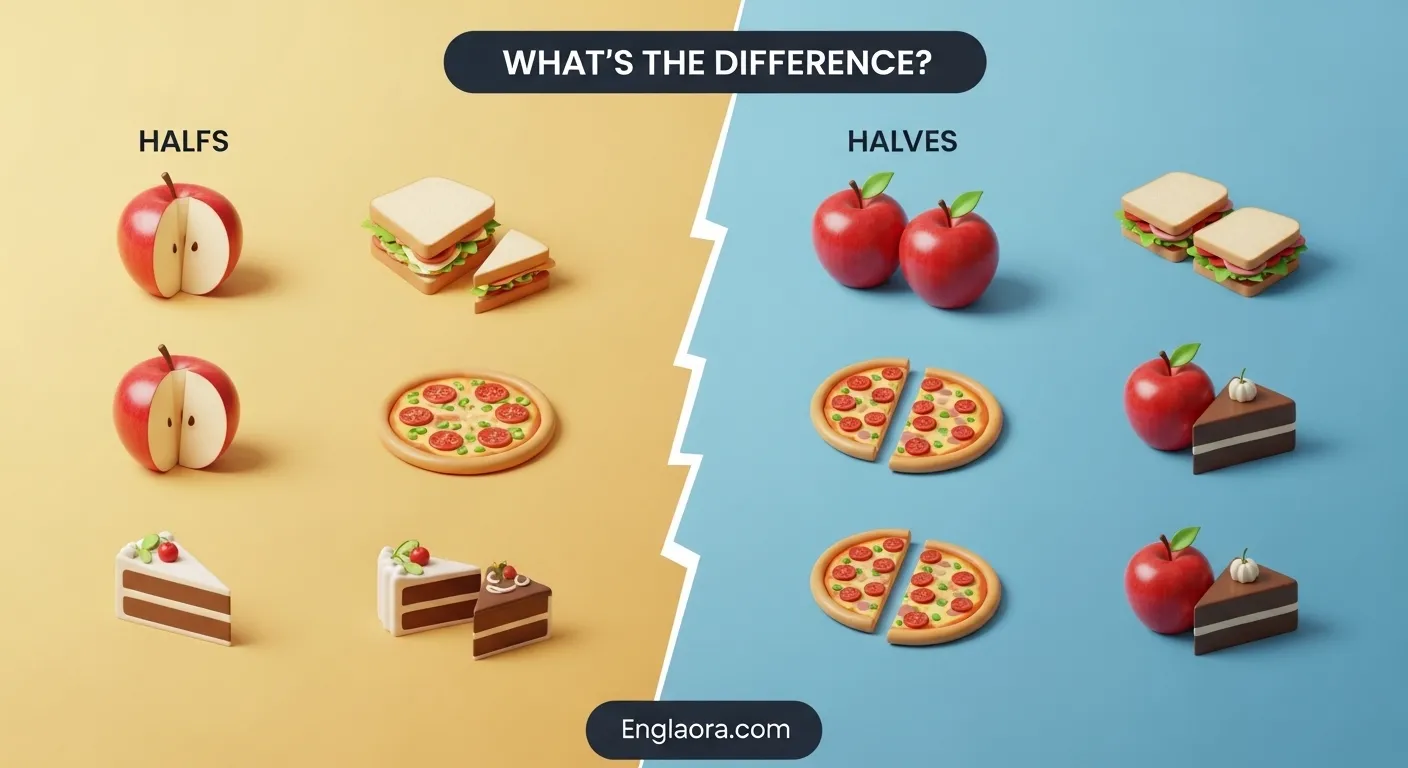
Hey, I want to share something that happened to me recently involving Halfs or Halves.
I was chatting with a friend when this word suddenly popped up, and honestly, I wasn’t sure which one was correct.
For a moment, I kept thinking, “Am I missing something here?” It felt confusing, and I didn’t want to reply the wrong way or sound clueless.
So, I decided to look into Halfs or Halves to understand the correct spelling and proper usage. Once I figured it out, everything clicked. I realized how small spelling differences can completely change how confident you sound in conversations.
Now, whenever I see Halfs or Halves in chats or on social media, I feel completely confident using the right form.
And trust me — knowing the difference saves you from those awkward “wait… is that correct?” moments.
Halfs or Halves – Quick Answer
The correct plural of half is halves.
- ✅ Correct: I ate two halves of a sandwich.
- ❌ Incorrect: I ate two halfs of a sandwich.
“Halves” follows the irregular plural rule where words ending in f often change to ves.
The Origin of Halves
The word half comes from Old English healf, meaning “one of two equal parts.” Historically, some English words ending with f or fe changed to ves in the plural form, like wolf → wolves and knife → knives. This spelling shift is why halves is correct, while “halfs” never became standard English.
British English vs American English Spelling
Both British and American English use halves as the plural of half. Unlike some words with spelling differences (like colour/color), “half” does not change.
| Aspect | British English | American English | Example |
| Singular | half | half | half a pizza |
| Plural | halves | halves | two halves of a pizza |
✅ Note: “Halfs” is considered incorrect in both versions.
Which Spelling Should You Use?
Always use halves regardless of audience. However:
- US audiences: Halves is standard in writing and speech.
- UK/Commonwealth audiences: Halves is also correct.
- Global English learners: Stick with halves to avoid mistakes.
Common Mistakes with Halves
Many people try to form the plural as halfs because it follows regular plural rules.
- ❌ Incorrect: I need two halfs of this cake.
- ✅ Correct: I need two halves of this cake.
Other mistakes include confusing halves with half’s (possessive) or using half as plural. Always remember: halves = plural.
Halves in Everyday Examples
Emails: “Please send me the two halves of the report.”
News articles: “The city was split into two halves after the storm.”
Social media: “Check out my pizza – two perfect halves!”
Formal writing: “The halves of the equation were equal in value.”
Halves – Google Trends & Usage Data
“Halves” is more commonly searched than “halfs” worldwide. Google Trends shows high searches in the US, UK, Canada, and Australia. Most queries relate to spelling, grammar, and math problems. People use it in cooking, sports (halftime), and measurement contexts.
Keyword Variations Comparison Table
| Singular | Plural | Incorrect |
| half | halves | halfs |
| half of | halves of | halfs of |
FAQs
1. Is it “halfs” or “halves”?
- The correct plural is halves.
2. Can I use “halfs” in informal writing?
- No, even informal writing should use halves.
3. Why do some words ending with “f” change to “ves”?
- This is an irregular plural rule in English (wolf → wolves, knife → knives).
4. What is the singular of halves?
- The singular form is half.
5. Is “half’s” the plural?
- No, half’s is possessive, not plural.
6. How do I use halves in math?
- Example: “Divide the cake into two halves.”
7. Are there any regional differences in using halves?
- No, halves is correct in both American and British English.
Conclusion
The plural of half is always halves. Confusion with halfs is common, but remembering the irregular plural rule makes it simple. Whether you are writing an email, posting on social media, or completing a school assignment, using halves correctly ensures clarity and professionalism. Both British and American English follow this rule, making it safe for global use. Always double-check your writing when splitting items, discussing portions, or giving instructions, and your grammar will remain accurate. By using halves consistently, you demonstrate careful language skills and avoid common pitfalls in English writing.

Hi, I’m Emma Caldwell, an expert author at Englaora.com. I share clear insights on language differences and provide readers with reliable, easy-to-understand content.