Hey, I recently faced a common confusion while chatting with a friend about a kitchen issue. He wrote, “There is mold on the wall.”
For a moment, I paused and thought: Wait… is it mold or mould?
I had seen both spellings online, but I was never sure which one was actually correct.
So I decided to research it properly. After understanding the difference, everything became clear.
Now, whenever I see mould or mold, I know exactly which spelling to use and when.
Quick Answer: Which One Is Correct?
Both “Mold” and “Mould” are correct.
- Mold → American English spelling
- Mould → British English spelling
They have the same meaning — the only difference is regional spelling preference.
Mold or Mould – Regional Differences
| Region | Correct Spelling | Example |
|---|---|---|
| United States | Mold | There is mold on the wall |
| United Kingdom | Mould | There is mould on the wall |
| Australia | Mould | The bread has mould |
| Canada | Mostly Mould | Check for mould in the basement |
Mold or Mould in Australia
Australia follows British English, so the correct spelling is mould. You will mostly see “mould” in Australian websites, recipes, and official documents.
Example: Black mould is a common problem in humid Australian homes.
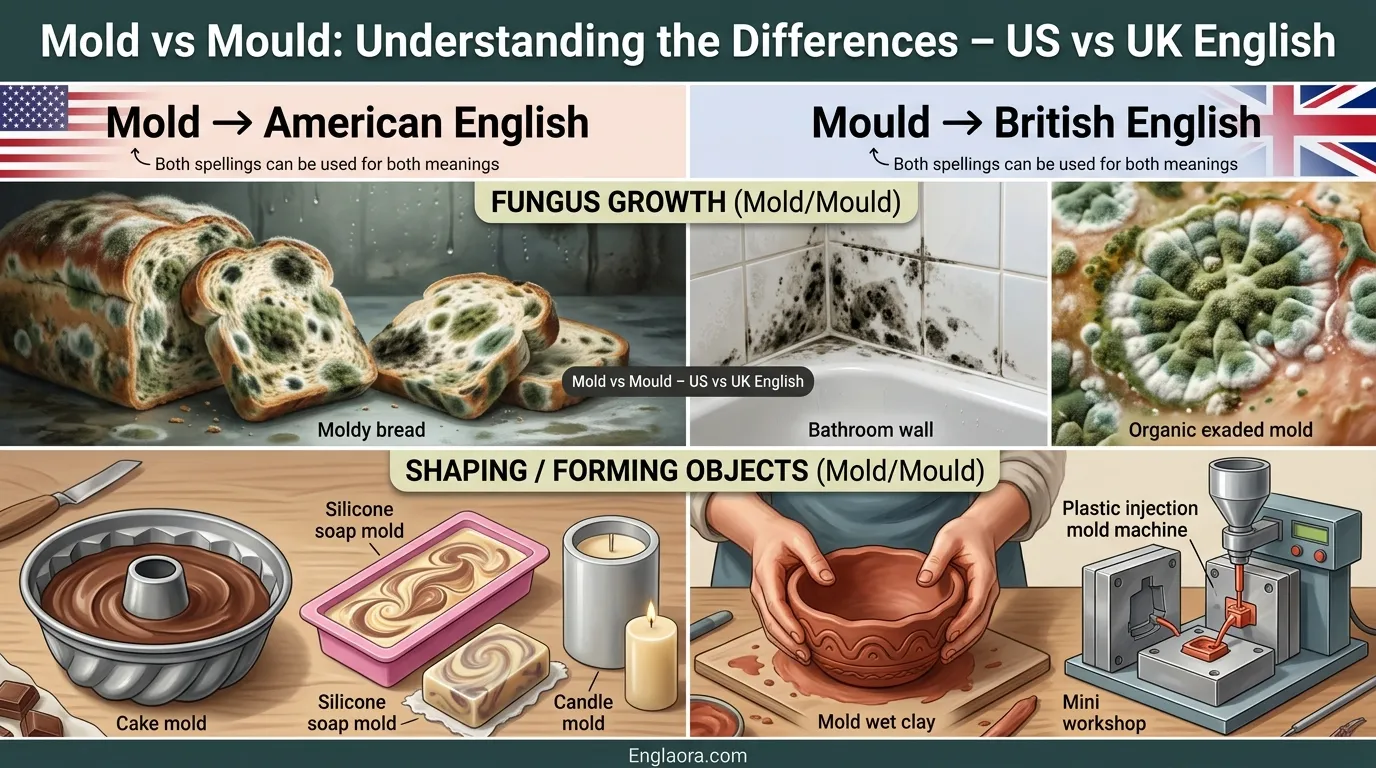
Mold or Mould – Two Main Meanings
- Fungus – A type of fungus that grows in damp places.
- Shape or Form – A hollow container used to shape materials.
Is It Mold or Mould for Fungus?
Yes, both spellings are used when referring to the fungus.
- American English: Black mold
- British English: Black mould
Does Mould Mean to Shape?
Yes. As a verb, mould (or mold) means “to shape or form something.”
Examples:
- The artist will mold the clay into a statue. (US)
- The potter will mould the clay into a bowl. (UK)
Mold or Mould Verb
When used as a verb, it means to shape or influence:
- She tried to mold her son’s personality.
- You can mould your future with hard work.
Fit the Mold or Mould (Idiom)
The common idiom is “fit the mold” (American) or “fit the mould” (British). It means to match a typical pattern or expectation.
Example: She doesn’t fit the mold of a traditional teacher.
Mold or Mould in Bathroom
Mold/mould grows very quickly in bathrooms due to moisture. People often search: “mold on bathroom wall” or “mould in shower”.
Tip: Keep the area dry and well-ventilated to prevent mould growth.
Mold or Mould Spelling
- Mold = One syllable, simpler spelling (American)
- Mould = Contains “ou” (British)
Both are correct depending on the variety of English you use.
Silicone Mold or Mould
Silicone molds (US) or moulds (UK) are popular in baking and crafts because they are flexible and non-stick.
Plastic Mold or Mould
In manufacturing, plastic is injected into a mold or mould to create bottles, toys, and car parts.
Mold and Mould in a Sentence
- The bread has mold on it. (US)
- There is mould growing on the wall. (UK)
- She used a cake mold to bake a perfect round cake.
British vs American English Spelling Differences
| British English | American English |
|---|---|
| Mould | Mold |
| Colour | Color |
| Flavour | Flavor |
| Honour | Honor |
Which Spelling Should You Use?
- Use mold for American audience.
- Use mould for UK, Australia, or Canadian audience.
- For global content, mold is more commonly accepted.
Rule: Stay consistent in the entire article.
Common Mistakes With Mould/Mold
- Mixing both spellings in one article
- Using “mould” in US-focused content
- Using “mold” in formal British writing
FAQs
Is mold or mould correct?
Both are correct. “Mold” is American, “mould” is British.
Is it mold or mould for fungus?
Both are acceptable depending on the region.
How do you pronounce mold and mould?
Both are pronounced the same: /moʊld/.
Is it moldy or mouldy?
- American: moldy
- British: mouldy
What is the plural form of mold/mould?
- Mold → molds
- Mould → moulds
Is mold or mould safe to touch?
Some types can cause allergies. It’s best to wear gloves when cleaning.
How can I identify mold or mould?
Look for black, green, or white fuzzy patches with a musty smell.
Conclusion
The confusion between mould or mold is very common because English has two major spelling systems. Both spellings are correct, but they belong to different regions.
- Mold = American English
- Mould = British English (used in UK, Australia, and mostly Canada)
If you’re talking about fungus or shaping clay, the meaning remains the same. Choose one spelling according to your audience and stay consistent.
Now you can confidently use mold or mould in your writing!

I’m Liam Prescott, writing for Englaora.com. I explain the nuances of commonly confused words, making complex topics simple and engaging for readers.