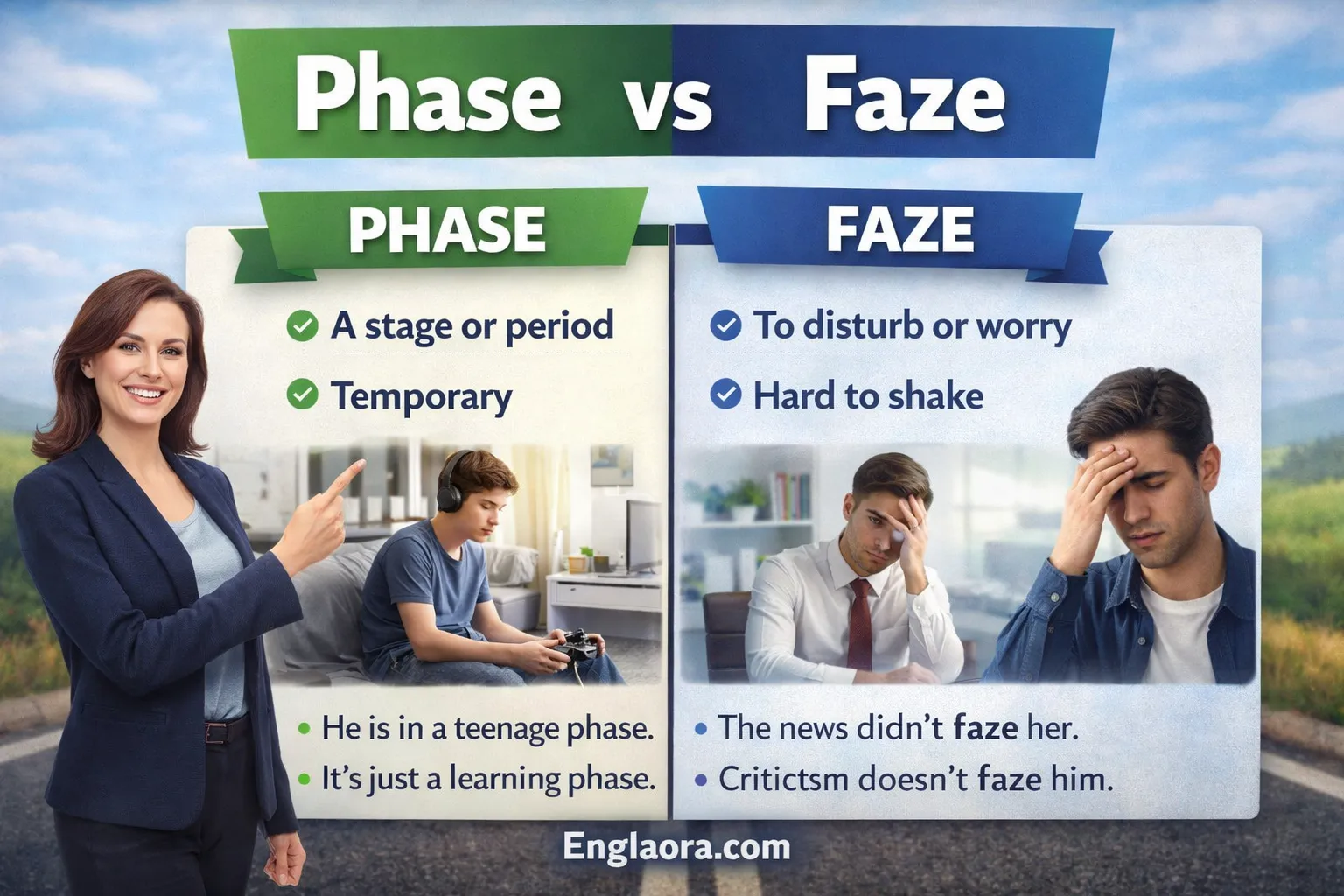
Hey, I want to share something that happened to me recently involving phase or faze.
I was chatting with a friend online when this phrase suddenly appeared in the conversation. My friend wrote, “That comment didn’t phase me at all.”
For a moment, I paused and thought, “Wait… is it phase or faze?” Both words sound exactly the same when spoken, and that made it even more confusing.
I didn’t want to reply with the wrong word and sound careless. So I kept rereading the message, trying to decide which spelling was actually correct.
That small moment made me curious. I realized that many people face the same confusion because phase and faze are homophones—words that sound alike but have different meanings.
If you use the wrong one, your sentence can quickly look incorrect.
So I decided to look deeper into phase or faze to understand the correct meaning and proper usage.
Once I figured it out, everything became clear. Now whenever I see phase or faze in emails, chats, or articles, I know exactly which one to use—and you will too after reading this guide.
Phase Or Faze – Quick Answer
The difference between phase and faze is simple.
| Word | Meaning | Example |
|---|---|---|
| Phase | A stage or step in a process | The project entered its final phase. |
| Faze | To disturb or bother someone | The criticism didn’t faze her. |
Quick rule:
- Use phase when talking about stages or periods.
- Use faze when talking about something that bothers or unsettles someone.
Examples
- The moon is in a new phase tonight.
- His rude comment didn’t faze me.
Does Faze Mean Phase?
No, faze does not mean phase. They are completely different words even though they sound the same.
Phase relates to stages or periods of development, while faze refers to emotional disturbance or reaction.
Example:
- Correct: The company entered a new phase of growth.
- Correct: The bad news didn’t faze her.
Using phase instead of faze in emotional situations is a common mistake.
When To Use Faze Vs Phase?
Understanding when to use each word is easy once you remember their meanings.
Use Phase When:
- Talking about stages
- Describing time periods
- Discussing development
Examples:
- The project is in the testing phase.
- Children often go through a rebellious phase.
Use Faze When:
- Something shocks or disturbs someone
- Someone stays calm despite problems
Examples:
- The criticism didn’t faze him.
- She wasn’t fazed by the challenge.
What Does “You Faze” Mean?
The phrase “you faze” usually appears in sentences like:
- You don’t faze me.
It means someone’s actions or words do not bother you.
Example:
- Your insults don’t faze me anymore.
Here, faze means to disturb emotionally.
How To Use Faze In A Sentence?
Here are some simple examples of faze in everyday writing.
Examples:
- The loud noise didn’t faze the baby.
- Negative comments never faze her.
- He looked calm, but the news clearly fazed him.
In most sentences, faze is used with not.
Example:
- It didn’t faze me.
Phase Or Faze Meaning
Both words sound the same but mean different things.
| Word | Meaning |
|---|---|
| Phase | A stage, step, or period in a process |
| Faze | To disturb, worry, or bother someone |
Example:
- The construction entered a new phase.
- The delay didn’t faze the workers.
Phase Or Faze Me
The phrase “phase me” is usually incorrect when talking about emotions.
Correct usage:
- That comment didn’t faze me.
Incorrect usage:
- That comment didn’t phase me.
Remember: emotional reaction = faze.
Faze Meaning
The word faze means to disturb, upset, or worry someone.
It often appears in negative sentences.
Examples:
- Nothing seems to faze him.
- The criticism didn’t faze her confidence.
The word suggests someone staying calm despite pressure.
Phase Or Faze Synonym
Synonyms Of Phase
- Stage
- Period
- Step
- Cycle
Synonyms Of Faze
- Disturb
- Upset
- Bother
- Shake
Example:
- The company entered a new stage (phase) of growth.
- The harsh review didn’t disturb (faze) her.
Phase Or Faze In English
In English grammar, phase is more common because it is used in science, business, and everyday discussions.
Examples:
- Lunar phases
- Project phase
- Growth phase
Faze is less common and mainly used in emotional contexts.
Example:
- The criticism didn’t faze him.
I’m Not Fazed Or Phased
The correct phrase is:
✔ I’m not fazed
This means you are not bothered or disturbed.
Incorrect:
✘ I’m not phased
Correct example:
- I’m not fazed by negative comments.
Phase Or Faze UK
Both phase and faze are spelled the same in British and American English.
Unlike words like colour/color, these words do not change spelling.
| Word | UK Spelling | US Spelling |
|---|---|---|
| Phase | Phase | Phase |
| Faze | Faze | Faze |
Only the meaning differs, not the spelling.
Phase Or Faze Examples
Here are clear examples showing the difference.
| Sentence | Correct Word |
|---|---|
| The project entered its final ___ | Phase |
| The criticism didn’t ___ her | Faze |
| Teenagers often go through a rebellious ___ | Phase |
| The loud noise didn’t ___ the dog | Faze |
The Origin Of Phase Or Faze
The word phase comes from the Greek word “phasis”, meaning appearance. It was originally used to describe the changing appearance of the moon.
Over time, it began to mean a stage or period in development.
The word faze comes from an older English word “feeze”, meaning to frighten or drive away. Its meaning slowly changed to disturb or unsettle someone emotionally.
Although they sound the same, these words developed from different historical roots, which explains their different meanings today.
British English Vs American English Spelling
Unlike many words in English, phase and faze do not change spelling between British and American English.
| Feature | Phase | Faze |
|---|---|---|
| Meaning | Stage or step | Disturb emotionally |
| Usage | Science, business, life stages | Emotions and reactions |
| UK Spelling | Phase | Faze |
| US Spelling | Phase | Faze |
This makes them homophones, not spelling variations.
Which Spelling Should You Use?
Choosing the correct word depends on context, not location.
Use phase when discussing:
- Stages of life
- Project development
- Scientific cycles
Use faze when describing:
- Emotional reactions
- Someone staying calm under pressure
Simple rule
Stage → Phase
Emotion → Faze
Common Mistakes With Phase Or Faze
Many writers confuse these words.
Mistake 1
Incorrect: The comment didn’t phase me.
Correct: The comment didn’t faze me.
Mistake 2
Incorrect: The project entered a new faze.
Correct: The project entered a new phase.
Mistake 3
Incorrect: I’m not phased by criticism.
Correct: I’m not fazed by criticism.
Remember: phase = stage, faze = disturb.
Phase Or Faze In Everyday Examples
The project will move into the next phase next week.
News
The economy is entering a new recovery phase.
Social Media
Negative comments don’t faze me anymore.
Workplace Writing
The development team completed the testing phase.
Phase Or Faze – Google Trends & Usage Data
Search interest shows that phase is used much more often than faze because it appears in science, education, and business topics.
However, people frequently search “phase or faze” because they are unsure which word fits emotional expressions.
Countries with high search interest include:
- United States
- United Kingdom
- Canada
- Australia
Most searches come from people trying to confirm sentences like “I’m not fazed.”
FAQs
What Is The Difference Between Phase And Faze?
Phase means a stage in a process. Faze means to disturb or upset someone.
Is It “Not Phased” Or “Not Fazed”?
The correct phrase is not fazed.
Why Do People Confuse Phase And Faze?
They sound identical when spoken, making them easy to mix up.
Can Phase And Faze Be Used Interchangeably?
No. They have completely different meanings.
Is Faze A Common Word?
It is less common than phase but still widely used in expressions like “not fazed.”
Do Phase And Faze Have Different Spellings In UK English?
No. Both words are spelled the same in UK and US English.
How Can I Remember The Difference?
Think: Phase = Stage, Faze = Feelings.
Conclusion
Understanding the difference between phase or faze is important because these words may sound the same but have completely different meanings. Many people confuse them, especially in phrases like “I’m not fazed” or when describing stages of development.
The key idea is simple. Phase refers to a stage or period in a process. You might use it when talking about the phases of the moon, stages of a project, or periods of growth in life. On the other hand, faze describes emotional reactions. When something doesn’t disturb or bother you, you say it doesn’t faze you.
Learning this small difference can greatly improve your writing and communication. It helps you avoid common grammar mistakes and makes your sentences clearer. Whether you are writing emails, social media posts, or professional documents, choosing the right word shows attention to detail.

Hi, I’m Emma Caldwell, an expert author at Englaora.com. I share clear insights on language differences and provide readers with reliable, easy-to-understand content.