Hey, I want to share something that happened to me recently about Resume or Resumé. I was chatting with a friend when this term suddenly popped up, and honestly, I paused for a second.
I thought, “Wait… are these two different words, or just different spellings?” It felt a bit confusing, and I didn’t want to sound unsure or respond the wrong way.
That curiosity pushed me to dig deeper into Resume or Resumé and understand what each one actually means and when to use them.
Once I figured it out, everything clicked. I realized how important it is to know these small language differences—especially in professional conversations, emails, or social media—so you don’t end up in an awkward situation.
Now, whenever I see Resume or Resumé, I feel confident using the right form in the right context.
Resume or Resumé – Quick Answer
Quick Answer:
Both resume and resumé refer to a summary of education, work experience, and skills used when applying for jobs.
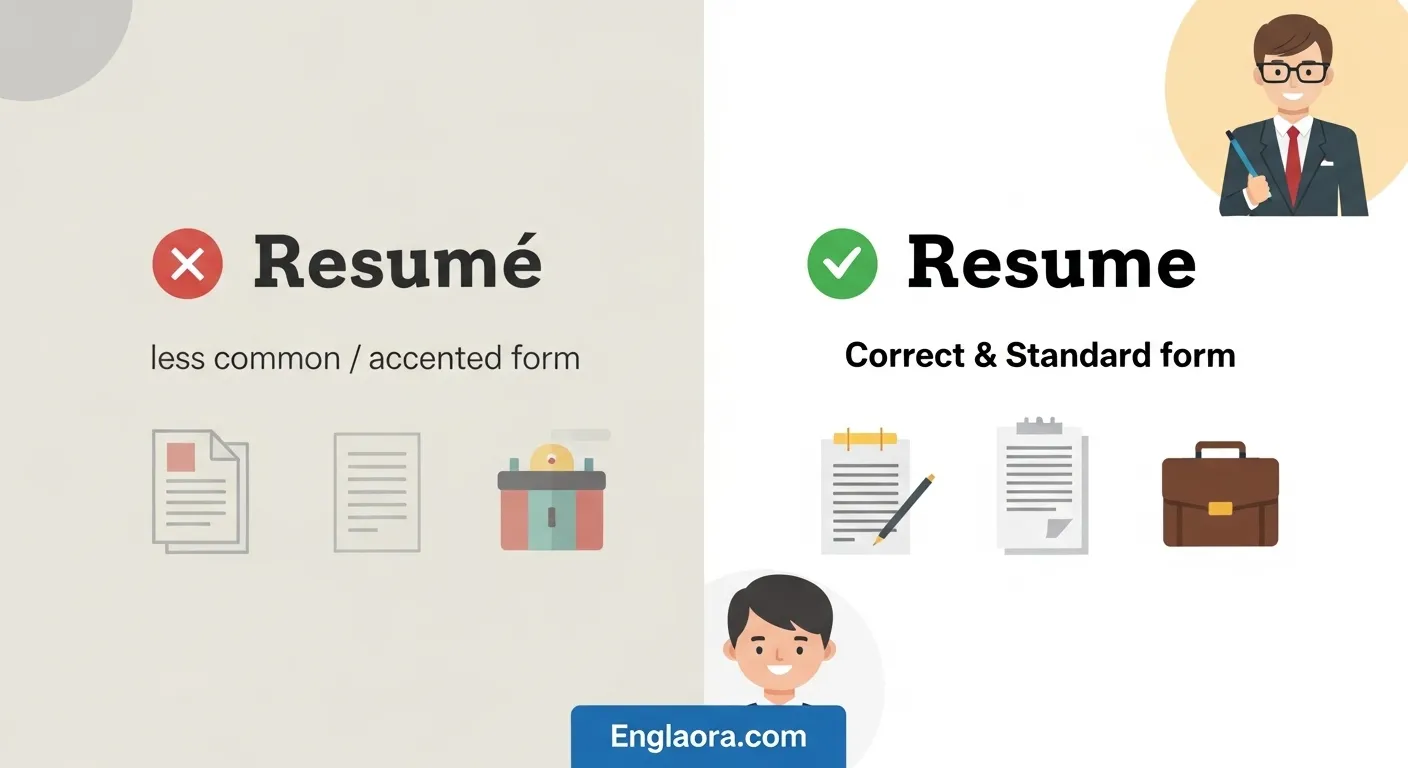
- Resume → Standard spelling in American English, widely accepted and preferred.
- Resumé → Adds accents to match the original French word résumé, meaning “summary.”
Example:
- “Please email your resume before Friday.”
- “I updated my resumé with new achievements.”
Modern usage leans toward resume without accents in most professional settings.
The Origin of Resume or Resumé
The word resume comes from French résumé, which literally means “summary.” Early English writers adopted it in the 19th century to describe a brief summary of skills and experiences.
- Original French: résumé
- Early English: resumé (kept accents)
- Modern American English: resume (dropped accents for simplicity)
The spelling difference exists because English often removes accents from borrowed words, making them easier to type and read.
British English vs American English Spelling
Spelling conventions differ between the US and UK:
| Feature | American English | British English | Notes |
| Spelling | resume | CV (Curriculum Vitae) often used instead | In UK, CV is more common; resumé is rare |
| Accents | Usually omitted | Rarely used | British writers generally avoid resumé |
| Usage | Job applications | Academic vs Job | UK prefers CV for professional summary documents |
Americans mostly use resume, while Brits rarely use either; they prefer CV.
Which Spelling Should You Use?
- United States: Use resume (without accents). Most employers expect this form.
- United Kingdom & Commonwealth countries: Use CV instead. If using resume, resume without accents is fine but uncommon.
- Global audience: Stick with resume to avoid confusion; accents are optional and often unnecessary.
Pro Tip: Focus on clarity and professional presentation, not accents.
Common Mistakes with Resume or Resumé
| Mistake | Correction | Notes |
| Using resumé with accents inconsistently | Use resume consistently | Accents are optional but often avoided |
| Mixing CV and resume terminology | Use CV in UK contexts, resume in US contexts | Avoid confusing your audience |
| Spelling as resumee | Correct to resume | Extra letters are incorrect |
| Forgetting proper capitalization | Capitalize in titles: Resume | Important in headers, documents |
Resume or Resumé in Everyday Examples
Emails:
- “Attached is my resume for the Marketing Manager position.”
News:
- “The company received over 500 resumes for the internship program.”
Social Media:
- “Update your resume before LinkedIn networking events!”
Formal Writing:
- “Applicants must submit a current resume along with a cover letter.”
Use resume in most professional writing; accents are rarely needed.
Google Trends & Usage Data
Search trends indicate that resume is far more popular than resumé:
- United States: Highest search volume, peaks during job seasons (Jan–Mar, Sep–Nov).
- Canada: Similar trends to the US.
- United Kingdom: Searches are low; “CV” dominates instead.
Observation: For global reach, always prefer resume.
Keyword Variations Comparison Table
| Variation | Region | Correct Usage | Notes |
| resume | US, Global | ✅ | Preferred professional spelling |
| resumé | French origin, rare | ⚠️ Optional | Less common in modern writing |
| resumee | – | ❌ | Incorrect spelling |
| CV | UK/Commonwealth | ✅ | Standard in UK; not interchangeable with resume |
FAQs
1. Is “resumé” incorrect?
No, it’s not incorrect, but modern usage favors resume without accents.
2. Can I use accents on my resume?
Yes, but most employers in the US prefer plain resume.
3. What’s the difference between a resume and a CV?
A resume is a brief job-focused summary; a CV is longer and often academic.
4. Why do some people spell it “résumé”?
This follows the original French spelling; it’s mainly stylistic.
5. Should I change my resume to include accents?
Not necessary—keep it simple for readability and ATS (Applicant Tracking Systems).
6. Which spelling is better for international applications?
Use resume; it’s widely understood globally.
7. Is “resume” pronounced differently than “resumé”?
No, both are pronounced the same: /ˈrez-ə-ˌmā/.
Conclusion
When deciding between resume or resumé, clarity and professionalism should guide your choice. While accents reflect the word’s French origin, modern English usage—especially in the United States—favors resume without accents. Understanding regional differences, such as the UK preference for CV, can help you communicate effectively.
Always double-check your documents, avoid common spelling mistakes, and use consistent formatting. Remember, your resume is your first impression—making it clear, concise, and properly spelled can make a significant difference. Stick with resume for global audiences, and use resumé only if you want to emphasize style or heritage.
By mastering this small detail, you show professionalism and attention to language—skills employers value highly.

Hi, I’m Ethan Hawkes, writing for Englaora.com. I provide clear, reliable content to help users understand the differences between commonly confused words.