Hey, I want to share something that happened to me recently about pass or past. I was chatting with a friend online when they wrote, “I walked pass your house yesterday.”
I’m stopped for a moment and thought, “Wait… is it pass or past?” Both words sound the same, so I got confused. I didn’t want to reply the wrong way and look careless.
This happens a lot in English. Many words sound alike but have different meanings and spellings. When we type fast in messages, emails, or social media, it’s easy to mix them up.
So, I decided to check the difference between pass and past. I learned that pass is usually a verb, like “to go by,” and past often talks about time or position.
Now, when I see pass or past, I feel confident using the right word.
Do You Say Pass Or Past?
The correct word depends on what you mean.
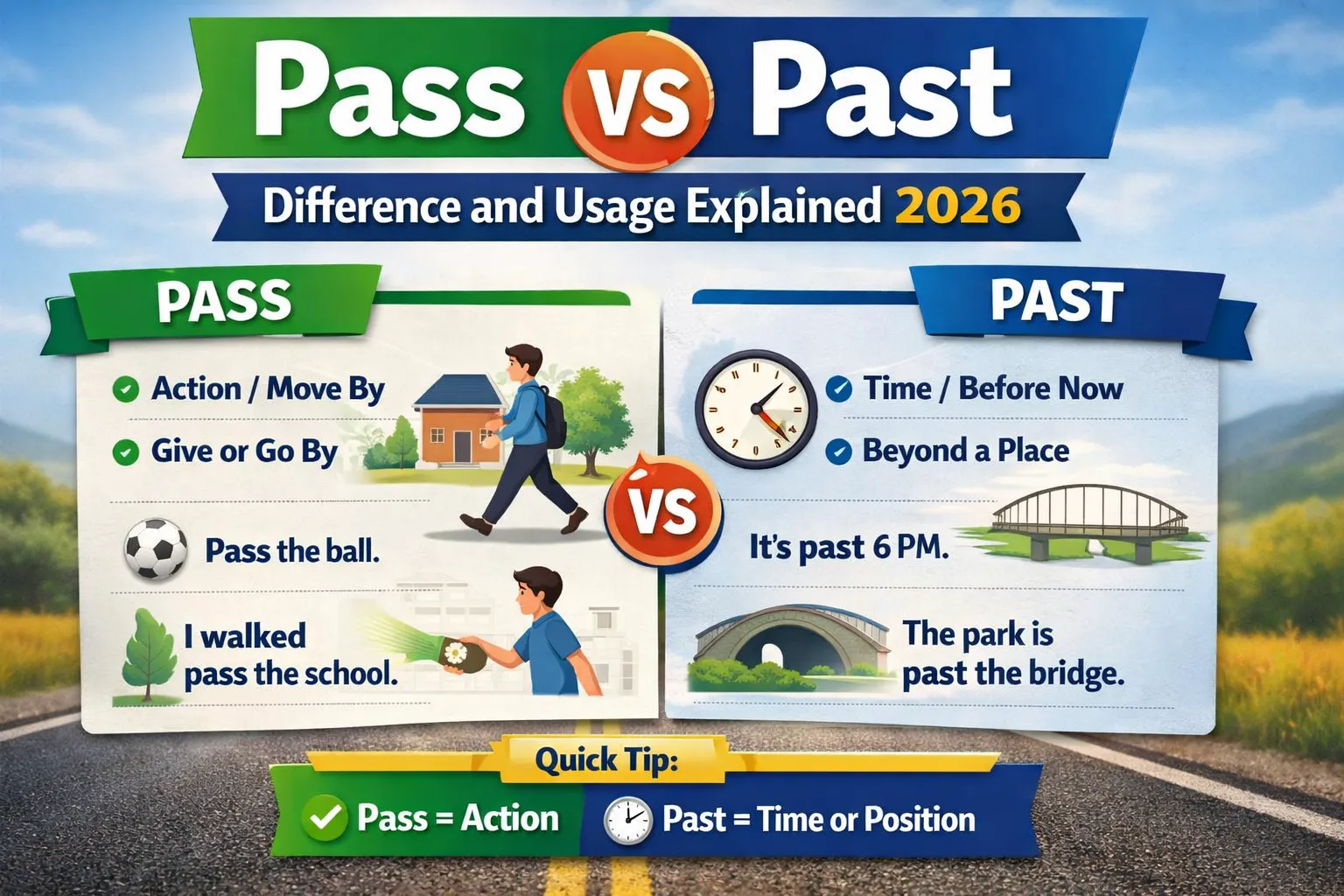
- Pass is a verb. It means to move, give something, or go by something.
- Past usually refers to time that has already happened or a position beyond something.
Examples:
- Please pass the salt.
- I walked past the store.
- The bus will pass this street soon.
- My school is just past the bridge.
A simple trick:
If you can replace the word with move by, use pass.
If you are talking about time or position, use past.
Is It Pass Or Past Time?
The correct phrase is past time when referring to time.
Example:
- It is past time to start the meeting.
- It is already past time for dinner.
However, pass time can appear in a different meaning.
Example:
- I read books to pass time while waiting.
So:
- Past time → refers to time that has already gone.
- Pass time → means spending time doing something.
Is It Pass You Or Past You?
The correct phrase is usually past you when describing movement.
Example:
- The car drove past you quickly.
- I walked past you at the mall.
But pass you can appear when using a verb.
Example:
- I will pass you the ball.
- Please pass you the document.
Is It Drove Past Or Passed?
Both can be correct depending on the meaning.
Drove past means moving beyond something.
Example:
- I drove past the restaurant.
Passed is the past tense of pass.
Example:
- The car passed the truck on the highway.
Pass Or Past Meaning
| Word | Meaning | Example |
|---|---|---|
| Pass | To move, give, or go by | Please pass the book |
| Past | Time gone or beyond a point | The store is past the park |
Simple explanation:
- Pass = action
- Past = time or position
I Walked Past Or Passed
Both can work, but they mean different things.
Walked past
This means moving beyond something.
Example:
- I walked past the bank.
Walked passed
This is usually incorrect unless used in a different structure.
Correct sentence:
- I passed the bank while walking.
Past Vs Passed Examples
Examples with past:
- It is past midnight.
- The dog ran past the house.
- The meeting is past the deadline.
Examples with passed:
- She passed the test.
- The train passed the station.
- Time has passed quickly.
Past 6pm Or Pass 6pm
The correct phrase is past 6pm.
Example:
- It is already past 6pm.
- We stayed out past 6pm.
Pass 6pm would only work if using a verb.
Example:
- The time will pass 6pm soon.
But this usage is rare.
Pass Or Past In A Sentence
Examples with pass:
- Please pass the water bottle.
- The teacher will pass the papers.
- The bus will pass this stop.
Examples with past:
- We walked past the park.
- It is past bedtime.
- The house is past the bridge.
Pass Or Past Quiz
Choose the correct word.
- I walked _ the library.
- Please _ the salt.
- It is already _ midnight.
- The car _ the bus quickly.
Answers:
- past
- pass
- past
- passed
Pass Is Pass Or Past Is Past
This phrase means what happened cannot be changed.
Example:
- The past is past.
- Let’s move forward.
It reminds people not to worry about mistakes from earlier.
Time Has Passed Or Past
The correct phrase is time has passed.
Example:
- A lot of time has passed since we met.
- Many years have passed.
Past cannot be used as a verb here.
Pass Or Past – Quick Answer
Here is the quick rule.
| Word | Type | Meaning | Example |
|---|---|---|---|
| Pass | Verb | Move or give something | Pass the ball |
| Past | Noun / Preposition / Adjective | Time before now or beyond a point | Past the store |
Quick tip:
- Action → pass
- Time or position → past
The Origin Of Pass Or Past
Both words come from Latin and Old French.
Pass comes from the Latin word “passus.” It means to step or move forward. Over time, English adopted the word to describe movement or giving something.
Past developed from the past tense form of pass. Eventually, it became a separate word used to describe time that has already happened.
This is why they sound similar but have different meanings today.
Language changes slowly over centuries. Words evolve, and sometimes their spelling or usage shifts. That is how pass and past became separate words.
British English Vs American English Spelling
Unlike some other words, pass and past are spelled the same in both British and American English.
| Region | Pass | Past |
|---|---|---|
| American English | Pass | Past |
| British English | Pass | Past |
| Australian English | Pass | Past |
The difference is not spelling.
The difference is meaning and grammar.
Which Spelling Should You Use?
The correct spelling depends on your sentence.
Use pass when:
- You are describing an action
- Someone gives something
- Someone moves by something
Use past when:
- Talking about time
- Describing a location beyond something
- Referring to previous events
For global audiences, simply follow the meaning rule. Both spellings are standard English.
Common Mistakes With Pass Or Past
Many people confuse these words because they sound identical.
Common mistakes:
Incorrect:
I walked pass the school.
Correct:
I walked past the school.
Incorrect:
The train past the station.
Correct:
The train passed the station.
Incorrect:
Time has past quickly.
Correct:
Time has passed quickly.
Pass Or Past In Everyday Examples
You will see these words everywhere.
Email example:
- Please pass the report to the manager.
News example:
- The car sped past the checkpoint.
Social media example:
- Time has passed so quickly this year.
Formal writing example:
- The deadline has passed.
Everyday English often uses both words, but their meaning changes the sentence.
Pass Or Past – Google Trends & Usage Data
Search data shows that many people search for pass or past because the words sound identical.
Common search questions include:
- pass vs past difference
- when to use pass or past
- time has passed or past
- walked past or passed
Countries with frequent searches:
- United States
- United Kingdom
- Canada
- Australia
- India
Students, writers, and English learners often search this keyword when writing essays or emails.
FAQs
What Is The Difference Between Pass And Past?
Pass is a verb meaning to move or give something. Past refers to time before now or a position beyond something.
Is It Walked Past Or Walked Passed?
The correct phrase is walked past when describing movement beyond something.
Is It Past Midnight Or Pass Midnight?
The correct phrase is past midnight because it refers to time.
Can Past Be A Verb?
No. Past is not used as a verb. The verb form is pass or passed.
Is Time Has Past Correct?
No. The correct sentence is time has passed.
Why Do People Confuse Pass And Past?
They sound the same in pronunciation, which makes them easy to mix up.
Is Pass Used In Formal Writing?
Yes. Pass is common in both formal and informal English.
Conclusion
Understanding the difference between pass or past can make your writing clearer and more professional. These words sound the same, which is why many people confuse them in everyday conversation and writing. However, once you learn their basic roles, the difference becomes easy to remember.
The key idea is simple. Pass is usually a verb. It describes an action, such as moving by something or giving something to another person. For example, you might say, “Please pass the book,” or “The bus will pass this street.” On the other hand, past is related to time or position. It describes something that has already happened or something located beyond another place, such as “past midnight” or “past the bridge.”
Another important detail is the verb form passed, which often appears in sentences about time or movement. For instance, “Time has passed quickly” or “The car passed the station.”
If you remember one rule, remember this: action means pass, time or position means past. Using this simple guideline will help you avoid mistakes and write with confidence in emails, essays, and everyday conversations.

I’m Liam Prescott, writing for Englaora.com. I explain the nuances of commonly confused words, making complex topics simple and engaging for readers.