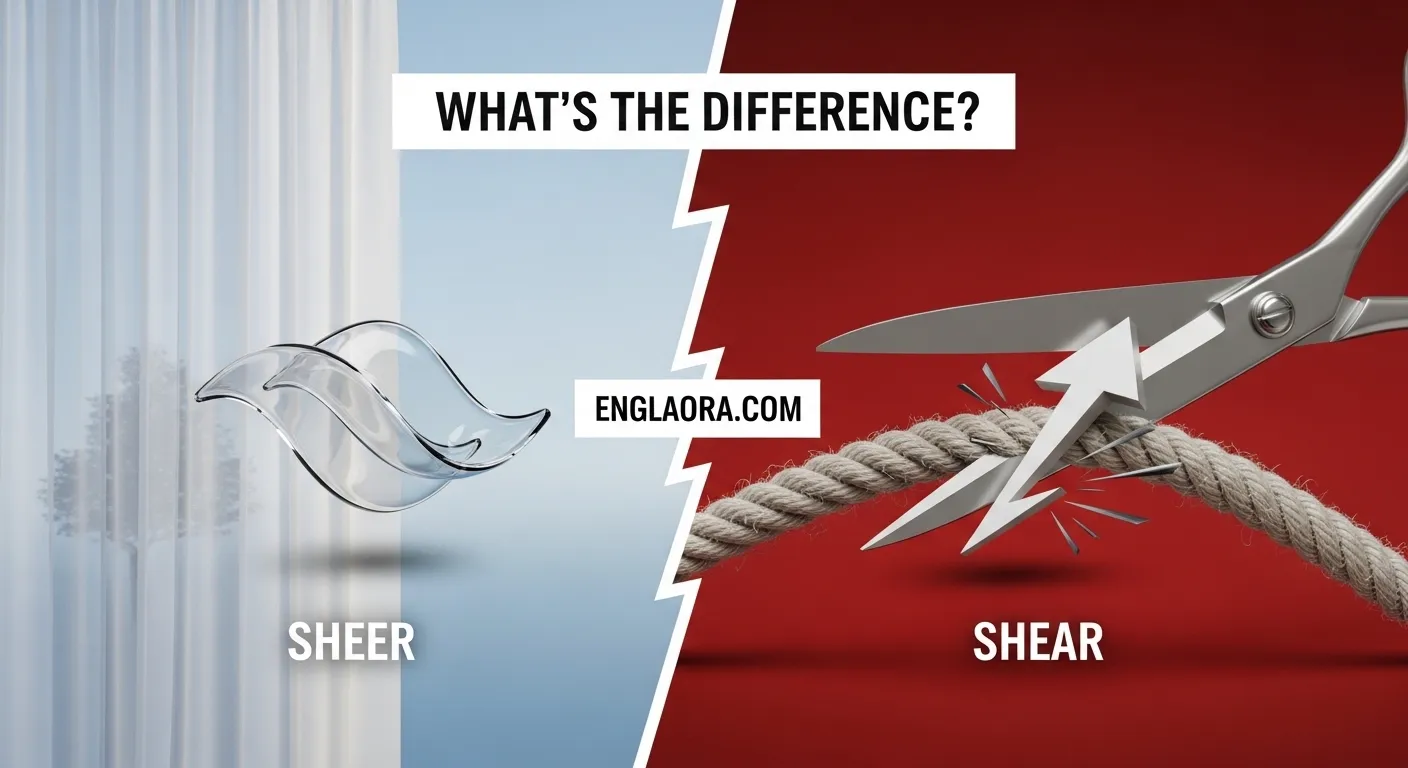
Hey, I want to share something that happened to me recently about sheer or shear.
I was chatting with a friend when one of these words suddenly popped up, and honestly, I had no idea what it meant at first.
I paused for a moment, thinking, “Am I missing something here?” It was a bit confusing, and I didn’t want to reply incorrectly or sound awkward. So, I decided to look into sheer or shear to understand their meanings and how they’re used in real conversations.
Once I figured it out, I realized how important it is to know the difference between these two words to avoid misunderstandings.
Now, whenever I see sheer or shear in chats or on social media, I feel confident responding the right way.
Sheer or Shear – Quick Answer
- Sheer – Means extremely steep, thin, or complete.
- Example: The mountain had a sheer drop.
- Example: She wore a sheer dress.
- Example: The mountain had a sheer drop.
- Shear – Means to cut or clip, especially wool, or to break under pressure.
- Example: Farmers shear sheep every spring.
- Example: The wind can shear branches from trees.
- Example: Farmers shear sheep every spring.
Quick Tip: If you’re describing thinness, steepness, or intensity → use sheer. If you’re describing cutting or breaking → use shear.
The Origin of Sheer or Shear
- Sheer comes from Old English scīr, meaning “pure” or “bright.” It evolved to describe steep surfaces, thin fabrics, and intensity.
- Shear originates from Old English scieran, meaning “to cut.” It is linked to physical actions like cutting, clipping, or slicing.
The spelling differences exist because English borrowed words from different roots, and over time, pronunciation stayed similar, but spelling followed distinct etymological rules.
British English vs American English Spelling
Both sheer and shear are spelled the same in British and American English. However, usage can vary slightly in formal and technical contexts.
| Word | Meaning | British Usage | American Usage |
| Sheer | Steep, thin, complete | Common in writing & speech | Common in writing & speech |
| Shear | Cut, clip, break | Common in farming & engineering | Common in farming & engineering |
Note: There’s no variation in spelling for these words between US and UK; the difference lies mainly in usage frequency and context.
Which Spelling Should You Use?
- If writing for a US audience → use sheer for steepness/intensity, shear for cutting/clipping.
- If writing for a UK/Commonwealth audience → same rules apply; spelling does not change.
- For global or online content → focus on meaning rather than guessing which word looks “right.”
Tip: Always double-check context: a sheer cliff ≠ a shear cliff.
Common Mistakes with Sheer or Shear
- Incorrect: The farmer will sheer the cliff.
Correct: The farmer will shear the sheep. - Incorrect: She wore a shear dress.
Correct: She wore a sheer dress. - Incorrect: The wall had a shear drop.
Correct: The wall had a sheer drop.
Rule of Thumb: If it’s a cutting action, use shear. If it’s about thinness, steepness, or totality, use sheer.
Sheer or Shear in Everyday Examples
- Emails:
“The sheer size of the report surprised me.” - News Articles:
“Strong winds may shear power lines in coastal areas.” - Social Media:
“Can’t believe the sheer beauty of this sunset!” - Formal Writing:
“The engineer calculated the shear stress on the beam.”
Sheer or Shear – Google Trends & Usage Data
- Sheer is more common in lifestyle, fashion, and descriptive writing.
- Shear appears in technical, agricultural, and engineering contexts.
- Popularity is higher in English-speaking countries like the US, UK, Australia, and Canada.
- Search trends show spikes for shear wool and sheer fabric seasonally.
Comparison Table – Sheer vs Shear
| Word | Meaning | Usage Example | Common Contexts |
| Sheer | Steep, thin, complete | She wore a sheer scarf. | Fashion, descriptions, intensity |
| Shear | Cut, clip, break | He will shear the sheep. | Farming, engineering, physics |
FAQs
1. Can I use sheer and shear interchangeably?
No, they have different meanings; using them incorrectly can change your sentence.
2. Is there a US vs UK spelling difference?
No, spelling is the same; only context matters.
3. How do I remember which is which?
Think: shear = cut, sheer = thin/steep/intense.
4. Can “shear” describe emotions?
No, emotional or figurative intensity uses sheer, e.g., sheer joy.
5. Is “sheer” used in technical contexts?
Rarely; mostly in descriptive or figurative writing.
6. Is “shear” only for sheep?
No, it can refer to any cutting or slicing, including metal, wood, or physics.
7. Are there idioms with sheer or shear?
Yes, like sheer luck (sheer) and shear force (shear in physics/engineering).
Conclusion
Understanding sheer or shear is simple once you know the meaning behind each word. Sheer refers to steepness, thinness, or intensity, while shear relates to cutting or breaking. Both words are spelled the same in US and UK English, so context is your guide. Avoid common mistakes by checking whether your sentence describes an action or a description. By following these rules, you can confidently write, edit, and communicate without confusion. Whether you’re working on formal reports, casual social media posts, or creative writing, knowing the difference ensures your message is clear and professional. Always remember: sheer = extreme or thin, shear = cut or break—and you’ll never mix them up again.
Discover More Article’s:
Training vs Trainning: Meaning, Grammar and Usage(2026)
Sceptical or Skeptical: Meaning, Grammar and Usage(2026)
Apologise or Apologize: A Complete Comparison Guide(2026)

I’m Samantha Greene, working at Englaora.com to explain language differences and provide readers with easy-to-understand insights on commonly mistaken terms.