Hey, I want to share something that happened to me recently involving stationary vs stationery.
I was shopping online for office supplies. I typed “stationary” in the search bar. The results showed me yoga mats, bike trainers, and treadmill accessories. I was confused. I just wanted notebooks and pens!
Then I realized my mistake. I had spelled it wrong. It should have been stationery — with an “e.”
For a moment, I felt silly. These two words look almost identical. They even sound exactly the same. But they mean completely different things.
So I decided to look into stationary vs stationery properly. And honestly, I learned a lot. Thousands of people make this same mistake every day.
Some search “stationary vs stationery meaning.” Others ask “are pens stationery or stationary?” or “is it stationary or stationery for kids?”
This confusion is real — and very common.
In this article, I will explain everything clearly. You will learn the correct meaning of each word.
And after reading this, you will never mix them up again.
Let us get started.
Stationary vs stationery – Quick answer
Here is the simplest way to remember the difference:
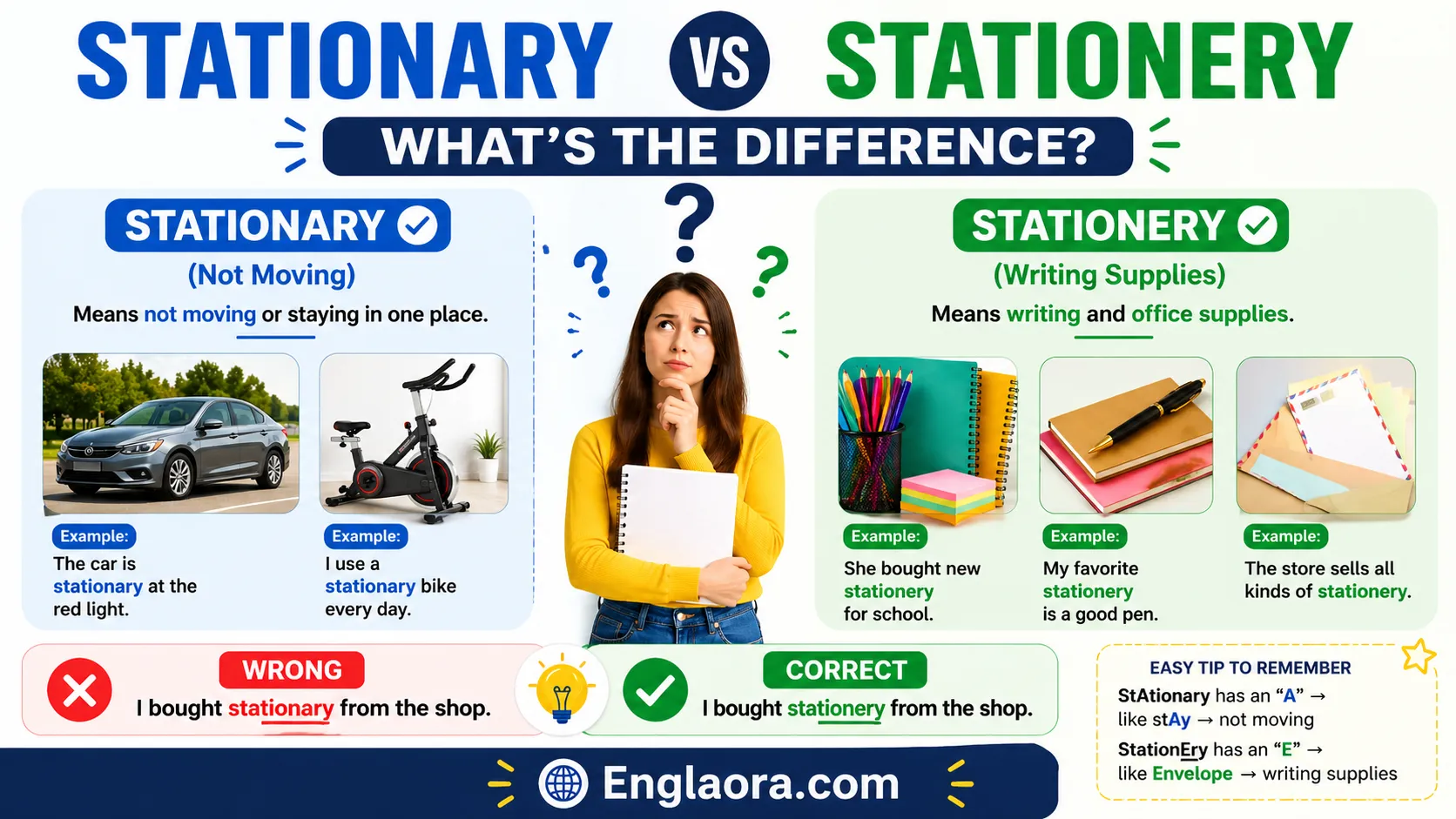
- Stationary (with an A) = not moving, staying in one place
- Stationery (with an E) = writing materials like paper, pens, envelopes, notebooks
Memory Trick:
- Stationary → stay → staying still
- Stationery → envelope → writing supplies
Examples:
- The car was stationary at the red light. (not moving)
- She bought new stationery for her home office. (writing supplies)
- The stationary bike at the gym is broken. (not moving)
- The teacher handed out stationery to every student. (paper and pens)
The origin of stationary vs stationery
Understanding the etymology helps you remember the difference forever.
Stationary comes from the Latin word stationarius, which means “belonging to a military station.” Over time, it evolved to mean “fixed in one place” or “not moving.” It entered English in the early 15th century.
Stationery has a fascinating history. In medieval times, most books and writing materials were sold by traveling merchants — people who moved from town to town. But one type of seller was different. They had a fixed shop near a university or market. They were called a stationer — someone with a permanent station.
These stationers sold manuscripts, parchment, ink, quills, and later, paper. Their goods became known as stationery — things sold by the stationer.
So both words come from the same Latin root: statio (a standing place). But over centuries, they split into two very different meanings:
- One describes a thing that does not move
- The other describes goods sold from a fixed shop
This is also why “stationary and stationery are homophones” — they sound exactly the same but have completely different meanings and spellings.
British English vs American English spelling
Good news: the spelling of both words is the same in British and American English. There is no regional spelling difference.
However, there are differences in usage and terminology:
In the UK:
- “Stationery” is widely used and understood by everyone
- Common items: exercise books, fountain pens, writing paper, envelopes
- British English speakers frequently visit a “stationery shop” or “stationer’s”
In the USA:
- Americans use “stationery” too, but often say “office supplies” instead
- “Stationery store” exists, but “office supply store” is more common
- Many people ask: What do Americans call stationery? — the answer is mostly “office supplies” or just calling items by name (pens, notebooks, paper)
- Interestingly, “What do Americans call toilet paper?” sometimes comes up in stationery searches — the answer is simply “toilet paper” or “bathroom tissue.” It is NOT considered stationery.
Pronunciation: Both “stationary” and “stationery” are pronounced exactly the same: STAY-shuh-nair-ee. This is what makes them true homophones. Searching for “stationary vs stationery pronunciation” will confirm — they sound identical.
Comparison Table: Stationary vs Stationery
| Feature | Stationary | Stationery |
|---|---|---|
| Spelling | S-T-A-T-I-O-N-A-R-Y | S-T-A-T-I-O-N-E-R-Y |
| Part of Speech | Adjective | Noun |
| Meaning | Not moving; fixed in place | Writing and office supplies |
| Origin | Latin stationarius | Latin stationarius (via “stationer”) |
| Example (US) | The escalator was stationary. | She ordered stationery online. |
| Example (UK) | The train remained stationary. | He visited the stationer’s shop. |
| Pronunciation | STAY-shuh-nair-ee | STAY-shuh-nair-ee |
| Homophones? | ✅ Yes | ✅ Yes |
| Plural form | Not applicable (adjective) | Stationery (uncountable noun) |
Which spelling should you use?
The rule is simple. Ask yourself: what am I talking about?
Use STATIONARY when:
- Describing something that is not moving
- Talking about a fixed or still position
- Describing exercise equipment that does not travel (stationary bike, stationary treadmill)
- Answering: Does stationary mean still? → YES
Examples:
- The guard stood stationary at the gate.
- Her eyes remained stationary, fixed on the screen.
- What are examples of stationary objects? → A parked car, a standing person, a building, a rock.
Use STATIONERY when:
- Talking about paper, pens, notebooks, envelopes, stamps
- Referring to writing supplies or office materials
- Answering: What falls under stationery? → pens, pencils, paper, envelopes, notebooks, stamps, ink, folders
Examples:
- The wedding stationery included invitations and thank-you cards.
- Our company ordered branded stationery.
- What are the top 5 stationery items? → Pens, notebooks, sticky notes, envelopes, and paper.
For kids: If you are writing for children and ask is it stationary or stationery for kids? — use “stationery” when talking about school supplies and “stationary” when describing something that is not moving.
Common mistakes with stationary vs stationery
These are the most frequent errors writers make:
| Mistake Type | Wrong ❌ | Correct ✅ |
|---|---|---|
| Shopping/buying | I need to buy stationary. | I need to buy stationery. |
| Describing movement | The train was stationery. | The train was stationary. |
| Store context | A stationary store sells pens. | A stationery store sells pens. |
| Exercise equipment | I ride a stationery bike. | I ride a stationary bike. |
| Office supplies | Please order office stationary. | Please order office stationery. |
| School items | Buy stationery objects for the lab. | Buy stationary objects for the lab. |
Most Common Question
Are pens stationery or stationary?
Pens are stationery — they are writing supplies. They are not stationary (unless they are sitting still on a desk, in which case “stationary” describes their position, not what they are).
Are pencils stationary?
Pencils are stationery items. But a pencil sitting on a desk is in a stationary position.
Are notebooks considered stationary?
Notebooks are stationery items (writing supplies). They are not “stationary” items.
Is paper a stationary item?
Paper is a stationery item, not stationary.
Stationary vs stationery in everyday examples
Here is how both words appear in real life writing:
Email Example:
Subject: Office Supply Order Dear Team, please submit your stationery requests by Friday. We will be ordering pens, notebooks, and envelopes. Note that the delivery van will be stationary in the parking lot from 10 AM to 2 PM for collection.
Social Media Example:
Posted on Instagram: “Just unboxed my new luxury stationery haul 🖊️📓 Obsessed with this aesthetic! Meanwhile my gym life: stationary bike for 30 mins every morning 💪 #stationery #studygram”
News/Formal Example:
The company announced a new line of premium stationery products for corporate clients. The launch event was held at a stationary venue in central London.
Formal/Business Writing Example:
Please note that all company stationery must carry the updated logo. The printer will remain stationary during the calibration process.
What is stationary in a store? What falls under stationery?
This is a very common question. Let us clear it up.
What is stationary in a store?
If a product in a store is “stationary,” it means it is fixed in place — like a display stand, a mounted screen, or a floor unit that does not move.
What is stationery in a store?
A stationery section in a store sells writing and office supplies. Here is what falls under stationery:
- Paper (notebooks, writing pads, printer paper)
- Pens and pencils
- Envelopes and stamps
- Folders and binders
- Sticky notes and index cards
- Ink and correction fluid
- Rulers, scissors, tape
Stationery plural:
“Stationery” is an uncountable noun in English. You do not say “stationeries.” You say “stationery items” or “pieces of stationery.”
What are the two types of stationery?
- Personal stationery : writing paper, personal notecards, letters, wedding invitations
- Corporate/office stationery : letterheads, business envelopes, branded paper, business cards
What is luxury stationery?
Luxury stationery refers to high-end writing materials — handmade paper, gold-foil envelopes, fountain pens, embossed notebooks, and personalized letter sets. Brands like Smythson, Crane & Co., and Papyrus are known for luxury stationery.
Which is the No. 1 stationery brand?
Globally, brands like Moleskine, Leuchtturm1917, Staedtler, and Pilot are among the most recognized stationery brands. In Asia, brands like Muji and Pentel are extremely popular.
Stationary vs stationery – Google Trends and usage data
When we look at global usage patterns, some interesting facts emerge:
- “Stationery” is searched far more often than “stationary” in the context of shopping and office supplies
- “Stationary bike” is one of the most searched “stationary” phrases globally — especially in the US and Australia
- “Stationary vs stationery grammar” spikes during school exam seasons — showing this is a top spelling question for students
- In the UK, searches for “stationery shop” are very high, while in the US, people search more for “office supply store”
- The phrase “stationary and stationery are homophones” is a popular teaching query used by English teachers worldwide
- Searches for “stationary vs stationery etymology” show growing interest in word origins among language learners
- “Stationary meaning and sentence” is frequently searched by ESL (English as a Second Language) learners
What is stationary and non-stationary?
In mathematics and statistics, “stationary” has a technical meaning. A stationary process has constant statistical properties over time. A “non-stationary” process changes over time. This is completely unrelated to writing supplies!
FAQs
Q1. What is the difference between stationary and stationery?
Stationary (A) = not moving. Stationery (E) = writing supplies. Memory tip: stationERy has an E, just like Envelope.
Q2. Are pens stationery or stationary?
Pens are stationery — they are writing tools/supplies. If a pen is sitting still, you could say it is in a stationary position, but pens as objects belong to the stationery category.
Q3. What do Americans call stationery?
Americans mostly call it “office supplies.” A stationery store in the US is often called an “office supply store.” But “stationery” is understood and used, especially for personal writing items.
Q4. Why is stationery called stationery?
It comes from the word “stationer” — a merchant with a fixed shop (a station) who sold writing materials. Their goods became known as “stationery.”
Q5. Are pencils stationary? Are notebooks considered stationary?
No. Pencils and notebooks are stationery items (writing supplies). They are not “stationary.” However, an object sitting still can be described as being in a stationary position.
Q6. Is paper a stationary item?
Paper is a stationery item — it is a writing supply. It is not “stationary” (that word means not moving).
Q7. What are the top 5 stationery items?
Pens/pencils 2. Notebooks 3. Paper/writing pads 4. Envelopes 5. Sticky notes
Q8. What falls under stationery?
Pens, pencils, notebooks, paper, envelopes, folders, stamps, ink, correction fluid, rulers, scissors, tape, and other writing/office supplies.
Q9. Does stationary mean still?
Yes. Stationary means not moving, fixed in place, or remaining in one position.
Example: The bus was stationary for 10 minutes.
Q10. What are examples of stationary objects?
A parked car, a building, a rock, a person standing still, a stationary bike (fixed equipment), a mountain, a desk.
Q11. What is stationery plural?
Stationery is an uncountable noun. It has no plural form.
Say “stationery items” instead of “stationeries.”
Q12. Stationary vs stationery grammar which is adjective and which is noun?
Stationary = adjective (describes a state of not moving).
Stationery = noun (refers to writing materials).
Conclusion
Let us wrap it all up.
Stationary vs stationery is one of the most common spelling confusions in the English language — and it is completely understandable. These two words are true homophones. They sound exactly the same. They look almost identical. But they mean very different things.
Stationary (with an A) is an adjective. It means not moving, fixed, or still. Use it when describing a car at a red light, a person standing in place, or a stationary bike at the gym.
Stationery (with an E) is a noun. It means writing and office supplies — pens, paper, notebooks, envelopes, and more. Use it when shopping, ordering office supplies, or talking about writing materials.
The easiest memory trick: stationERy has an E — just like Envelope. If it is a writing supply, use the E.
Whether you are a student, a teacher, a professional, or someone shopping online — now you know exactly which word to use. No more confusing search results. No more wrong spellings in emails.
Use stationary when something is not moving. Use stationery when you mean pens and paper. It is that simple.
Share this article with anyone who gets these two words mixed up. Good writing always starts with choosing the right word!

I’m Samantha Greene, working at Englaora.com to explain language differences and provide readers with easy-to-understand insights on commonly mistaken terms.