✅ Quick Answer
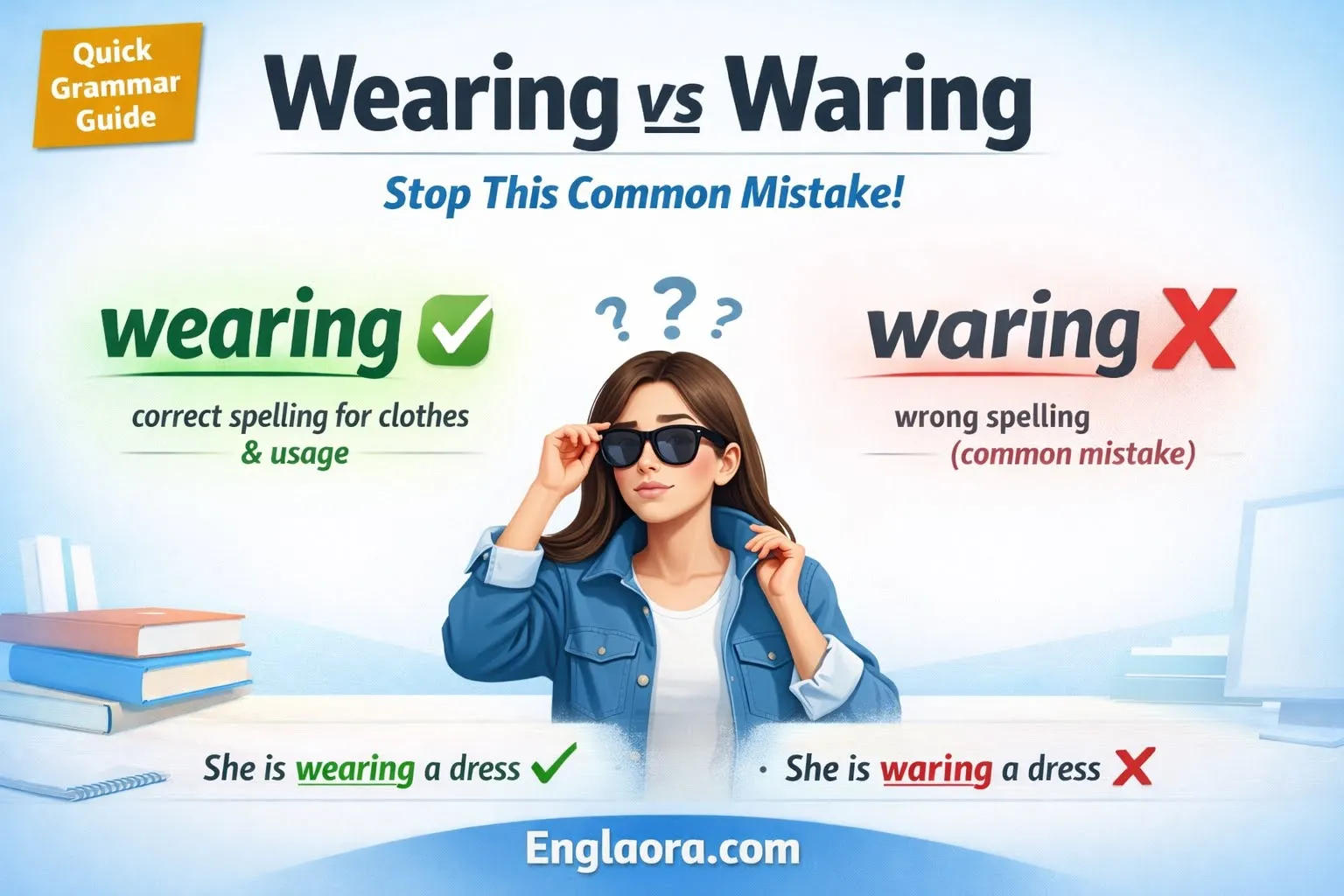
Correct: Wearing
Incorrect: Waring (almost always a spelling mistake)
- ✅ She is wearing a beautiful dress.
- ✅ My shoes are wearing out.
- ❌ She is waring a blue shirt. (Wrong)
Rule: Use wearing for clothes, accessories, or when something slowly gets damaged or tired. “Waring” is rarely correct.
Introduction
Hey, I want to share something that happened to me recently involving wearing or waring. I was chatting with a friend when this word came up. Honestly, I had no idea which one was right.
For a moment, I thought, “Am I missing something here?” It felt confusing. I did not want to reply the wrong way or look clueless.
So, I decided to learn about wearing or waring. I wanted to understand the correct meaning and how to use it properly.
Once I learned it, everything became clear. Now I feel confident using the right word in chats, emails, and social media. This guide will help you too.
Wearing Meaning
Wearing is the present form of the verb “wear.” It has two main uses.
1. Clothes and accessories
- She is wearing jeans and a T-shirt.
- He loves wearing sunglasses.
2. Gradual damage or becoming thin
- The carpet is wearing thin.
- My patience is wearing thin.
Wearing clothes meaning: It means having something on your body right now.
Wearing or Waring Synonym
Synonyms of wearing (clothes):
dressed in, clad in, sporting, having on, rocking
Synonyms of wearing (damage/tiring):
eroding, fraying, thinning, exhausting, tiring, weakening
Examples:
- She is dressed in a red gown.
- He is sporting a new watch.
- I’m rocking my favorite hoodie today.
What Is the Difference Between Wearing / Waring?
Wearing = the correct word for clothes and damage.
Waring = rarely used and usually wrong for clothes.
Wearing or waring grammar:
Always use wearing unless you are talking about a person named Waring.
Is it wearing or waring?
99% of the time, the correct answer is wearing.
The Origin of Wearing
“Wearing” comes from old English. It first meant “to carry on the body.” Later, it also meant slow damage. That is why waring feels like a common mistake today.
British English vs American English Spelling
| Form | British English | American English | Status |
|---|---|---|---|
| Wearing | Correct | Correct | ✅ Always correct |
| Waring | Rare / Wrong | Rare / Wrong | ❌ Usually wrong |
| Warring | Correct | Correct | Fighting (different meaning) |
Both British and American English use wearing for clothes and damage.
Which Spelling Should You Use?
- Use wearing in global English.
- Never use waring for clothes.
- Use warring only for fighting.
Final advice: If it is about clothes or something getting old or thin, use wearing.
Pronunciation of Wearing or Waring
Let’s learn how to say these words.
Wearing
/wair-ing/
Sounds like: wair-ing
Example: She is wearing a red dress.
Waring
/wair-ing/ (same sound)
It sounds the same but is usually the wrong spelling.
Warring
/wor-ring/
Sounds like: wor-ring
Meaning: fighting
Example: The two countries are warring.
Quick Tip:
- Wearing → clothes, damage, or feeling tired
- Waring → avoid
- Warring → fighting
Common Mistakes with Wearing or Waring
Here are common errors:
- ❌ She is waring a red scarf.
✅ She is wearing a red scarf. - ❌ The tires are waring out.
✅ The tires are wearing out. - Is it wear or ware for damage?
✅ Use wear or wearing. “Ware” means products (like kitchenware).
Memory tip: “Wear” has “ear” — like “hear” what someone is wearing.
Wearing or Waring – Google Trends & Usage Data
People often search “wearing or waring meaning” and “is it wearing or waring”.
These searches are very common in India, Pakistan, USA, UK, Canada, and Nigeria.
People get confused because the words sound the same. The confusion grows during exams and while writing posts.
Wearing or Waring Grammar Rules
Here are simple rules:
- Wearing is used for things happening now.
Example: She is wearing a black dress. - Use wore for past.
Example: She wore a black dress yesterday. - Use were wearing for past continuous.
Example: They were wearing uniforms. - Never use waring for clothes.
- Wearing can also mean slow damage.
Example: The fabric is wearing out.
Quick Grammar Tip: If it is about clothes or getting tired, use wearing.
Wearing or Waring in Everyday Examples
- Email:
- The team is wearing casual clothes on Friday.
- Social Media:
- Just wearing my favorite hoodie today 😊
- News:
- The bridge is wearing down.
- Wearing or waring on me:
- This noise is wearing on me.
- Wearing out meaning:
- My shoes are wearing out.
Correct sentence: What are you wearing today?
Wrong sentence: What are you waring today?
Wearing Thin – Special Idiom
What does wearing thin mean?
It means something is becoming weak or boring.
- My patience is wearing thin.
- That joke is wearing thin now.
What does wearing mean tiring?
It means something slowly makes you tired.
Comparison Table
| Word | Meaning | Example | Correct? |
|---|---|---|---|
| Wearing | Clothes / gradual damage | She is wearing a coat. | ✅ Yes |
| Waring | Usually wrong | (Almost never used) | ❌ No |
| Warring | Fighting | Warring countries signed a treaty. | ✅ Yes |
| Ware | Goods | Kitchenware is on sale. | ✅ Yes |
FAQs
Q1: Wearing or waring meaning?
Wearing = clothes or damage. Waring = almost always wrong.
Q2: What is the difference between wearing and waring?
Wearing is correct. Waring is a common mistake.
Q3: Is it waring or wearing thin?
It is wearing thin.
Q4: What is the meaning of wearing?
To have clothes on, or something slowly getting damaged.
Q5: What is the meaning of waring?
Usually a wrong spelling. Not used for clothes.
Q6: How do you say “wearing”?
It sounds like “wair-ing.”
Q7: Is it wearing or warring?
Wearing = clothes. Warring = fighting.
Q8: What does waring out mean?
It should be wearing out.
Q9: Were wearing or wore?
“Were wearing” = past continuous. “Wore” = simple past.
Q10: What is the use of wearing?
It describes clothes you have on now or something slowly getting damaged.
Conclusion
Understanding wearing or waring is easy. Just remember: wearing is the correct spelling for clothes and slow damage. “Waring” is almost always a mistake.
Now you can write with confidence. You will avoid errors and sound professional in messages, posts, and emails.
Final Tip: When in doubt, ask: “Is this about clothes or damage?” If yes — use wearing.

Hi, I’m Emma Caldwell, an expert author at Englaora.com. I share clear insights on language differences and provide readers with reliable, easy-to-understand content.