Raise or rise is one of the most common grammar confusions in English. Hey, I want to share something that happened to me recently involving raise or rise.
I was in a meeting when my manager said, “We will raise the targets next quarter.” For a second I thought, “Is it raise or rise?” I stayed quiet because I didn’t want to sound confused.
Later that day, a friend asked, “Did your salary rise this year?” Again, the same doubt hit me. This guide explains raise or rise meaning, rules, and real-life raise or rise examples clearly.
This small confusion creates awkward moments in professional talks, job interviews, and writing.
So I decided to dig deep into their differences and correct usage. After understanding it clearly, everything became simple.
This guide will remove all your confusion with easy explanations, real examples, and practical tips.
Raise vs Rise – Quick Answer
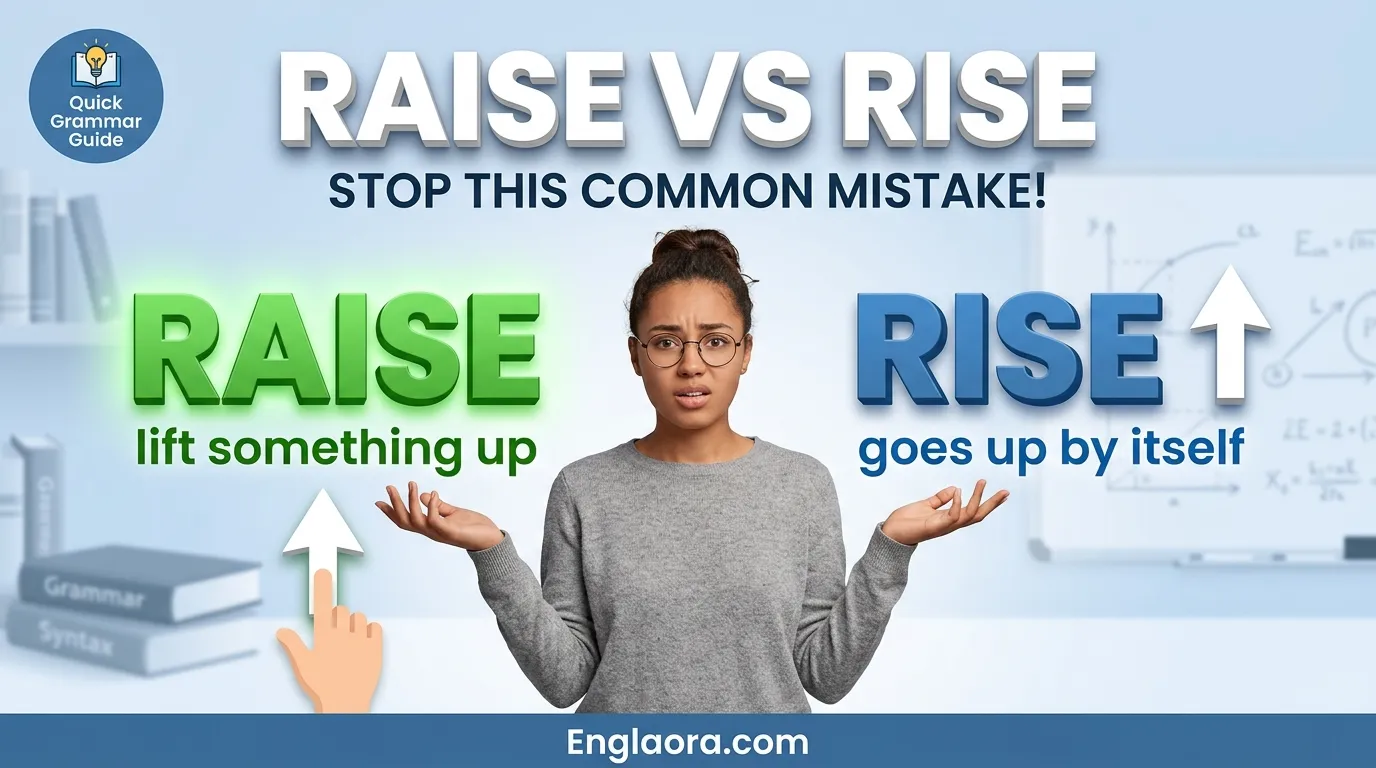
Rise = goes up by itself (no object)
Raise = you lift something (needs an object)
Simple Rule:
- If it happens naturally → rise
- If someone causes it → raise
Examples:
✅ The sun rises in the east.
✅ Please raise your hand.
Raise or Rise Pronunciation
Many learners search for “raise or rise pronunciation” to understand the sound difference clearly.
| Word | Pronunciation (IPA) | Sounds Like | Audio Tip |
|---|---|---|---|
| Rise | /raɪz/ | “ryze” | Long “i” sound like in “eyes” |
| Raise | /reɪz/ | “rayz” | Long “a” sound like in “day” |
Key Difference:
- Rise rhymes with eyes, size, prize
- Raise rhymes with days, ways, praise
Examples in Sentences:
- The sun rises (/raɪzɪz/) every morning.
- Please raise (/reɪz/) your hand if you understand.
Raise or Rise Meaning
Rise is an intransitive verb – it moves upward by itself.
Raise is a transitive verb – someone causes it to move up.
Examples:
- The balloon rises in the sky.
- I raise the balloon higher.
Raise vs Rise Difference
The raise vs rise difference is simple:
👉 Rise happens naturally (no object)
👉 Raise is done by someone (needs an object)
Example:
- Prices rise.
- Companies raise prices.
When to use raise or rise?
When to use raise or rise?
- Use rise when there is no object:
The economy rises. The level rises. The sun rises. - Use raise when there is an object:
Raise the flag. Raise taxes. Raise your voice.
Is it rise or raise my salary?
Correct: “Will my salary rise?” or “Will they raise my salary?”
Is it rise or raise the level?
→ Raise the level (you do it).
→ The level rises (it happens itself).
Is it rise or raise prices?
Companies raise prices. Prices rise.
Raise vs Rise grammar rules
Raise vs Rise grammar rules are simple:
- Rise = Intransitive verb (subject does the action alone)
- Raise = Transitive verb (needs an object)
You cannot say “rise something” — it is grammatically wrong.
Raise vs Rise examples
Raise vs Rise examples in daily life:
- The bread rises nicely in the oven.
- Can you raise your voice a bit?
- She watched the sun rise from the hill.
- Students must raise their hands.
- There is a rise in prices.
- I got a raise in my salary (American English).
How to use raise and rise in a sentence?
How to use raise and rise in a sentence? Here are useful examples:
- The cake rises beautifully when baked.
- Please raise your hand if you have a question.
- Inflation continues to rise every month.
- The manager decided to raise the salary of top performers.
- Don’t raise your voice at me.
Raise or Rise Noun
- Rise (noun) = An increase
Example: There was a sharp rise in temperature. - Raise (noun) = Salary increase (mainly American English)
Example: I asked my boss for a raise.
Raise or Rise Voice / Hand / Issue
- Raise your voice (correct)
- Raise your hand (correct)
- Raise an issue (correct)
The Origin of Raise and Rise
Rise comes from Old English “risan” (to get up).
Raise comes from Old Norse “reisa” (to cause to rise).
This history explains why rise is automatic and raise needs action.
British English vs American English
| Form | British English | American English |
|---|---|---|
| Salary increase | Pay rise | Pay raise |
| Verb rules | Same | Same |
Common Mistakes with Raise or Rise
- Wrong: Please rise your hand.
Right: Please raise your hand. - Wrong: They will rise the prices.
Right: They will raise the prices. - Wrong: I got a good salary rise. (in US)
Right: I got a good raise.
Raise or Rise in Everyday Examples
Email: “I would like to request a raise in my salary.”
Social Media: “Nothing beats watching the sun rise 🌅”
News: “Inflation continues to rise as the government raises taxes.”
Formal: “We need to raise this issue in tomorrow’s meeting.”
Raise or Rise – Google Trends & Usage Data
“Raise or rise” searches are very high in India, Pakistan, USA, and UK, especially during job seasons and English exams. People also search raise or rise quiz and how to use raise and rise.
🧠 Quick Practice (Test Yourself)
Choose the correct word (rise or raise):
- The sun __ every morning.
- Please __ your hand if you know the answer.
- Prices __ quickly during festivals.
- They want to __ the prices next month.
- The dough will __ after two hours.
Answers: rises | raise | rise | raise | rise
FAQs
Q1: What is the difference between rise and raise with examples?
Rise = moves by itself. Raise = someone lifts it.
Q2: How do you use rise and raise?
Rise (no object), Raise (with object).
Q3: Is it rise or raise in salary?
Both: “My salary will rise” or “They will raise my salary.”
Q4: Raise or rise an issue?
Raise an issue.
Q5: What’s an easy trick to remember raise vs rise?
“Rise = stands alone. Raise = needs help (an object).”
Q6: Are raise and rise synonyms?
Not exactly — similar meaning but different grammar.
Q7: Raise or rise quiz
Practice the questions given above.
Conclusion
Now you fully understand raise or rise — including raise vs rise difference, raise vs rise grammar, correct pronunciation, and real-life usage. Remember: Rise happens by itself, Raise is caused by someone. Pay attention to the object and the vowel sound (/raɪz/ vs /reɪz/) when speaking.
This knowledge will make your English much clearer in meetings, emails, exams, and daily conversations. Keep practicing with real examples and you’ll never mix them up again!
Final Tip: Ask yourself — “Is there an object?” If yes → raise. If no → rise.

I’m Samantha Greene, working at Englaora.com to explain language differences and provide readers with easy-to-understand insights on commonly mistaken terms.