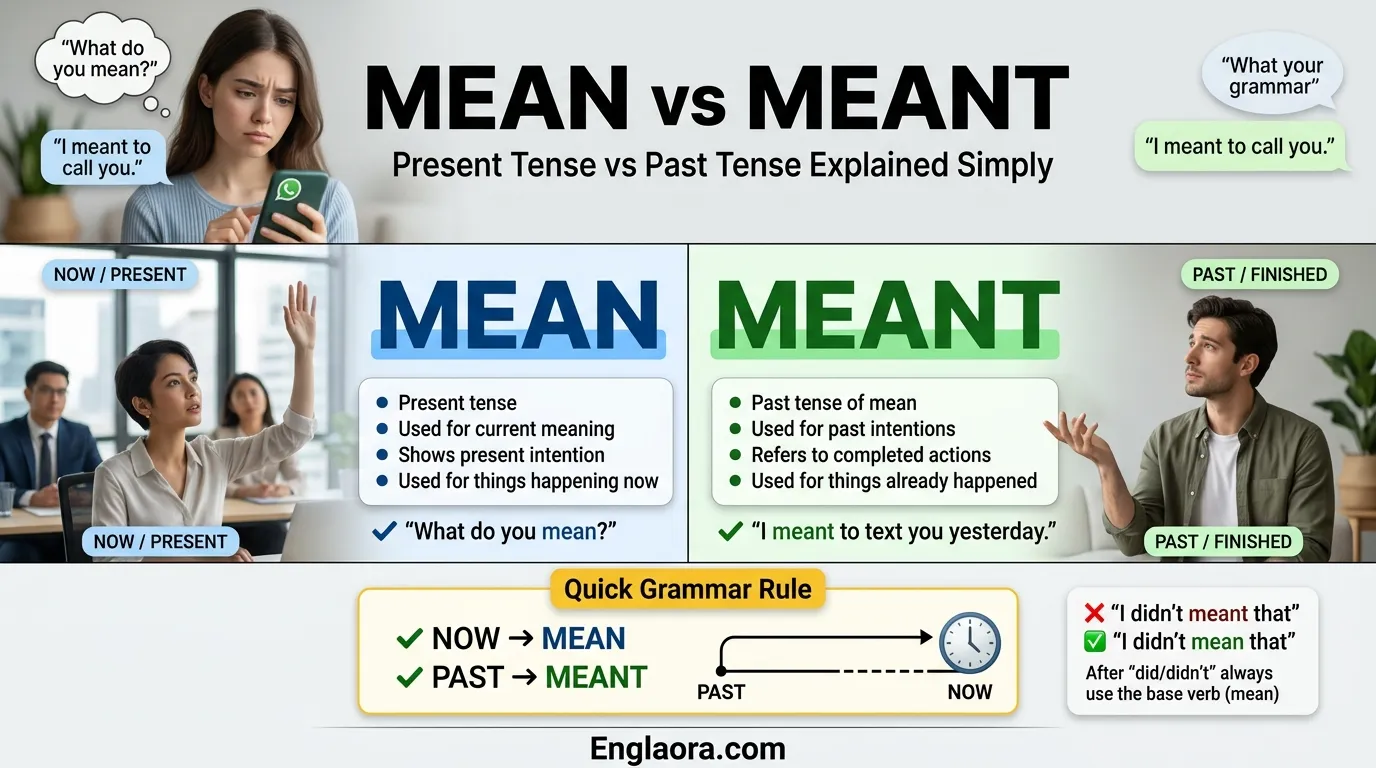
Hey, I want to share something that happened to me recently involving mean or meant. I was chatting with a friend on WhatsApp when she wrote, “I didn’t mean to hurt you.”
For a moment, I paused and started thinking, “Wait… should it be mean or meant here?”
Both words look very similar and are closely connected in meaning, which makes them confusing for many English learners. I didn’t want to misunderstand the sentence or reply incorrectly.
Questions like “Should I use mean or meant?”, “mean or meant past tense”, “mean or meant in a sentence”, and “I didn’t mean or meant” are extremely common online.
Many people struggle with these words while writing messages, emails, essays, or even speaking in daily conversations.
The confusion usually happens because mean and meant come from the same verb but are used in different tenses.
One is used for the present, while the other refers to the past. A small mistake can make your sentence grammatically incorrect or confusing.
So, I decided to properly understand the difference. I studied their meanings, grammar rules, pronunciation, sentence structure, verb forms, and everyday usage.
Once everything became clear, using these words felt much easier.
If you’ve ever been confused about mean or meant, this detailed guide will make everything simple for you.
Mean or Meant – Quick Answer
Here’s the simple answer:
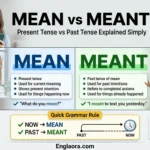
- Mean = present tense
- Meant = past tense and past participle
You use mean when talking about something happening now, something general, or a current intention.
You use meant when talking about something that already happened in the past.
Quick Examples:
Present Tense (Mean):
- “What do you mean?”
- “I mean what I say.”
- “I mean it from the bottom of my heart.”
Past Tense (Meant):
- “I meant to call you yesterday.”
- “She meant every word she said.”
- “I never meant to upset you.”
Simple Rule to Remember
If the action is happening now → use mean
If the action already happened → use meant
Think of it like this:
| Time | Correct Word |
|---|---|
| Present / Now | Mean |
| Past / Finished | Meant |
This one simple rule solves most confusion instantly.
Meaning of Mean and Meant
Although these words come from the same root verb, their meanings depend on time and sentence context.
Mean Meaning (Present Tense)
Mean is the base form (V1) of the verb. It is mostly used in the present tense and has two major meanings:
1. To Intend Something
When you mean something, you intend to do it or truly feel it.
Examples:
- “I mean to finish my homework tonight.”
- “I mean what I say.”
- “Do you really mean that?”
In these examples, mean shows present intention.
2. To Explain or Show Meaning
Mean is also used when asking for clarification or explanation.
Examples:
- “What does this word mean?”
- “What do you mean by that?”
- “This sign means danger.”
In this situation, the word refers to explanation or significance.
Common Expressions Using “Mean”
You will often hear phrases like:
- I mean it → I am serious
- What do you mean? → Explain yourself
- You mean a lot to me → You are important to me
These are very common in spoken English.
Meant Meaning (Past Tense)
Meant is the past tense (V2) and past participle (V3) of mean.
It is used when you talk about something that was intended, explained, or felt in the past.
Examples:
- “I meant to call you yesterday.”
- “She meant well.”
- “I never meant to hurt you.”
In these examples, the intention already happened in the past.
What Does “Meant For You” Mean?
When something is meant for you, it means it was intended or designed specifically for you.
Example:
- “This gift was meant for you.”
Meaning: The gift was specially intended for you.
Another example:
- “Maybe this opportunity was meant for you.”
Meaning: It was destined or intended for you.
Key Difference Between Mean and Meant
The easiest way to understand the difference is to focus on time.
| Word | Tense | Usage |
|---|---|---|
| Mean | Present | Current intention or explanation |
| Meant | Past | Previous intention or explanation |
Example Comparison:
✔ Present:
“I mean what I say.”
✔ Past:
“I meant what I said.”
See the difference?
The first sentence talks about something happening right now, while the second talks about something that happened earlier.
Quick Memory Trick
Ask yourself:
“Is this happening now or already finished?”
- Happening now → mean
- Already happened → meant
This trick helps avoid confusion instantly.
Mean or Meant Grammar Rules
Grammar becomes much easier once you understand verb forms.
Verb Forms of Mean
| Form | Word |
|---|---|
| Base Form (V1) | Mean |
| Past Tense (V2) | Meant |
| Past Participle (V3) | Meant |
Present Tense Examples
- “I mean every word.”
- “What do you mean?”
- “They mean business.”
Past Tense Examples
- “I meant to text you.”
- “She meant no harm.”
- “He meant well.”
Present Perfect Examples
- “I have meant to talk to you.”
- “She has always meant a lot to me.”
Past Perfect Examples
- “I had meant to visit earlier.”
Understanding verb forms helps you avoid grammar mistakes in speaking and writing.
Mean or Meant Past Tense
One of the biggest questions learners ask is:
What is the past tense of mean?
The correct answer is:
✅ Meant
❌ Mean (incorrect for past)
Correct Examples:
- “I meant to send the email.”
- “She meant what she said.”
Wrong Example:
❌ “I mean to call you yesterday.”
Correct Version:
✔ “I meant to call you yesterday.”
Always remember:
Past action = meant
I Didn’t Mean or Meant?
This is one of the most common grammar confusions.
People often write:
❌ “I didn’t meant to hurt you.”
But this is incorrect.
Correct Sentence:
✔ “I didn’t mean to hurt you.”
Why?
Because after did or didn’t, English grammar uses the base verb (V1).
That means:
Did + mean ✔
Did + meant ❌
More Examples:
✔ “I didn’t mean that.”
✔ “Did you mean to say this?”
✔ “She didn’t mean to offend anyone.”
Easy Rule:
After did/didn’t → always use MEAN
Mean or Meant in a Sentence
One of the best ways to understand confusing grammar words is by seeing them in real sentences. Once you start noticing context, choosing between mean and meant becomes much easier.
Sentences Using “Mean” (Present Tense)
Use mean when talking about something happening now, something general, or your present intention.
Examples:
- “What do you mean by that?”
- “I mean what I say.”
- “I mean to finish this project today.”
- “This word means something different in English.”
- “You really mean a lot to me.”
- “Do you mean that seriously?”
In all these examples, the speaker is talking about the present moment or a general truth.
Sentences Using “Meant” (Past Tense)
Use meant when talking about intentions, emotions, or actions from the past.
Examples:
- “I meant to call you yesterday.”
- “She meant every word she said.”
- “He meant no harm.”
- “I never meant to upset anyone.”
- “That gift was meant for you.”
- “The meeting was meant to start at 10 a.m.”
These examples refer to something that already happened.
Mean vs Meant Sentence Comparison
Sometimes seeing both words side by side makes the difference easier to understand.
| Present (Mean) | Past (Meant) |
|---|---|
| I mean what I say. | I meant what I said. |
| What do you mean? | What did you mean? |
| I mean to help you. | I meant to help you. |
| You mean a lot to me. | You meant a lot to me. |
Notice how the tense changes depending on time.
Meant Pronunciation
Many learners also struggle with meant pronunciation, especially because English spelling can be confusing.
How Is “Meant” Pronounced?
Meant is pronounced as:
/mɛnt/
It sounds like:
“ment”
It rhymes with words such as:
- went
- sent
- bent
- rent
A common mistake is pronouncing it as:
❌ “mee-ant”
❌ “me-ant”
These are incorrect.
Pronunciation Practice
Try saying these sentences aloud:
- “I meant to help you.”
- “I never meant that.”
- “She meant well.”
Repeating these naturally improves pronunciation confidence.
The Origin of Mean and Meant
Understanding where words come from can make them easier to remember.
The word mean comes from the Old English word “mænan”, which originally meant:
- to intend
- to signify
- to express meaning
Over time, English developed meant as the past form of the same verb.
That is why both words are closely connected but used in different tenses.
Even after hundreds of years, their meanings have stayed mostly the same.
This historical connection explains why they look similar but function differently in grammar.
British English vs American English Spelling
A lot of learners wonder:
Is there a spelling difference between British and American English?
The answer is:
No.
Unlike some English words that change spelling between regions, mean and meant stay exactly the same everywhere.
If you are writing in:
- the UK
- the US
- Canada
- Australia
- Pakistan
- India
…the spelling rules remain identical.
Comparison Table
| Word | Form | Tense | Example | Region |
|---|---|---|---|---|
| Mean | Base Form (V1) | Present | “I mean it.” | UK + US |
| Meant | V2 & V3 | Past | “I meant it.” | UK + US |
This makes learning easier because you do not need to memorize different spellings.
Which Spelling Should You Use?
If you still feel confused, here’s the easiest shortcut.
Use Mean When:
✔ Talking about the present
✔ Explaining something
✔ Showing current intention
Examples:
- “What do you mean?”
- “I mean what I say.”
- “I mean to study tonight.”
Use Meant When:
✔ Talking about the past
✔ Describing previous intentions
✔ Referring to completed situations
Examples:
- “I meant to text you.”
- “She meant no harm.”
- “The joke was meant to be funny.”
Quick Rule Box
Talking about NOW → Mean
Talking about the PAST → Meant
After did/didn’t → Always Mean
This simple formula solves most grammar mistakes instantly.
Common Mistakes with Mean or Meant
Because these words are closely related, learners often mix them up.
Here are some of the most common mistakes:
Mistake #1: Wrong Past Tense
❌ “I mean to call you yesterday.”
✔ Correct:
“I meant to call you yesterday.”
Why? Because yesterday = past.
Mistake #2: Using “Meant” After Didn’t
❌ “I didn’t meant that.”
✔ Correct:
“I didn’t mean that.”
Why? After did/didn’t, we always use the base verb.
Mistake #3: Forgetting Time Context
❌ “I meant what I say.”
✔ Correct:
“I mean what I say.”
Why? Because the sentence refers to a current feeling.
Pro Tip:
Whenever confused, ask:
“Am I talking about now or the past?”
The answer usually gives you the correct word immediately.
Mean or Meant in Everyday Examples
Here’s how these words appear naturally in real life.
WhatsApp / Chat Example
“I didn’t mean to ignore your message.”
Email Example
“I meant to send the report earlier. Sorry for the delay.”
Social Media Example
“What do you mean by this post?”
School Example
“The teacher meant to explain the topic but ran out of time.”
Office Example
“The email was meant for another department.”
Seeing real-life situations makes grammar easier to remember.
Mean or Meant – Why Do People Search It?
The phrase mean or meant gets searched a lot because many learners struggle with:
- past tense confusion
- negative sentence grammar
- pronunciation mistakes
- sentence formation
- speaking confidently
People often search:
- mean or meant past tense
- I didn’t mean or meant
- what do you mean grammar
- mean or meant examples
- meant pronunciation
This confusion is normal because English verbs often change forms in ways that feel tricky at first.
The good news is that once you learn the time rule, the confusion becomes much easier.
FAQs
Q1: Should I use mean or meant?
Use mean for present situations and meant for past situations.
Q2: What is the past tense of mean?
The correct past tense is meant.
Q3: Is it “I didn’t mean” or “I didn’t meant”?
Correct grammar is:
✔ I didn’t mean
Because after didn’t, we always use the base verb.
Q4: What is the difference between “I mean it” and “I meant it”?
I mean it = I am serious right now.
I meant it = I was serious in the past.
Q5: What does “meant to say” mean?
It means you intended to say something but either said it differently or forgot to say it correctly.
Example:
“I meant to say thank you.”
Q6: Is “meant” grammatically correct?
Yes, meant is completely correct when used for past actions or intentions.
Q7: How do you pronounce meant?
It is pronounced:
/mɛnt/ → sounds like “ment”
Q8: What is an example of meant?
Example:
“I meant to help you.”
Conclusion
Understanding the difference between mean or meant becomes easy once you focus on time and tense.
If you are talking about something happening now, a general meaning, or a current intention, mean is the correct choice. If you are talking about something that already happened in the past, then meant is the right word.
Many English learners confuse these words because they look and sound similar, but one simple rule can solve the problem forever:
Present = Mean
Past = Meant
The more you practice using these words in conversations, messages, emails, and writing, the more natural they will feel. Small grammar improvements like this can make a huge difference in your confidence and communication skills.
Now, whenever you see mean or meant, you will know exactly which one to choose—and why.

I’m Samantha Greene, working at Englaora.com to explain language differences and provide readers with easy-to-understand insights on commonly mistaken terms.