Hey, I want to share something that happened to me recently involving allusion or illusion.
I was reading a novel with a friend. She pointed to a line and said,
“That’s a great illusion.”
I nodded at first.
But then I paused.
Wait… did she mean allusion? Or illusion?
Were they even different words?
I honestly had no idea.
They sounded almost the same. They even looked similar on the page. For a moment, I thought I had probably been using one of them incorrectly for years.
So I looked it up.
Turns out, these two words have completely different meanings.
One is a figure of speech used in literature and writing.
The other describes something fake, misleading, or unreal that tricks the eyes or mind.
No wonder people confuse them.
Thousands of people search questions like:
- allusion or illusion meaning
- difference between allusion and illusion
- allusion and illusion sentence examples
- allusion vs illusion pronunciation
- allusion or illusion quiz
If you have ever felt confused too, this guide will clear everything up.
You will learn the meaning, pronunciation, examples, differences, and exactly when to use each word.
Let us clear it up once and for all.
Allusion or Illusion – Quick Answer
Here is the simple answer:
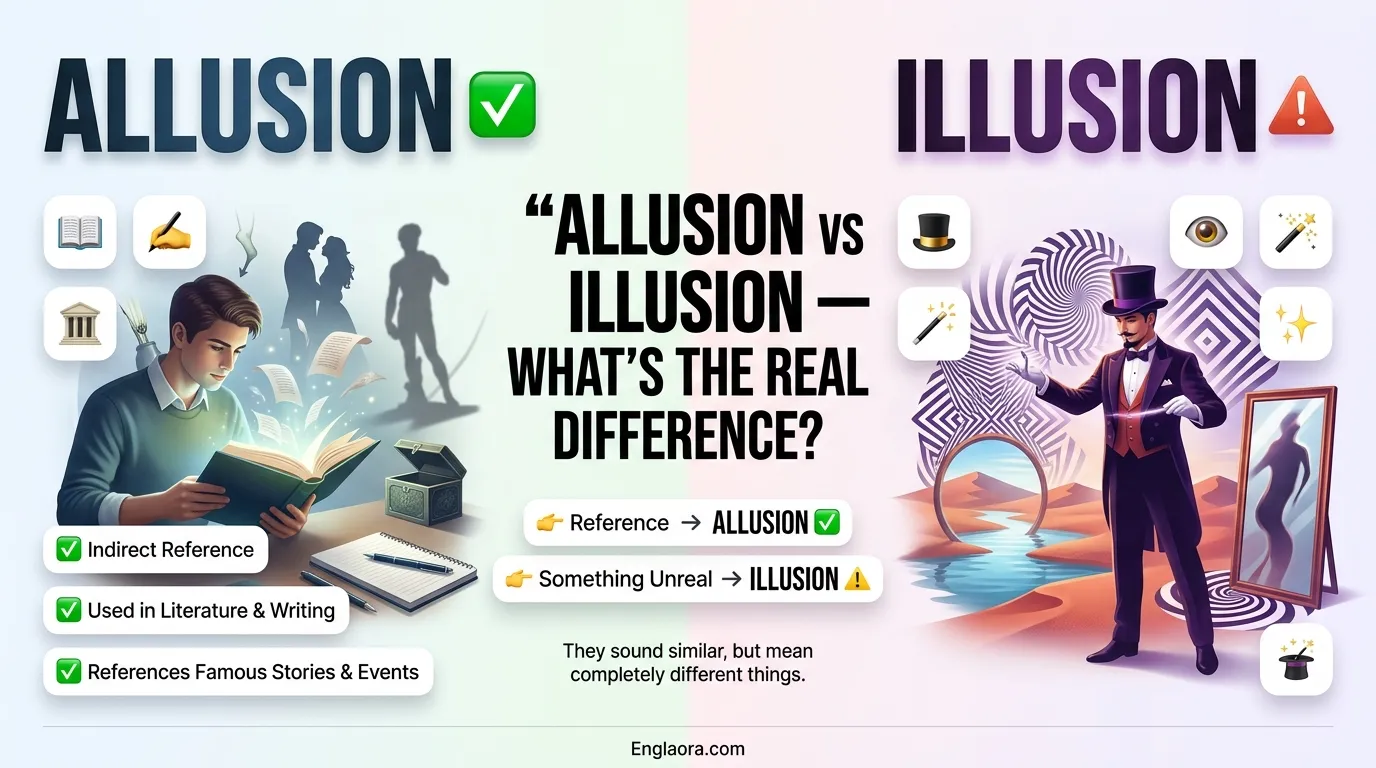
Allusion ✅
An allusion is an indirect reference to something famous.
It could refer to:
- A person
- A historical event
- A book or movie
- A myth or religious story
Example:
“He met his Waterloo.”
This is an allusion to Napoleon’s defeat at Waterloo.
Illusion ✅
An illusion is something unreal or misleading.
It tricks:
- The eyes
- The mind
- Perception
Example:
“The magician created an amazing illusion.”
Simple rule:
👉 Allusion = reference
👉 Illusion = something unreal
If you are referring to something famous → use allusion.
If something only appears real → use illusion.
Allusion or Illusion Meaning
Understanding the meaning of these words makes the difference much easier to remember.
What does allusion mean?
An allusion is an indirect reference to something well known.
Writers use allusions to add deeper meaning without explaining everything directly.
This could include:
- Historical events
- Literature
- Movies
- Myths
- Religion
- Famous people
Examples of allusion:
“He is a real Romeo.”
Reference to Shakespeare’s Romeo
“She opened Pandora’s box.”
Reference to Greek mythology
“This project became his Waterloo.”
Reference to Napoleon’s defeat
Allusions work best when readers recognize the reference.
What does illusion mean?
An illusion is something that appears real but is actually false or misleading.
It may trick:
- Your eyes (optical illusion)
- Your thinking (mental illusion)
- Your emotions (emotional illusion)
Examples of illusion:
“The desert heat created the illusion of water.”
“The mirror created an illusion of extra space.”
“His confidence was only an illusion.”
Easy way to remember:
👉 Allusion = reference
👉 Illusion = false appearance
Allusion vs Illusion Pronunciation
Many people confuse these words because they sound very similar.
Here is the correct pronunciation:
Allusion
uh-LOO-zhun
/əˈluː.ʒən/
Illusion
ih-LOO-zhun
/ɪˈluː.ʒən/
The biggest difference is the first sound.
- Allusion → starts with “uh”
- Illusion → starts with “ih”
It is only a tiny sound difference, which is why many people accidentally spell the wrong word.
Pronunciation tip:
Say these together:
Allusion = a reference
Illusion = not real
Practicing them side by side makes them easier to remember.
Difference Between Allusion and Illusion
Although these words look and sound similar, they mean completely different things.
| Feature | Allusion | Illusion |
|---|---|---|
| Meaning | Indirect reference | Something unreal or deceptive |
| Used in | Literature, speeches, essays | Magic, psychology, everyday life |
| Purpose | Add deeper meaning | Trick the eyes or mind |
| Example | “Achilles’ heel” | Optical illusion |
Quick examples:
Allusion:
“The speech made an allusion to Martin Luther King Jr.”
Illusion:
“The stage lights created an illusion of floating.”
Easy memory trick:
Ask yourself:
Am I referring to something famous?
Use allusion ✅
Does it seem fake or unreal?
Use illusion ✅
Example using both words:
“The story makes an allusion to Plato’s Cave while creating the illusion of a perfect society.”
This sentence shows both words used correctly together.
The Origin of Allusion or Illusion
Even though these words sound alike, they come from completely different roots.
Where does allusion come from?
Allusion comes from the Latin word alludere, meaning:
“to refer to” or “to play with”
It entered English during the 16th century and became common in literature and speech.
Writers used it to indirectly reference famous stories, myths, and historical events.
Where does illusion come from?
Illusion comes from the Latin word illudere, meaning:
“to deceive” or “to mock”
It entered English earlier, around the 14th century.
From the beginning, it described things that trick the mind or create false appearances.
This is why magicians create illusions, not allusions.
A small note about elusion
You may sometimes see the word elusion.
It means:
escaping or avoiding something
Example:
“His elusion of responsibility frustrated everyone.”
However, this word is rare.
For most people, understanding allusion and illusion is enough.
British English vs American English
Good news:
There is no spelling difference between British and American English.
Both countries spell these words the same way.
✅ Allusion
✅ Illusion
However, usage can vary slightly.
🇺🇸 American English
Allusion is very common in:
- School essays
- Journalism
- Literature classes
Example:
“The speech made an allusion to Martin Luther King Jr.”
🇬🇧 British English
Illusion often appears in:
- Literature
- Philosophy
- Art criticism
Example:
“The painting creates an illusion of depth.”
Comparison table
| Word | Meaning | Used In |
|---|---|---|
| Allusion | Indirect reference | Global |
| Illusion | Something unreal | Global |
| Elusion | Escape or avoidance | Rare |
Which Word Should You Use?
The rule is actually simple.
Use allusion when:
You are indirectly referencing:
- A book
- A movie
- A myth
- A historical event
- A famous person
Example:
“His success story is a real Cinderella tale.”
This sentence contains an allusion.
Use illusion when:
Something seems real but is not.
Example:
“The mirrors created the illusion of endless space.”
Use illusion for:
- Magic tricks
- Optical effects
- False beliefs
- Misleading appearances
Quick rule to remember:
👉 Reference = Allusion
👉 Not real = Illusion
Common Mistakes with Allusion or Illusion
These are the most common mistakes people make.
❌ Mistake 1: Using illusion instead of allusion
Wrong:
“The poem contains many illusions to Greek mythology.”
Correct:
“The poem contains many allusions to Greek mythology.”
Because literature uses allusions, not illusions.
❌ Mistake 2: Using allusion instead of illusion
Wrong:
“The magician created a powerful allusion.”
Correct:
“The magician created a powerful illusion.”
Because magic creates illusions.
❌ Mistake 3: Confusing them in essays
Wrong:
“Shakespeare uses many illusions.”
Correct:
“Shakespeare uses many allusions.”
In literature, writers usually make allusions to myths, religion, or history.
❌ Mistake 4: Thinking they mean the same thing
They do not mean the same thing.
One refers to something famous.
The other refers to something unreal.
Allusion or Illusion in Everyday Examples
Seeing real examples makes the difference much easier to understand.
📧 Email Example (Allusion)
Subject: Team Motivation
“As we enter the final phase of this project, remember — this is our David vs Goliath moment.”
This is an allusion to the Biblical story of David and Goliath.
📱 Social Media Example (Illusion)
“This sunset looks unreal. It almost feels like an illusion.”
Here, illusion means something that appears unreal or dreamlike.
📰 News Example (Allusion)
“Critics called the mayor’s decision his Achilles’ heel.”
This is an allusion to Greek mythology.
🎭 Magic Example (Illusion)
“The magician created the illusion that he disappeared into thin air.”
Magic tricks create illusions, not allusions.
📚 Literature Example (Using Both Correctly)
“The novel makes an allusion to Plato’s Cave while creating the illusion of a perfect society.”
This is one of the best examples because it uses both words correctly in one sentence.
Allusion or Illusion – Google Trends and Usage
Search behavior shows some interesting patterns.
📈 “Illusion” is searched far more than “allusion” because it appears in:
- Magic
- Psychology
- Movies
- Art
- Everyday speech
📈 “Allusion” becomes popular during:
- School exams
- Literature assignments
- Essay-writing seasons
Many people also search:
- difference between allusion and illusion
- allusion examples
- allusion vs illusion pronunciation
- allusion or illusion quiz
This shows the confusion is very common — especially among students and writers.
Full Comparison Table: Allusion vs Illusion
| Feature | Allusion | Illusion |
|---|---|---|
| Meaning | Indirect reference | Something unreal or misleading |
| Used in | Literature, essays, speeches | Magic, psychology, everyday life |
| Purpose | Add deeper meaning | Trick perception |
| Common context | Writing and analysis | Visual effects and beliefs |
| Example | “Achilles’ heel” | Optical illusion |
| Related word | Allude | Illusory |
One-line summary:
Allusion refers. Illusion deceives.
FAQs
Q1. What does allusion mean?
An allusion is an indirect reference to a famous person, place, story, myth, or event.
Example:
“He is a Romeo.”
This refers to Shakespeare’s Romeo.
Q2. What does illusion mean?
An illusion is something that appears real but is actually false or misleading.
Example:
“The magician created an illusion.”
Q3. What is the difference between allusion and illusion?
An allusion references something famous.
An illusion tricks the mind or senses.
Q4. What are the main types of allusion?
The most common types are:
- Historical allusion
- Literary allusion
- Mythological allusion
- Biblical allusion
Q5. What are the main types of illusion?
The most common types are:
- Optical illusion
- Auditory illusion
- Cognitive illusion
- Tactile illusion
Q6. What are some famous examples of allusion?
Popular allusions include:
- Achilles’ heel → Greek mythology
- Waterloo → Napoleon’s defeat
- Romeo → Shakespeare
- David vs Goliath → The Bible
Q7. How do you identify an allusion?
Ask yourself:
Is this referring to something outside the text?
If yes, it is probably an allusion.
Q8. What is a sentence using both allusion and illusion?
Example:
“The film makes an allusion to Greek mythology while creating the illusion of reality.”
Q9. Are allusion and illusion pronounced the same?
No.
They sound very similar, but the beginning sound is slightly different.
Allusion → uh-LOO-zhun
Illusion → ih-LOO-zhun
Q10. How do I remember the difference?
Easy trick:
👉 Allusion = reference
👉 Illusion = not real
Conclusion
Allusion and illusion may look and sound similar, but they mean completely different things.
Allusion is a literary device. It indirectly references something famous to add meaning.
Illusion describes something unreal, deceptive, or misleading.
The rule is simple:
👉 Reference → Allusion
👉 Something unreal → Illusion
Remember this:
Allusion refers. Illusion deceives.
Keep that in mind, and you will never confuse these two words again.

Hi, I’m Toby Kellan, writing for Englaora.com. I provide clear, reliable content to help users understand the differences between commonly confused words.