Hey, I want to share something that happened to me recently involving exiting or exciting.
I was texting a friend about an upcoming trip and wrote:
“This is going to be so exiting!”
A few seconds later, my friend replied:
“Do you mean exciting?”
I paused.
Wait… had I been spelling this wrong?
These two words look similar and even sound close, so the confusion makes sense.
But here is the truth:
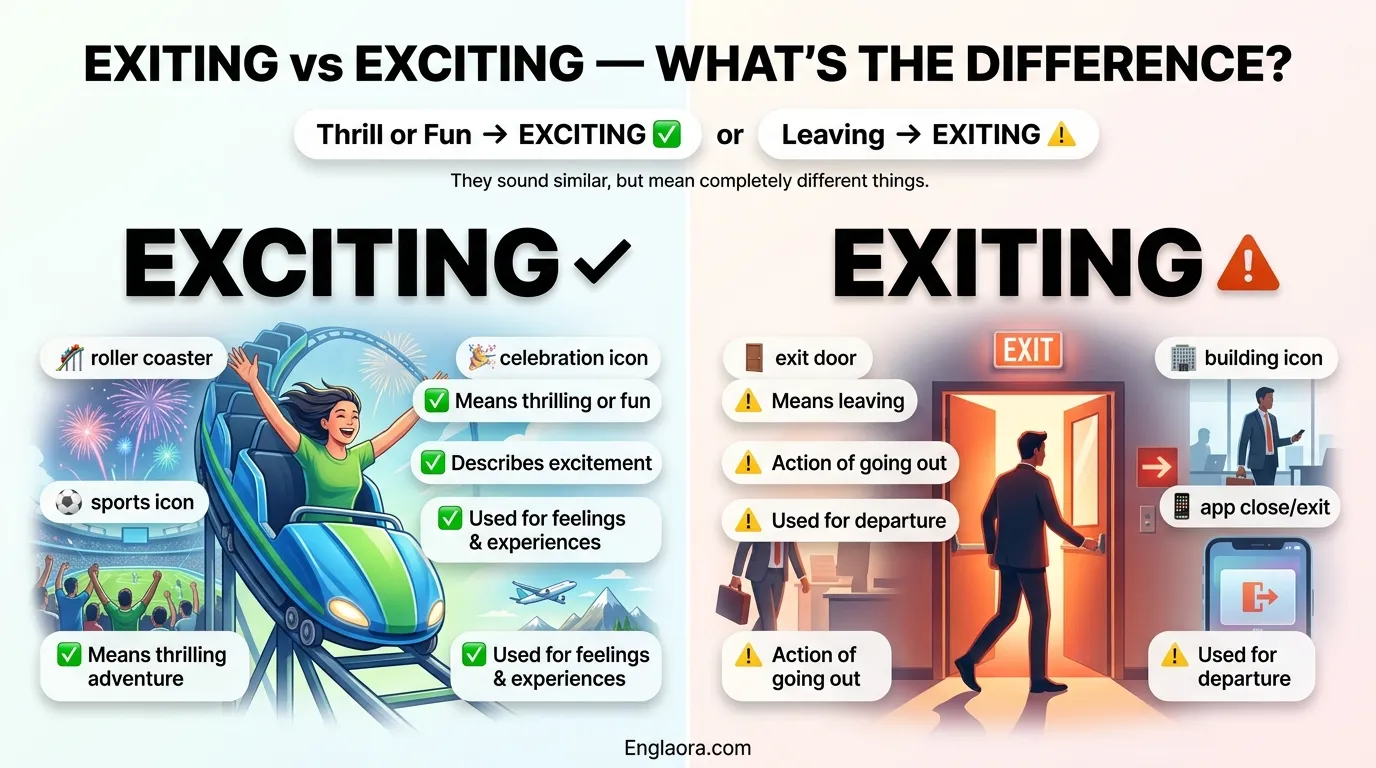
Exciting means something thrilling or fun.
Exiting means leaving or going out.
In this guide, you will learn the meaning, pronunciation, difference, examples, and correct usage so you never mix them up again.
Exiting or exciting – Quick answer
These two words are NOT the same. They look similar but mean completely different things.
Exciting is an adjective. It describes something that causes joy, thrill, or enthusiasm.
Exiting is a verb. It means leaving or going out of a place.
Here are two simple examples:
The game was so exciting that no one wanted to leave.
She was exiting the building when her phone rang.
The crowd cheered during the exciting final match.
One word describes a feeling. The other describes an action. Never swap them.
Exiting or Exciting Meaning
What does exciting mean?
Exciting means something that causes enthusiasm, happiness, or thrill.
Examples:
“The football match was exciting.”
“It was an exciting opportunity.”
What does exiting mean?
Exiting means leaving or going out of a place, situation, or system.
Examples:
“She was exiting the room.”
“The app is exiting automatically.”
Simple rule:
👉 Exciting = thrill or emotion
👉 Exiting = leaving
Exiting vs Exciting Pronunciation
These words sound similar, which causes confusion.
Exciting
ik-SAI-ting
/ɪkˈsaɪ.tɪŋ/
Exiting
EG-zit-ing or EK-sit-ing
/ˈek.sɪ.tɪŋ/
Pronunciation trick:
Exciting = excitement
Exiting = exit
This helps people remember the meaning while speaking.
Difference Between Exiting and Exciting
| Feature | Exciting | Exiting |
|---|---|---|
| Meaning | Thrilling or interesting | Leaving a place |
| Word Type | Adjective | Verb |
| Used For | Feelings & experiences | Movement/departure |
| Example | “The movie was exciting.” | “He was exiting the room.” |
Easy trick:
Ask yourself:
Does this describe excitement or energy?
Use exciting ✅
Does this mean leaving?
Use exiting ✅
The origin of exiting or exciting
Both words come from Latin, but from very different roots.
Exciting comes from the Latin word excitare, meaning “to rouse” or “to stir up.” It entered English in the 16th century. Over time, it became a common adjective to describe anything thrilling or stimulating.
Exiting comes from the Latin word exire, meaning “to go out.” The English word “exit” has been in use since the 16th century as well, originally as a stage direction in plays meaning “he goes out.”
So from the very start, these two words had nothing to do with each other. They only look alike because both start with “ex.” This is why so many people search for “exiting or exciting meaning” or “exiting or exciting grammar” when they are writing.
The confusion also comes from pronunciation. When people speak fast, “exciting” and “exiting” can sound similar, especially to non-native English speakers searching for “exiting or exciting pronunciation.”
British English vs American English spelling
There is no spelling difference between British and American English for these two words. Both are spelled the same way worldwide.
However, there are small differences in how they are used:
In American English, “exiting” is commonly used in business and tech contexts. For example: The user is exiting the app.
In British English, you might see “exiting” used more in formal documents. For example: The minister is exiting the chamber.
“Exciting” is used the same way in both dialects. No difference at all.
The word “existing” sometimes gets confused with “exiting” too. Many people search for “existing or exciting” by mistake when they mean something completely different. Existing means currently present or alive. It is a separate word entirely.
Comparison Table: Exiting vs Exciting vs Existing
| Word | Type | Meaning | Example |
|---|---|---|---|
| Exciting | Adjective | Causing thrill, joy, or enthusiasm | The match was exciting. |
| Exiting | Verb (present participle) | Leaving a place, situation, or program | She is exiting the room. |
| Existing | Adjective / Verb | Currently present, available, or alive | The existing rules still apply. |
| Excited | Adjective | Feeling thrilled, happy, or enthusiastic | He was excited about the trip. |
| Exited | Verb (past tense) | Left a place or situation | They exited the hall quietly. |
Quick Tip:
👉 Exciting = creates excitement ✅
👉 Excited = feels excitement ✅
👉 Exiting = leaving ✅
👉 Exited = already left ✅
👉 Existing = currently present ✅
Which spelling should you use?
The answer depends on what you want to say.
Use exciting when you describe something that gives a thrill or feeling of joy.
It was an exciting announcement.
What an exciting opportunity!
Use exiting when you describe the act of leaving.
He is exiting the building.
The file is exiting the system.
For global writing, both words are clear and standard. No regional preference needed.
One tip: ask yourself this simple question before writing. Am I describing a feeling? Use exciting. Am I describing an action of leaving? Use exiting.
This one trick will save you from making the wrong choice every time.
Common mistakes with exiting or exciting
People mix these words up more often than you think. Here are the most common errors and how to fix them.
Mistake 1:
Wrong: The concert was so exiting!
Correct: The concert was so exciting!
Mistake 2:
Wrong: She was exciting the store when it started to rain.
Correct: She was exiting the store when it started to rain.
Mistake 3 (exited vs excited):
This is one of the biggest sources of confusion. Many people ask: Is it exited or excited?
These are two different words.
Exited = past tense of exit (left a place). He exited the room.
Excited = adjective (feeling happy or thrilled). She was excited about her birthday.
Mistake 4:
Wrong: I am exiting about this new project.
Correct: I am excited about this new project.
Mistake 5 :
Some non-native speakers confuse “excited” and “exciting” through direct translation, but in English, “I am excited” simply means happy or enthusiastic.
Exiting or exciting in everyday examples
Here is how both words appear in real life situations.
Email Example (exciting):
Subject: Exciting News About Our Product Launch
Hi Team, I have exciting news to share. We are launching our new product next Monday. Please be ready.
Email Example (exiting):
Please note: All staff exiting the building after 8 PM must sign the log at the security desk.
Social Media Example:
“Just finished the most exciting hike of my life! The view from the top was unreal.”
“Live updates: The CEO is exiting the boardroom right now. Big announcement expected.”
News Example:
“The prime minister is exiting the summit after three days of talks.”
“Scientists made an exciting discovery in the deep ocean last week.”
Formal Writing Example:
All participants exiting the venue must return their access badges.
The company shared exciting financial results for the third quarter.
These examples show how “exciting” is used to express emotion and energy, while “exiting” is used to describe physical or digital departure.
Exiting or exciting – Google Trends and usage data
Search data tells a very clear story.
“Exciting” is searched and used far more than “exiting” in everyday writing and speech. It appears in marketing, news, entertainment, social media, and daily conversation.
“Exiting” spikes in tech and business contexts. Phrases like “i am exiting meaning” and “exiting or exciting in a sentence” are common search queries from students and non-native speakers.
Searches for “exiting or exciting synonyms” are also very common, showing that people want alternative words for both.
“Excited” vs “exciting” is another top search. People often ask: When to use excited or exciting? The rule is simple. Use “exciting” to describe the thing causing the feeling. Use “excited” to describe the person feeling it.
The movie was exciting. (The movie causes the feeling.)
I was excited by the movie. (I felt the feeling.)
Regionally, “exiting” in the tech sense (“exiting an app,” “exiting a program”) is most common in North America and among tech communities globally.
Exiting or exciting synonyms
Since many people search for “exiting or exciting synonyms,” here is a handy list.
Synonyms for Exciting:
There are many great options if you want a better word for exciting. Some of the best are: thrilling, exhilarating, stimulating, captivating, gripping, electrifying, riveting, and breathtaking.
5 synonyms for excited (the feeling):
thrilled, elated, enthusiastic, eager, animated.
What are 5 amazing synonyms?
If you need powerful alternatives to “amazing” (which often pairs with “exciting”): spectacular, extraordinary, phenomenal, astounding, remarkable.
Synonyms for Exiting:
Leaving, departing, withdrawing, going out, vacating.
What is a synonym for exiting?
The most common ones are: departing, leaving, withdrawing, heading out.
What is the opposite of exciting?
Boring, dull, tedious, uninteresting, flat, mundane.
FAQs
1.What is the difference between exciting and exiting?
Exciting describes something fun or thrilling. Exiting means leaving a place or situation.
2.Is it exited or excited?
They are different words.
Exited = left a place
Excited = feeling happy or thrilled
Example:
He exited the room.
She was excited about the trip.
3.What does exciting mean?
Exciting means causing enthusiasm, joy, or thrill.
Example:
The football match was exciting.
4.What does exiting mean?
Exiting means leaving or going out.
Example:
She was exiting the building.
5.When should I use excited or exciting?
Use exciting for the thing causing the feeling.
Use excited for the person feeling it.
The trip was exciting.
I was excited about the trip.
6.Is exiting the same as exciting?
No.
Exiting = leaving ✅
Exciting = thrilling ✅
They only look similar.
7.What type of word is exiting?
Exiting is a verb form of exit and usually means leaving.
Example:
He is exiting the app.
8.What does “I am exiting” mean?
It means:
“I am leaving” or “I am going out.”
Example:
I am exiting the meeting now.
9.What is a better word for exciting?
Some strong alternatives are:
thrilling, captivating, exhilarating, gripping, and electrifying.
10.How do I remember the difference?
Easy trick:
👉 Exciting = excitement
👉 Exiting = exit
This makes the difference easy to remember.
Conclusion
Exiting and exciting are two completely different words. One describes a feeling. The other describes an action.
Exciting means something is thrilling, joyful, or full of energy. Use it when you describe a movie, a game, a trip, or any experience that stirs good emotions.
Exiting means leaving a place or program. Use it when someone or something departs.
The biggest mistakes people make are: writing “exiting” when they mean “exciting,” and confusing “exited” with “excited.” Now you know the difference clearly.
Remember the simple rule: Feeling? Use exciting. Leaving? Use exiting.
Both words are correct English. Both are used worldwide. You just need to pick the right one for the right moment. With the examples, tables, and tips in this guide, you will never mix them up again.

Hi, I’m Ethan Hawkes, writing for Englaora.com. I provide clear, reliable content to help users understand the differences between commonly confused words.