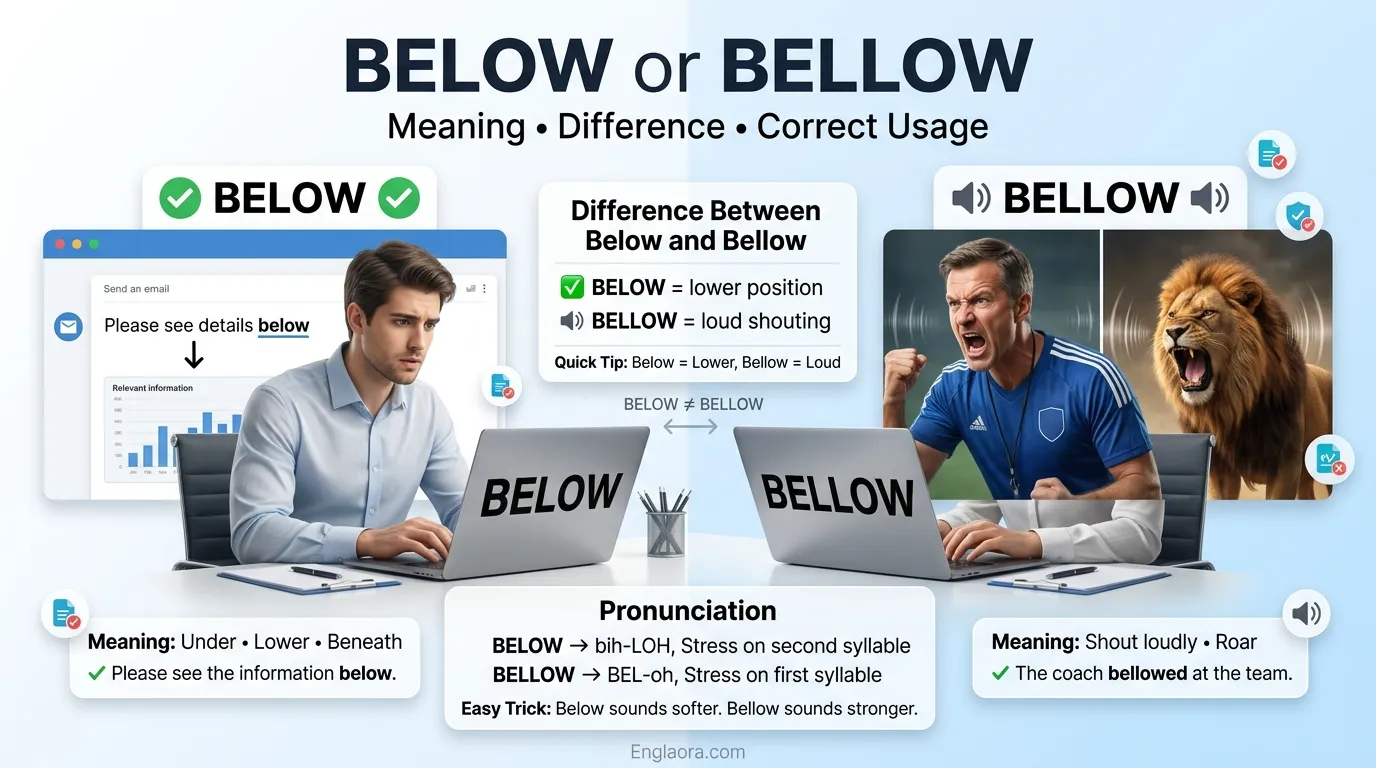
Hey, I want to share something that happened to me recently involving below or bellow.
I was writing a quick message to a friend and wanted to say, “Please see the details below.” But suddenly I paused and thought, Wait… is it below or bellow?
Both words looked surprisingly similar, and for a moment I was not fully sure which one was correct in that situation.
I did not want to send the message with the wrong word and sound careless. It is a small difference, but mistakes like this happen all the time, especially when two words look almost identical.
So, I decided to look into below or bellow and understand the real difference. Once I explored their meanings, everything became clear.
Here is the good news: although these words look similar, they have completely different meanings. And once you understand the difference, it becomes very easy to remember which one to use.
This guide will explain everything simply, including meanings, examples, pronunciation, common mistakes, and everyday usage.
Let us get into it.
Below or Bellow: Quick Answer
Both below and bellow are correct English words, but they mean very different things.
- Below means under something or at a lower level.
- Bellow means to shout loudly or make a deep loud sound.
Quick Examples
✔ The instructions are written below the image.
✔ The angry coach bellowed at the players.
Quick Comparison Table
| Word | Meaning | Example |
|---|---|---|
| Below | Under or lower than something | Look at the chart below. |
| Bellow | To shout loudly | The captain bellowed orders. |
Easy trick to remember:
Below = lower
Bellow = loud
Difference Between Below and Bellow
The biggest difference between below and bellow is their meaning.
Although the words look similar, they are used in completely different situations.
Below
Below is used when talking about position, location, level, or something underneath.
Examples:
- Please read the information below.
- The temperature dropped below freezing.
- The valley sits below the mountain.
Think of below as meaning:
under • lower • beneath
Bellow
Bellow is used when talking about loud shouting, roaring, or deep sounds.
Examples:
- The teacher bellowed at the noisy class.
- The bull bellowed loudly.
- The captain bellowed commands.
Think of bellow as meaning:
shout • roar • yell loudly
Quick Rule
Ask yourself:
Am I talking about location or sound?
- Location → Below
- Loud shouting → Bellow
That one question can save you from mixing them up.
Below Meaning
The word below means something is:
- Under something else
- At a lower position
- Lower in amount, value, or level
It can work as a:
- Preposition
- Adverb
- Adjective
Examples of Below
- Please read the instructions below.
- The answer appears below the image.
- Temperatures fell below zero.
- His score dropped below average.
- The village lies below the mountain.
Common Situations Where We Use “Below”
You will commonly see below in:
Emails
Please see the details below.
Documents
Refer to the section below.
Articles
The chart below explains the data.
Measurements
The temperature fell below freezing.
This is why below appears much more often in daily writing.
Bellow Meaning
The word bellow means:
- To shout loudly
- To roar deeply
- To speak in a powerful voice
It is often used for:
- Angry people
- Coaches or teachers
- Military commanders
- Large animals like bulls and lions
Examples of Bellow
- The coach bellowed at the team.
- The sergeant bellowed orders.
- The lion bellowed across the field.
- The angry manager bellowed from his office.
Bellow as a Noun
Bellow can also be a noun.
Example:
We heard the loud bellow of a bull in the distance.
In this case, bellow means a loud roar or shout.
Does Bellow Mean Under?
No. Bellow does not mean under.
This is one of the biggest mistakes people make.
Many writers accidentally type bellow when they actually mean below, especially in emails.
Wrong vs Correct
❌ The answer is written bellow.
✔ The answer is written below.
❌ Please see bellow.
✔ Please see below.
Remember:
Below = under
Bellow = loud shouting
What Does “Bellow Me” Mean?
The phrase “bellow me” is usually a spelling mistake.
Most people actually mean:
✔ below me
Example:
The apartment below me is noisy.
Correct Examples
✔ The temperature dropped below zero.
✔ The lion bellowed loudly in the jungle.
If someone writes “bellow me,” they most likely confused the spelling.
Please See Below or Bellow?
The correct phrase is:
✔ Please see below
This phrase is extremely common in:
- Emails
- Reports
- Workplace communication
- School assignments
Example Email
Hello Team,
Please see the report below for updated numbers.
❌ Please see bellow.
That spelling is incorrect in professional writing.
A good rule:
If you are directing someone to information further down a page, always use below.
Pronunciation of Below and Bellow
Even though the words look similar, they are pronounced differently.
Below Pronunciation
Pronunciation: bih-LOH
IPA: /bɪˈloʊ/
Stress is on the second syllable.
Example:
be-LOW
Bellow Pronunciation
Pronunciation: BEL-oh
IPA: /ˈbɛloʊ/
Stress is on the first syllable.
Example:
BELL-oh
Quick Pronunciation Tip
Below → stress at the end
Bellow → stress at the beginning
This small pronunciation difference helps many learners remember the meaning.
Below or Bellow in Everyday Examples
Here is how both words appear in real life.
Email Example
Please review the information below before the meeting.
News Example
Temperatures dropped below freezing overnight.
Social Media Example
Check the link below for the full video.
Story Writing Example
The angry captain bellowed commands to the crew.
Workplace Example
Please see the details below regarding next week’s schedule.
Animal Example
The bull bellowed loudly across the field.
These examples make the difference much easier to understand.
Below or Bellow Examples
Below Examples
- The answer is written below.
- See the image below for details.
- His score fell below average.
- Temperatures dropped below freezing.
- The village lies below the mountain.
Bellow Examples
- The captain bellowed commands.
- The bull bellowed loudly.
- The manager bellowed across the room.
- The lion bellowed at sunset.
- The coach bellowed instructions.
Below or Above
Above and below are opposites.
| Word | Meaning | Example |
|---|---|---|
| Below | Lower than something | The text is below the picture. |
| Above | Higher than something | The title is above the image. |
Example:
The temperature dropped below normal.
The sun appeared above the clouds.
Below or Beneath
Many people also compare below and beneath because both words talk about something lower in position.
They are similar, but not always used in the same way.
Difference Between Below and Beneath
| Word | Usage | Example |
|---|---|---|
| Below | General everyday use | Look below the chart. |
| Beneath | More formal or literary | The treasure was buried beneath the sand. |
Examples
✔ Please read the information below.
✔ The river flowed beneath the bridge.
In most everyday situations, below sounds more natural.
When To Use a Bellows?
A bellows is a tool used to push air.
It is commonly used to make fires burn hotter, especially in blacksmithing or fireplaces.
Example
The blacksmith used a bellows to increase the fire.
The word bellows comes from the same historical root as bellow because both involve strong bursts of air or loud sounds.
The Origin of Below or Bellow
Although below and bellow look similar today, they come from completely different origins.
Origin of Below
The word below comes from Old English “belowe,” meaning:
lower • underneath • beneath
It has always referred to position or level.
Origin of Bellow
The word bellow comes from Old English “bellan,” meaning:
to roar • shout loudly
That is why bellow still refers to loud sounds or shouting today.
Even though the spellings look alike now, these words developed from different roots and have completely different meanings.
British English vs American English Spelling
Good news: there is no spelling difference between British and American English for these words.
Both countries use the exact same spelling.
| Word | British English | American English |
|---|---|---|
| Below | Below | Below |
| Bellow | Bellow | Bellow |
The meaning also stays exactly the same.
So whether you are writing in the US, UK, Canada, or Australia, you can use these words without changing the spelling.
Which Word Should You Use?
Choosing the correct word is simple once you understand the meaning.
Use Below When Talking About:
- Position
- Level
- Location
- Information written underneath
Examples
✔ See the instructions below.
Temperatures dropped below zero.
✔ The score fell below average.
Use Bellow When Talking About:
- Loud shouting
- Roaring animals
- Dramatic commands
- Deep loud sounds
Examples
✔ The coach bellowed at the players.
The lion bellowed loudly.
✔ The commander bellowed orders.
Quick Advice
Emails → Below
Instructions → Below
Stories → Bellow
Animals roaring → Bellow
Since most daily communication involves directions or information placement, below is used much more often than bellow.
Common Mistakes
These are the most common mistakes people make.
| Incorrect ❌ | Correct ✅ |
|---|---|
| Please see bellow | Please see below |
| The answer is bellow | The answer is below |
| The lion belowed | The lion bellowed |
| Check the image bellow | Check the image below |
Biggest Mistake
The most common error is using bellow when you mean below, especially in emails.
Remember:
Below = lower
Bellow = loud
That quick memory trick solves most confusion instantly.
Below or Bellow Quiz
Choose the correct word.
1. Please see the chart ___
A) Below
B) Bellow
2. The bull ___ loudly.
A) Belowed
B) Bellowed
3. Temperatures dropped ___ zero.
A) Below
B) Bellow
Answers
- Below ✅
- Bellowed ✅
- Below ✅
If you got all three right, you already understand the difference.
Comparison Table:
| Word | Meaning | Part of Speech | Example |
|---|---|---|---|
| Below | Under or lower | Preposition / Adverb / Adjective | The answer is below. |
| Bellow | To shout loudly | Verb / Noun | The bull bellowed. |
Quick Summary
Below = lower position
Bellow = loud shout
FAQs
Is It Below or Bellow in Emails?
The correct phrase is:
✔ Please see below
This is the standard wording used in emails and reports.
Can Bellow Mean Under?
No.
Bellow means to shout loudly or roar. It never means under.
Why Do People Confuse Below and Bellow?
People confuse them because:
- They look very similar
- They sound somewhat alike
- Only one extra letter changes the spelling
But their meanings are completely different.
Is Below a Preposition?
Yes.
Below can work as:
- A preposition
- An adverb
- An adjective
Example:
The answer is below the image.
Can Bellow Be a Noun?
Yes.
Bellow can also be a noun meaning a loud roar or shout.
Example:
We heard the bellow of a bull.
Which Word Is Used More?
Below is used far more often in everyday writing.
You commonly see it in:
- Emails
- Instructions
- Documents
- Articles
Bellow appears more in storytelling, literature, or dramatic situations.
Is Below Formal or Informal?
Below works in both formal and informal writing.
Examples:
Formal:
Please review the information below.
Informal:
Check the link below.
What Is the Difference Between Below and Bellow?
Below means under or lower.
Bellow means to shout loudly.
Example:
✔ The answer is below.
✔ The coach bellowed loudly.
Conclusion
The confusion between below or bellow happens because the words look very similar, but their meanings are completely different.
Below refers to something that is lower in position, level, or value. It is extremely common in emails, reports, instructions, and everyday writing. Whenever you write phrases like “please see below,” this is the correct word to use.
Bellow, on the other hand, means to shout loudly or make a deep roaring sound. It is commonly used for loud people, commanders, coaches, or animals like bulls and lions.
The easiest way to remember the difference is simple:
Below = lower
Bellow = loud
If you are talking about location or position, choose below. If you are describing shouting or roaring, choose bellow.
Once you understand this small difference, you will never confuse these two words again. If you are writing emails, chatting with friends, or working on professional documents.

Hi, I’m Emma Caldwell, an expert author at Englaora.com. I share clear insights on language differences and provide readers with reliable, easy-to-understand content.