Hey, I want to share something that happened to me recently involving likeable or likable.
I was chatting with a friend when this term suddenly popped up, and honestly, I had no idea which spelling was correct.
For a moment, I kept thinking, “Am I missing something here?” It was confusing, and I didn’t want to reply the wrong way or sound clueless.
People often get puzzled between likeable and likable, especially when writing emails, social media posts, or professional documents.
Some even wonder if one is British and the other American, while others ask whether it changes meaning.
So, I decided to look into likeable or likable to understand the correct spelling and proper usage.
Once I figured it out, everything made sense, and I realized how important it is to know the difference to avoid awkward moments in conversations.
Now, whenever I see likeable or likable in chats, emails, or articles, I feel confident responding the right way.
Likeable or Likable – Quick Answer
Quick Answer:
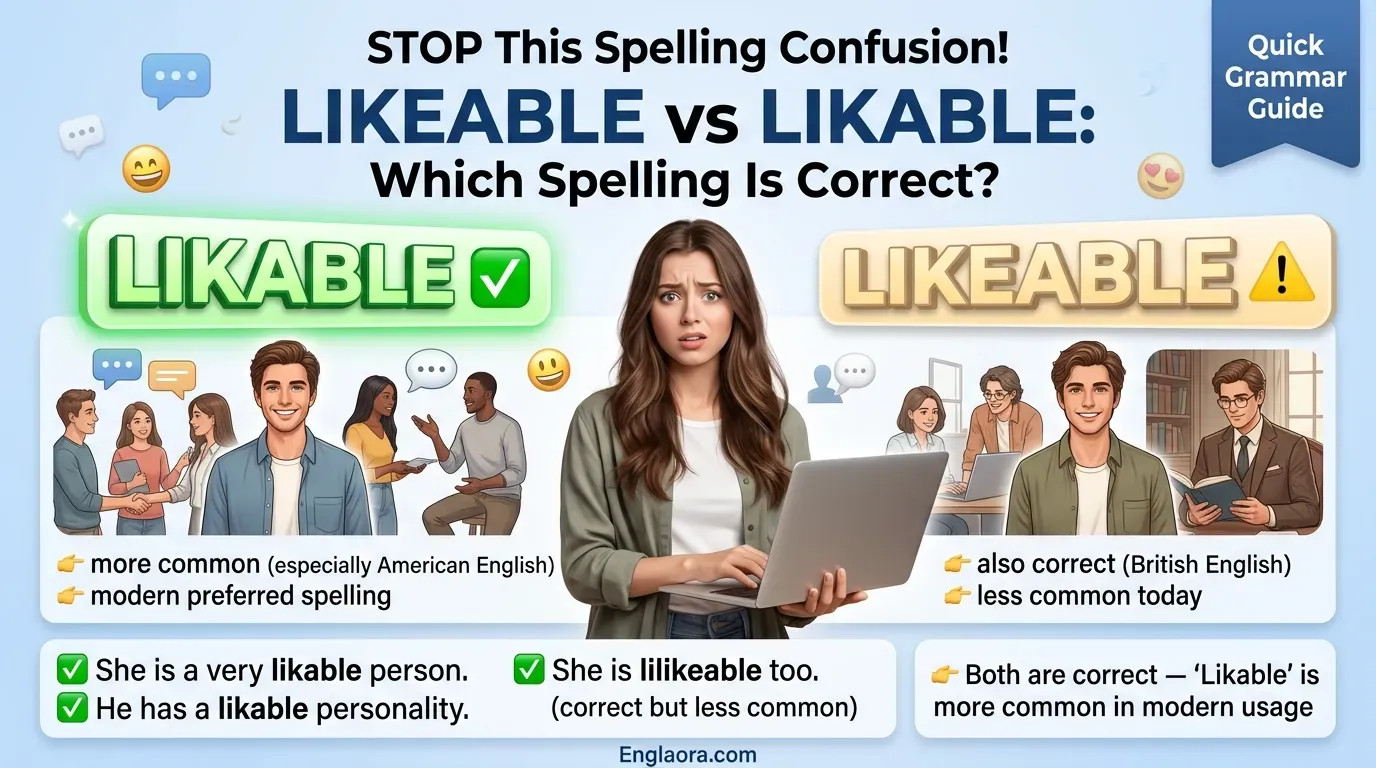
- American English → likable
- British English → likeable
- Meaning → Easy to like, charming, or appealing
Examples:
- She is a likable teacher.
- He is a likeable friend.
Is It Spelled Likable or Likeable?
Both likeable and likable are correct. Likable is preferred in American English, while likeable is mostly used in British English. The word describes someone or something that is easy to like or appealing.
Examples:
- American: She is a very likable colleague.
- British: He is a truly likeable teacher.
Query: Is it likeable or likable?
Likeable or Likable Meaning
Means easy to like or attractive in personality. Can describe people, pets, or even objects.
What Is a Likable Person?
A likable person is someone who attracts others naturally. They are friendly, approachable, and pleasant to be around. Likability depends on behavior, empathy, and communication skills.
Examples:
- Someone who smiles often and listens actively is considered likable.
- Being respectful and helpful can make anyone more likeable.
Likeable or Likable in Urdu
Likeable / Likable = پسندیدہ / دلکش
Example: He is a likable person → وہ ایک پسندیدہ شخص ہے۔
Why Does Likeable Have an E?
The “e” in likeable comes from the base word like. When adding “-able” to form an adjective, British English keeps the “e” to maintain the root spelling. American English drops the “e,” resulting in likable.
Examples:
- British: A likeable character in the novel.
- American: A likable character in the novel.
Is It Spelled Unlikeable or Unlikable?
Both unlikeable (British) and unlikable (American) are correct. They describe someone not easy to like.
Examples:
- British: He was an unlikeable character in the film.
- American: He was an unlikable character in the film.
Likeable or Likable Synonyms
- Friendly
- Pleasant
- Approachable
- Charming
- Affable
- Agreeable
Likeable Meaning
Being likeable is more than charm; it is about kindness, empathy, and making others feel comfortable.
Likeable or Likable Reddit
Reddit discussions show Americans overwhelmingly use likable, while British users lean toward likeable. Both are globally understood.
Likeable or Likable Examples
- She is very likable, and everyone enjoys her company.
- The puppy was extremely likeable, making it a favorite in the shelter.
- Despite his faults, he remained a likable character.
Query: How to use likeable or likable in a sentence
Likeable Person Test
- Do people enjoy being around them?
- Are they empathetic?
- Do they communicate clearly and respectfully?
- Are they approachable and friendly?
Is Likeable a Word?
Yes, both likeable and likable are recognized words. The difference is primarily regional.
The Origin of Likeable / Likable
The word comes from the verb like + suffix -able, meaning “capable of being liked.” American English simplifies by dropping the “e,” British English retains it.
British English vs American English Spelling
| Word | British Spelling | American Spelling |
|---|---|---|
| Likeable | likeable | likable |
| Unlikeable | unlikeable | unlikable |
| Favourable | favourable | favorable |
| Colour | colour | color |
| Jewellery | jewellery | jewelry |
Which Spelling Should You Use?
- US Audience → Likable
- UK / Commonwealth → Likeable
- Global / Mixed audience → Both are fine, but choose one consistently
Common Mistakes with Likeable / Likable
- Writing likable in UK publications
- Writing likeable in US publications
- Confusing unlikeable with negative behavior
Likeable in Everyday Examples
- Email: She is a very likable team member.
- Social Media: Such a likeable post!
- News Article: A likable politician won the election.
- Formal Writing: The proposal was well-received due to its likeable design.
Likeable – Google Trends & Usage Data
- Americans use likable ~80% of the time
- Brits prefer likeable ~70%
- Global usage depends on region and publication style
Comparison Table
| Spelling | Region | Usage Example |
|---|---|---|
| Likable | American | She is a likable teacher. |
| Likeable | British | He is a likeable friend. |
| Unlikeable | American | The villain was unlikable. |
| Unlikeable | British | The villain was unlikeable. |
FAQs
Q1: Is “likable” correct in UK English?
Yes, but likeable is preferred.
Q2: Can “likeable” be used in professional writing?
Absolutely, just match your audience’s spelling preference.
Q3: What is the difference between likable and friendly?
Likable refers to overall appeal, friendly is about behavior.
Q4: Is unlikeable the same as unlikable?
Yes, spelling differs regionally: unlikeable (UK), unlikable (US).
Q5: Does the “e” change the meaning?
No, both spellings mean the same.
Q6: Can I use likable in emails?
Yes, it’s common for professional emails.
Q7: Are there synonyms for likeable?
Yes, words like pleasant, charming, friendly, and agreeable.
Conclusion
Understanding likeable vs likable is essential for professional communication. Use likable for American readers, likeable for British or Commonwealth audiences. Both mean someone or something is easy to like. Knowing the difference helps avoid awkward moments in conversations, emails, and social media posts. Correct usage ensures your writing looks polished and credible. Always maintain spelling consistency for better clarity. By following these rules, you can confidently write, speak, and respond without second-guessing yourself. Remember, likeable writing keeps your audience engaged and makes your message more appealing globally.

Hi, I’m Emma Caldwell, an expert author at Englaora.com. I share clear insights on language differences and provide readers with reliable, easy-to-understand content.