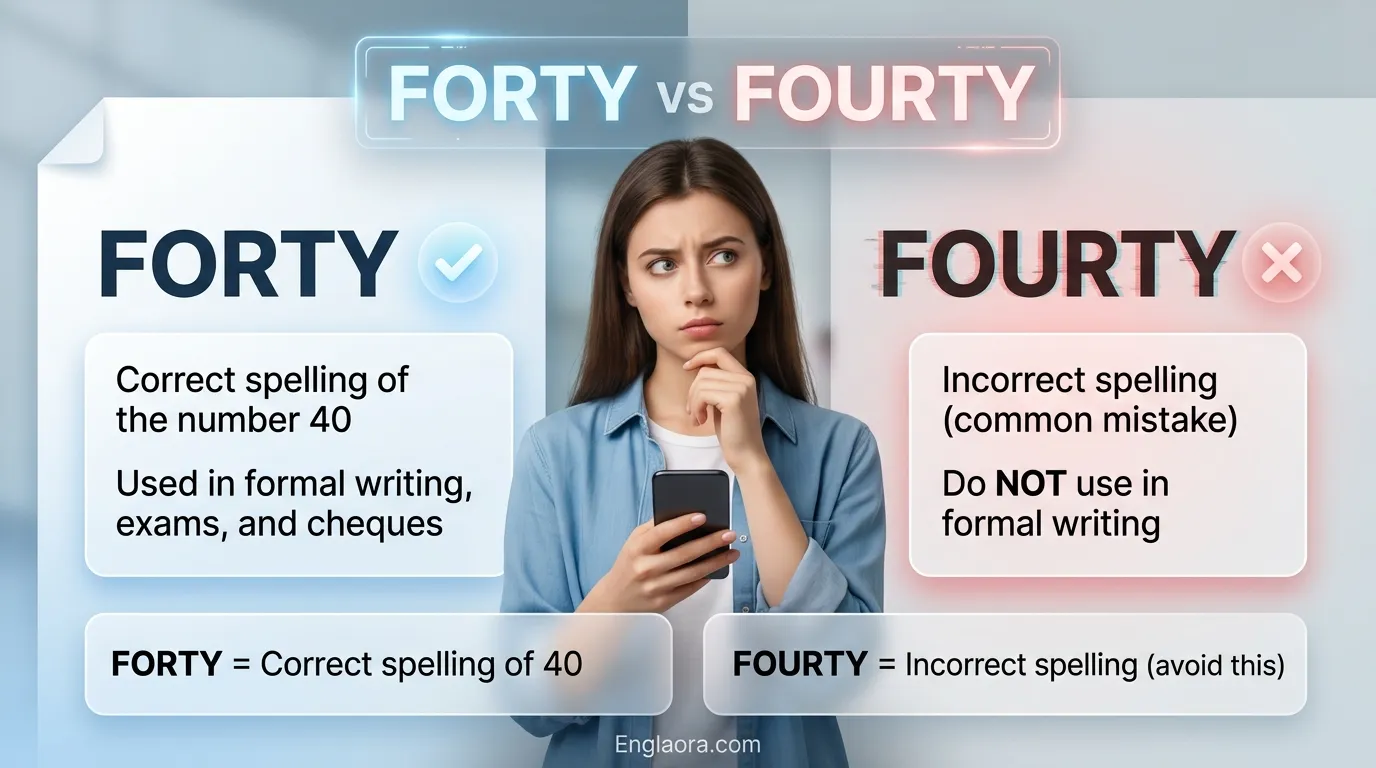
I recently came across a very common English confusion—whether it is spelled forty or fourty. It happened while I was helping a friend fill out a cheque.
He wrote “fourty thousand rupees,” and I immediately paused because something felt off.
At that moment, I realized how many people struggle with this simple spelling. It looks like it should be “fourty” because of the word “four,” but English doesn’t always follow logic in spelling rules.
This confusion is especially common among students, job seekers, and people writing in official situations like exams, banking forms, cheques, emails, and legal documents. Even a small spelling mistake can look unprofessional.
In this complete guide, we will clearly understand if it is forty or fourty, why one is correct and the other is wrong, and how to use it properly in real-life situations.
Fourty or Forty – Quick Answer
Let’s make it very simple:
✔ Correct spelling: forty
✘ Incorrect spelling: fourty (never correct in English)
Examples:
- She is forty years old. ✔
- I waited for forty minutes. ✔
- The price is forty thousand rupees. ✔
- He made a mistake writing “fourty.” ✘
👉 No matter the situation, “fourty” is always wrong.
Meaning of Forty
The word forty represents the number 40.
Mathematically:
👉 40 = 4 × 10 (four tens)
It is a cardinal number, meaning it is used for counting and quantity. We use it in daily life for:
- Age (forty years old)
- Money (forty rupees / forty thousand)
- Time (forty minutes)
- Quantity (forty items)
- Distance and measurements
So whenever you see the number 40, its word form is always forty.
Correct Spelling of Forty
The correct spelling is:
👉 F O R T Y
There is no “u” in the word.
This confuses learners because the number “four” includes a “u,” but English spelling often has historical exceptions.
Related number spellings:
- Forty-one ✔
- Forty-two ✔
- Forty-three ✔
- Forty-four ✔
- Forty-five ✔
- Forty-six ✔
- Forty-seven ✔
- Forty-eight ✔
- Forty-nine ✔
👉 Notice that all follow the same rule and use a hyphen in compound numbers.
Why “Fourty” Is Wrong
“Fourty” is incorrect because it is not part of modern or historical standard English spelling.
The mistake happens mainly because:
- People associate it with “four”
- It sounds like it should contain “u”
- Learners guess spelling based on pronunciation
- Confusion with similar words like “fourteen”
However, English spelling is not always phonetic. Many words have irregular forms, and forty is one of them.
Origin and History of Forty
The word comes from Old English “feowertig,” meaning “four tens.”
Over centuries, English evolved:
- Early forms sometimes included variations like “fourty”
- Spelling was not standardized in older English texts
- By the 16th–18th century, modern English fixed the spelling as forty
Since then, dictionaries and grammar rules have consistently used forty as the only correct form.
Forty in Cheques and Banking
One of the most important uses of number spelling is in financial documents.
In cheques, you must be extremely careful:
✔ Correct: Rupees Forty Thousand Only
✘ Incorrect: Rupees Fourty Thousand Only
Even a small spelling mistake can:
- Look unprofessional
- Create confusion
- Cause rejection in formal checks (in some cases)
👉 That’s why correct spelling is very important in banking and legal writing.
Pronunciation of Forty
The pronunciation of forty is:
👉 FOR-tee (/ˈfɔːr.ti/)
It is smooth and simple.
Many learners search this because they are unsure whether it sounds like “four-tee” or something else. The correct natural pronunciation is FOR-tee, not “four-ty.”
British vs American English
Good news: there is no difference between British and American English for this word.
Both use:
✔ Forty (correct)
✘ Fourty (incorrect everywhere)
So whether you are writing for exams, work, or international communication, the spelling remains the same.
Common Confusions with Forty
Many learners mix up “forty” with other similar words:
1. Forty vs Fourteen
- Forty = 40
- Fourteen = 14
👉 “Fourteen” has “u,” but “forty” does not.
2. Forty vs Fourty
- Forty ✔ correct
- Fourty ✘ incorrect
3. Forty-five vs Fourty-five
- Forty-five ✔ correct
- Fourty-five ✘ incorrect
Common Mistakes People Make
Here are frequent errors in real writing:
- Adding “u” → writing fourty
- Mixing spelling with “four”
- Forgetting hyphens in compound numbers
- Writing “fourty thousand” in cheques
- Confusing pronunciation-based spelling
These mistakes are small but can affect writing quality.
Everyday Usage Examples
Let’s see how forty is used in real life:
Email:
The meeting will start in forty minutes, please be on time.
Social Media:
Finally turning forty this year 🎉 feeling grateful!
News:
The company has completed forty years of service.
Formal Writing:
The total amount is forty thousand rupees only.
Conversation:
“I will be there in forty minutes.”
Memory Trick to Remember
Here is a simple trick:
👉 Think: “Four has U, but Forty has no U.”
This helps you instantly remember the correct spelling.
Why This Mistake Is So Common
This confusion happens because:
- English spelling is not fully logical
- People rely on pronunciation
- “Four” naturally misleads learners
- Schools don’t always emphasize irregular spelling rules
But once you remember it, you will never forget it again.
FAQs
Q1: Is it forty or fourty?
A: The correct spelling is forty.
Q2: How do you write 40 in words?
A: Forty.
Q3: Is forty-five or fourty-five correct?
A: It is forty-five.
Q4: Can we ever use fourty?
A: No, it is always incorrect.
Q5: Why is forty spelled without “u”?
A: Because English spelling evolved historically and dropped the “u.”
Q6: How do you spell 44?
A: Forty-four.
Q7: Is forty used worldwide?
A: Yes, both British and American English use it.
Q8: Is fourty used in any English dictionary?
A: No, it is not accepted.
Conclusion
The confusion between forty or fourty is very common, but the rule is simple and final: only forty is correct.
Even though it feels natural to include a “u” because of “four,” English spelling does not follow that logic here.
Whether you are writing exams, cheques, emails, or formal documents, always use forty to stay correct and professional.
Now that you know the rule clearly, you will never make this mistake again—and your English writing will instantly look more accurate and confident.

Hi, I’m Ethan Hawkes, writing for Englaora.com. I provide clear, reliable content to help users understand the differences between commonly confused words.