Hey, I want to share something that happened to me recently involving prise or prize. I was chatting with a friend on WhatsApp when this word suddenly came up while we were talking about a school competition.
For a moment, I paused and thought, “Wait… is it prise or prize? Am I missing something here?” I had seen both words before, but honestly, I was not sure which one was correct. I didn’t want to reply with the wrong word or sound careless.
This confusion is more common than you might think. Many people search questions like “prise or prize meaning,” “What is the difference between prize and prise?”, “prise or prize pronunciation,” and even “price vs prize pronunciation” because these words look and sound similar.
So, I decided to understand prise or prize properly. I checked meanings, pronunciation, spelling differences, examples, and real-life usage. Once I understood everything clearly, the confusion disappeared.
If you have ever wondered whether to use prise or prize, this guide will make everything simple and easy to understand.
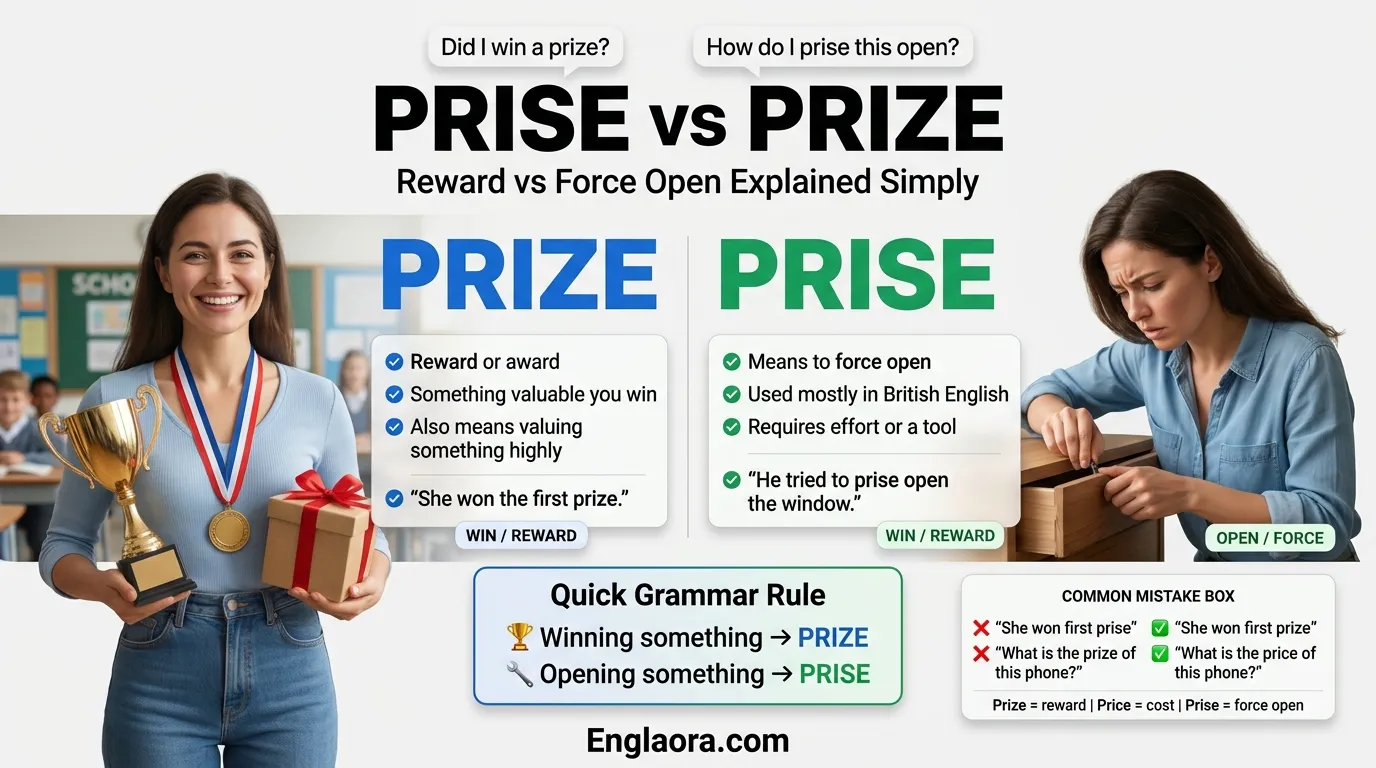
Prise or Prize – Quick Answer
The short answer is:
Prize
Used for a reward, award, or something valuable that you win in a competition.
Prise
Used when you force something open with effort. This word is more common in British English.
Examples:
- “She won the first prize in the art competition.”
- “He tried to prise open the stuck window.”
Simple Rule:
✔ Prize = reward or something valuable
✔ Prise = force open
This quick rule solves most confusion instantly.
Prise or Prize Meaning
Both words have different meanings, even though they sound almost the same.
What Does Prize Mean?
Prize can be used as both a noun and a verb.
As a noun, it means something valuable that you win.
Examples:
- “The winner received a cash prize.”
- “Her science project won first prize.”
As a verb, prize means to value something highly.
Example:
“I really prize my old family photos.”
This means the person values the photos a lot.
What Does Prise Mean?
Prise is a verb only.
It means:
To force something open using effort or a tool
Examples:
- “He used a knife to prise open the box.”
- “She tried to prise the lid off the jar.”
Important Note:
Prise has nothing to do with money or price.
Many learners confuse:
- Price = cost
- Prize = reward
- Prise = force open
What Is the Difference Between Prise and Prize?
The difference becomes easy when you think about the situation.
Use Prize when:
✔ Talking about rewards
✔ Winning competitions
✔ Valuing something highly
Use Prise when:
✔ Opening something stuck
✔ Using effort to force something open
Quick Comparison Table
| Situation | Correct Word |
|---|---|
| Winning a competition | Prize |
| Cash reward | Prize |
| Valuing something important | Prize |
| Opening a stuck drawer | Prise |
| Removing a lid with force | Prise |
| Talking about cost | Price |
Example Sentences:
- “He won a huge cash prize.”
- “She had to prise the drawer open.”
- “The price of the laptop is expensive.”
This small difference changes the meaning completely.
Prise or Prize in English
In everyday English, prize is much more common than prise.
You will often see prize in:
- Schools
- Competitions
- Offices
- Sports events
- Giveaways
Examples:
- “The first prize is a gold medal.”
- “Congratulations! You won the lucky draw prize.”
Prise, on the other hand, appears less often and is mostly used in British English or formal writing.
Example:
“The workers had to prise the door open.”
What Is a Prize Called?
A prize may also be called:
- Award
- Trophy
- Reward
- Gift
- Certificate
Does Prize Mean Money?
Sometimes, yes.
A prize can be:
- Money
- Trophy
- Gift item
- Certificate
- Scholarship
For example:
“The contest offered a cash prize of 50,000 rupees.”
Prise or Prize Pronunciation
Prise or prize pronunciation is almost exactly the same.
Both words sound like:
/praɪz/
It sounds like:
“pryz”
That is one big reason why people confuse them.
Price vs Prize Pronunciation
These words sound slightly different.
- Price → ends with an “s” sound
- Prize → ends with a “z” sound
Try saying them slowly:
Price → Pryss
Prize → Pryz
Practicing this difference helps improve pronunciation quickly.
The Origin of Prise and Prize
Both words come from old French and Latin roots, which is one reason they look similar today.
Prize Origin
The word prize developed from the Latin word “pretium”, meaning value, reward, or worth.
Over time, English speakers began using it for things won in competitions.
Prise Origin
The word prise came from an old French word meaning “to take” or “to grasp.”
Later, British English kept this spelling for the action of forcing something open.
That is why confusion happens today:
Both words sound alike but developed different meanings over time.
British English vs American English Spelling
One reason people get confused about prise or prize is that British and American English sometimes use different spellings.
In British English:
People often use prise when talking about forcing something open.
Example:
“He had to prise the window open.”
In American English:
Many writers use prize for the same action, although it is less common in everyday speech.
Example:
“She tried to prize the lid off the container.”
However, when talking about a reward or award, both British and American English use:
✅ Prize
Examples:
- “She won the first prize.”
- “The competition offers exciting prizes.”
Comparison Table
| Word | Meaning | Region Preference | Example Sentence |
|---|---|---|---|
| Prize | Reward or something valuable | UK + US | He won first prize in the race. |
| Prise | Force something open | Mainly UK | She had to prise the drawer open. |
| Price | Cost of something | UK + US | What is the price of this phone? |
Which Spelling Should You Use?
For most situations, prize is the safer choice because it is widely understood around the world.
Use Prize when:
✔ Talking about rewards
✔ Referring to competitions
✔ Valuing something highly
Use Prise when:
✔ Writing in British English
✔ Talking about opening something by force
Example:
✔ “She won a cash prize.”
✔ “He tried to prise open the locked drawer.”
Simple Advice:
If you are unsure, ask yourself:
Am I talking about winning something or opening something?
- Winning → Prize
- Opening → Prise
That one question removes most confusion.
Common Mistakes with Prise or Prize
Many English learners make small mistakes with these words. Here are the most common ones:
Mistake 1: Using “prise” for a reward
❌ “She won first prise.”
✔ “She won first prize.”
Mistake 2: Mixing price and prize
❌ “What is the prize of this phone?”
✔ “What is the price of this phone?”
Remember:
- Price = cost
- Prize = reward
Mistake 3: Using “prize” instead of “prise” in British English
❌ “He used a tool to prize the box open.” (British style)
✔ “He used a tool to prise the box open.”
Is It Door Price or Door Prize?
Many people ask this.
The correct phrase is:
✅ Door Prize
A door prize means a free gift or reward given at an event.
Example:
“Everyone who entered the hall had a chance to win a door prize.”
Prise or Prize in Everyday Examples
Learning through real situations makes grammar easier.
WhatsApp Chat Example
“Congrats! You won the first prize in the quiz!”
School Example
“The science fair offered prizes for the best projects.”
Home Example
“Dad had to prise the stuck cupboard door open.”
Office Email Example
“The company announced a special prize for top employees.”
News Example
“The lucky winner received a cash prize worth one million rupees.”
Using real-life examples helps you remember the difference naturally.
FAQs
What is the difference between prize and prise?
Prize means a reward or something valuable. Prise means forcing something open.
What is the meaning of prise?
It means opening something using effort or a tool.
How is prise used in a sentence?
“He had to prise the lid off the jar.”
What is a cash prize?
Money given as a reward after winning a contest or competition.
Does prize mean money?
Sometimes. A prize can be money, a trophy, a gift, or a certificate.
What is a prize called?
A prize may also be called an award, reward, trophy, or gift.
How does prise differ from prize?
Prise is about opening something with force. Prize is about rewards or value.
What is the full meaning of prize?
Something valuable you win or something you consider important.
Conclusion
Understanding prise or prize becomes simple when you remember one key rule: prize is used for rewards, awards, and things you value, while prise is used when talking about forcing something open.
Most people will use prize more often because it appears in competitions, schools, offices, and daily conversations. Prise is less common and mainly appears in British English writing.
Also, be careful not to confuse prize with price. A small spelling difference can completely change the meaning of your sentence.
The more you practice these words in real-life examples, the easier they become. Once you remember the simple rule — winning = prize, opening = prise — you will feel much more confident using them correctly.

Hi, I’m Toby Kellan, writing for Englaora.com. I provide clear, reliable content to help users understand the differences between commonly confused words.