Hey, I want to share something that happened to me recently involving sowing or sewing. I was chatting with a friend when this word suddenly came up, and honestly, I paused for a second.
I kept thinking, “Wait… is it sowing or sewing? Am I using the right word?” Both words sound exactly the same, which makes them very confusing in real-life conversations and writing.
This confusion is actually very common among English learners because these words are called homophones (same sound, different meaning and spelling). That’s why people often mix them up while speaking or typing.
Understanding the difference between sowing or sewing is important because even a small mistake can completely change the meaning of your sentence and make it incorrect.
So, let’s understand it in detail in a very simple way.
Sowing or Sewing – Quick Answer
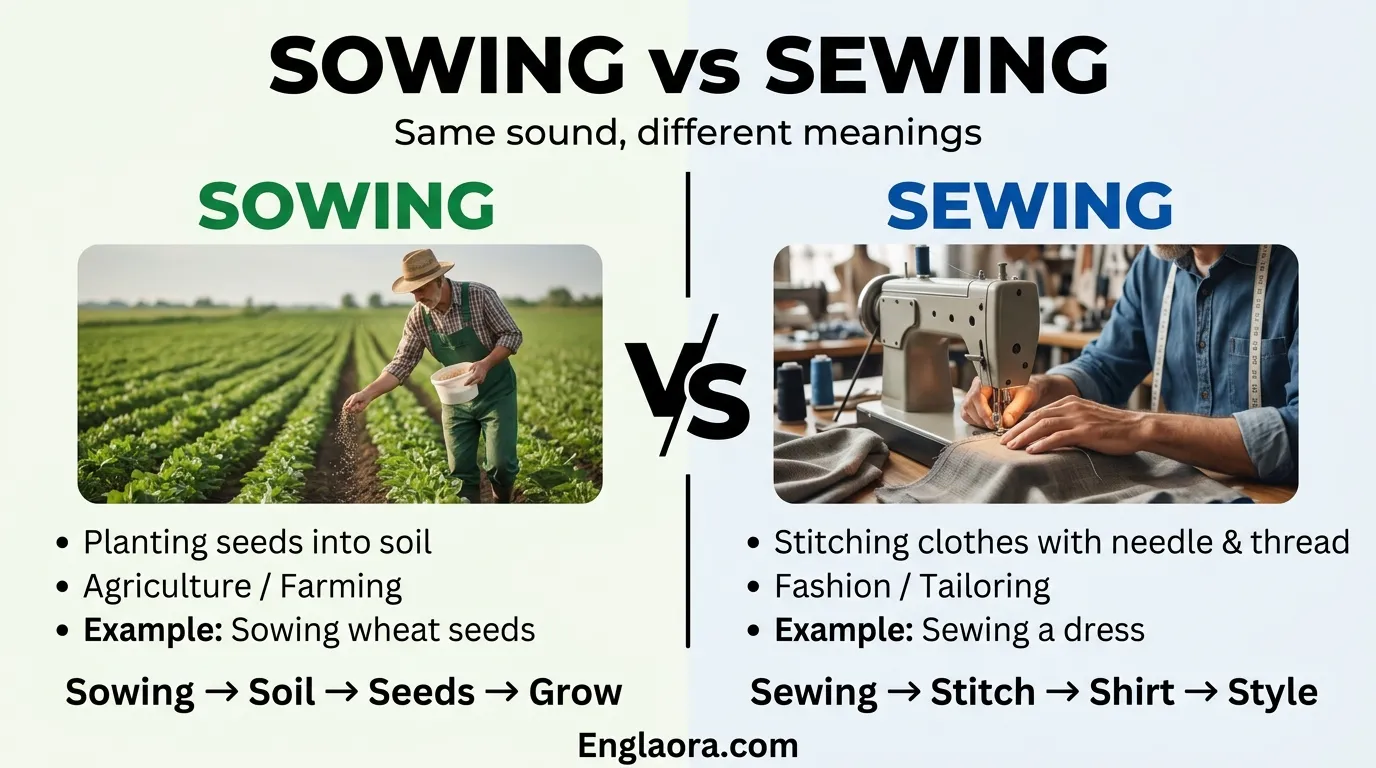
- Sowing means planting seeds into the soil so they can grow into plants, crops, or vegetables.
- Sewing means stitching pieces of fabric together using a needle and thread to make or repair clothes.
Example:
- The farmer is sowing seeds in the field before the rainy season.
- She is sewing a beautiful dress for her sister’s wedding.
👉 The key point here is context: one belongs to farming, the other belongs to clothing.
Meaning of Sowing and Sewing
Sowing Meaning
Sowing is an agricultural process where seeds are placed into soil in a proper way so they can germinate and grow into healthy plants. It is one of the most important steps in farming because without sowing, no crop production is possible.
Farmers usually sow seeds manually or using machines, depending on the land and type of crop. Timing is also very important because seeds need the right weather and soil conditions to grow properly.
In simple words:
Sowing = starting plant life by planting seeds in soil
Sewing Meaning
Sewing is the process of joining fabric pieces using a needle and thread. It is widely used in tailoring, fashion design, and even basic home repairs like fixing torn clothes.
Sewing can be done by hand or with a sewing machine. Professional tailors use advanced machines to create shirts, pants, dresses, and uniforms.
In simple words:
Sewing = creating or repairing clothes using stitches
Key Difference Between Sowing and Sewing
The main difference is not just meaning, but the entire field they belong to.
- Sowing → Agriculture, farming, nature, plant growth
- Sewing → Fashion, tailoring, clothing, fabric work
So whenever you hear or read the word, ask yourself:
👉 Am I talking about plants or clothes?
Sowing or Sewing in Real-Life Use
Let’s make it more practical:
- A farmer goes to the field early morning for sowing seeds before the season starts.
- A tailor sits in a workshop carefully sewing fabric pieces to complete a dress.
- Gardeners also perform sowing when they grow flowers or vegetables at home.
- Designers use sewing to create stylish outfits for customers.
Sowing vs Sewing – Simple Comparison
| Situation | Meaning | Correct Word |
|---|---|---|
| Planting wheat, rice, or seeds | Agricultural process of growing plants | Sowing |
| Making shirts, dresses, uniforms | Joining fabric using thread | Sewing |
Common Grammar Forms
Both words have different verb forms, and using the correct form is very important in grammar.
- Sow → sowed → sown
- Sew → sewed → sewn
Examples in Sentences:
- The farmer has sown the seeds after preparing the field properly.
- The tailor has sewn the torn jacket very neatly.
👉 Notice how both past participles describe completed actions but in different fields.
Is It Sow or Sew?
This is where most confusion happens.
- Use sow when talking about seeds, farming, or gardening activities.
- Use sew when talking about clothes, stitching, or fabric-related work.
👉 A simple rule:
If it grows → sow
If it wears → sew
Sewing Machine or Sowing Machine?
✔ Correct: Sewing machine
❌ Incorrect: Sowing machine
A sewing machine is a mechanical or electronic device used to stitch fabric efficiently. There is no such thing as a sowing machine in English because sowing is done in fields, not machines for clothing.
Sown vs Sewn (Clear Difference)
These two words are often confused in writing.
- Sown → used for seeds that have been planted in soil
- Sewn → used for fabric or clothes that have been stitched
Examples:
- The wheat seeds have been sown in the field.
- The torn curtains have been sewn properly by the tailor.
Why People Get Confused
People confuse sowing or sewing mainly because:
- They sound exactly the same when spoken
- Their spelling is very similar
- Both are common in everyday English
- Learners often rely more on pronunciation than meaning
This makes it easy to mix them up while writing or speaking.
Easy Trick to Remember
A very simple memory trick:
- Sowing → Soil → Seeds → Sprout (Grow)
- Sewing → Stitch → Shirt → Style (Clothes)
👉 This connection helps your brain instantly pick the right word.
Everyday Examples
- The farmer is sowing wheat seeds in fertile land.
- She is sewing her graduation dress at home.
- Farmers finish sowing before the rainy season starts.
- Tailors spend hours sewing different parts of a garment.
FAQs
What is the difference between sowing and sewing?
Sowing refers to planting seeds in soil, while sewing refers to stitching clothes using thread and needle.
Is it sowing seeds or sewing seeds?
Correct phrase is sowing seeds.
Is sewing used for clothes only?
Yes, sewing is used for stitching or repairing fabric and clothes.
What is the past form of sow?
The past form is sown, which is used when seeds are already planted.
What is the past form of sew?
The past form is sewn, used when clothes or fabric are stitched.
Conclusion
The difference between sowing or sewing may look small at first, but it is actually very important for clear and correct English usage.
Both words are homophones, which means they sound the same but have completely different meanings and applications. This is exactly why learners often get confused while speaking or writing.
To make it simple and permanent in your memory:
- Sowing is always related to seeds, soil, farming, and plant growth.
- Sewing is always related to clothes, fabric, stitching, and tailoring work.
The easiest way to avoid mistakes is to focus on context. If the sentence is about something that grows in a field, it is sowing. If it is about something you wear or stitch, it is sewing.
Once you train your mind to automatically connect these words with their correct situations, the confusion disappears completely. This not only improves your grammar accuracy but also makes your English sound more natural and confident in both writing and speaking.
So next time you come across sowing or sewing, you won’t need to guess—you’ll instantly know which one fits the sentence correctly.

Hi, I’m Toby Kellan, writing for Englaora.com. I provide clear, reliable content to help users understand the differences between commonly confused words.