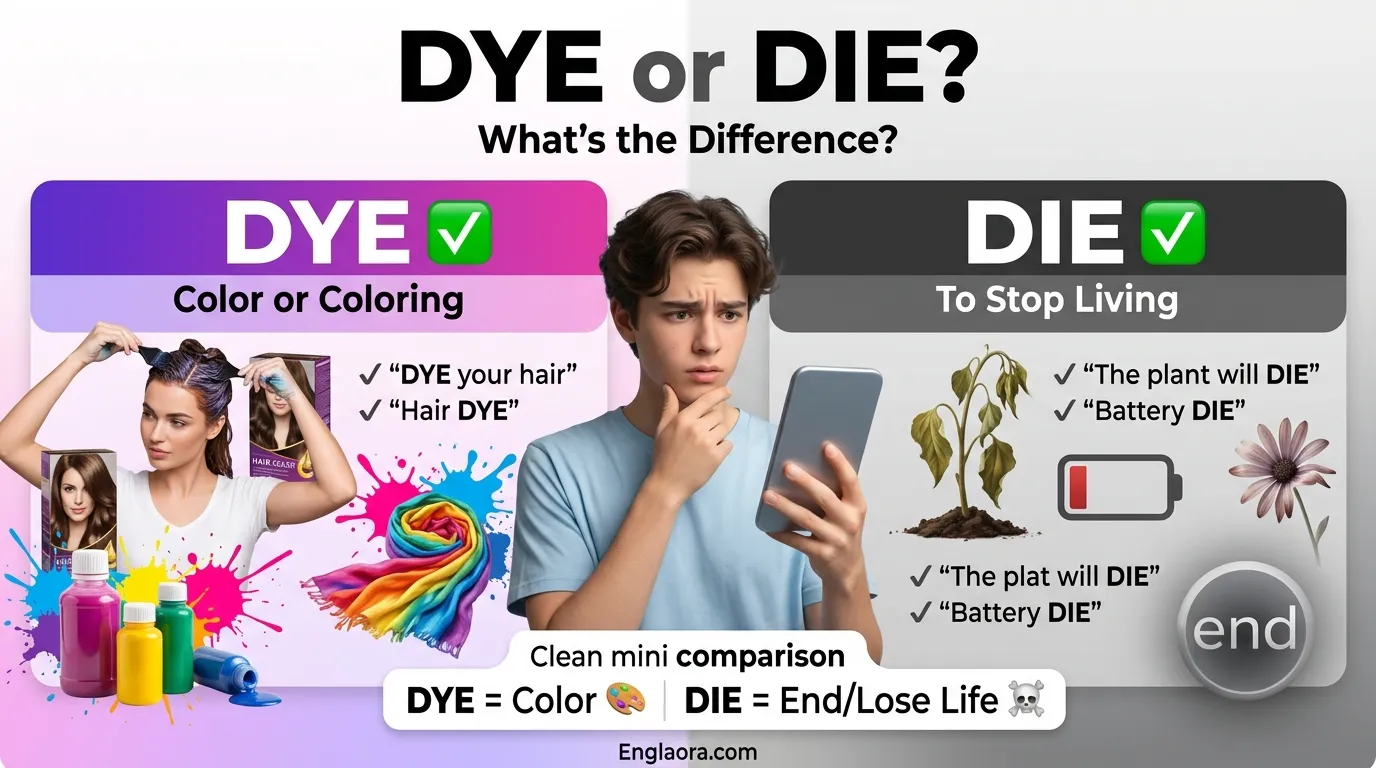
Hey, I want to share something that happened to me recently involving dye or die.
I was texting a friend about changing my hair color when I suddenly paused and thought, “Wait… is it dye or die?”
Honestly, I got confused because both words sound exactly the same. I did not want to send the wrong message or look careless.
Questions like “Is it dye or die for hair?”, “Is it dyeing or dying?”, and “What is the difference between dye and die?” started coming to my mind.
So, I decided to look into dye or die properly. Once I understood the meaning, spelling, pronunciation, and common mistakes, everything became much easier.
If you have ever been confused too, this simple guide will clear it up completely.
Dye or die – Quick answer
These two words sound exactly the same. But they mean very different things.
Dye is a colored substance. You use it to change the color of something. Hair dye, fabric dye, and food dye are common examples.
Die means to stop living. It can also refer to a tool used for cutting or shaping materials.
Quick examples:
- She used a red dye to color her hair.
- The plant will die if you do not water it.
- He bought a die to stamp metal parts in the factory.
So: if you are talking about color, use dye. If you are talking about death or a shaping tool, use die.
The Origin of Dye or Die
Both words are very old, but they come from different places.
Dye comes from an Old English word related to color or pigment. People have used natural dyes from plants, flowers, and minerals for hundreds of years to color clothes, food, and fabrics.
Die comes from an old word meaning to stop living. Over time, it became the common English word used for death or the end of life.
The word die also has another meaning. In factories and manufacturing, a die is a hard tool used to cut, shape, or stamp materials.
Even though dye and die sound exactly the same, they have completely different meanings and origins. That is why they are called homophones.
British English vs American English spelling
There is no spelling difference between British and American English for these words. Both countries spell them as dye and die.
However, the continuous form causes a lot of confusion.
When you add ing to dye, it becomes dyeing (not dying). The extra e is kept to avoid confusion with dying, which comes from die.
Word Adding ING Correct Form Meaning Dye dye + ing Dyeing Coloring with dye Die die + ing Dying In the process of death
Many people search is it dyeing or dying because this is one of the most common spelling mistakes in English. The answer is simple: dyeing is for color, dying is for death.
Both British and American English follow this same rule.
Which spelling should you use?
Use dye when you are talking about:
- Coloring hair, fabric, or food
- A substance that changes color
- The process of adding color to something
Use die when you are talking about:
- Death or the end of life
- A tool that cuts or shapes hard materials
- Something coming to an end
If you are asking is it called hair dye or hair die, the answer is always hair dye. The substance you put in your hair to change its color is called hair dye. You dye your hair. You do not die your hair.
For global writing, these rules apply everywhere. There is no regional exception.
Common mistakes with dye or die
Here are the most common errors writers make:
Mistake 1: Using die instead of dye for hair color
Wrong: I want to die my hair red. Correct: I want to dye my hair red.
Mistake 2: Spelling dyeing as dying
Wrong: She is dying her hair at the salon. Correct: She is dyeing her hair at the salon.
Mistake 3: Using dye when talking about death
Wrong: The flowers will dye without water. Correct: The flowers will die without water.
Mistake 4: Writing died instead of dyed
❌ Wrong: She died her hair last night.
✔ Correct: She dyed her hair last night.
Many people ask “Is it died or dyed my hair?”
The correct word is always dyed because you are talking about adding color.
✔ “I dyed my hair brown.”
❌ “I died my hair brown.”
Mistake 5: Confusing die the tool with die the verb
Wrong: The factory uses a dye to stamp metal. Correct: The factory uses a die to stamp metal.
Dye or die in everyday examples
Email example:
Hi Sarah, I wanted to ask about the dyeing process for the fabric samples. Can you confirm which dye we are using for the blue collection?
Social media example:
Just finished dyeing my hair for the first time. Took two hours but totally worth it! Pro tip: always use a color-safe shampoo after you dye your hair.
News example:
Local authorities reported that several fish species may die if the factory continues releasing untreated chemicals into the river. Environmental groups called for a ban on synthetic dye disposal in waterways.
Formal writing example:
The textile company confirmed that all dye materials used in production are certified non-toxic. The company denies that the chemicals cause any harm or contribute to the dying of aquatic life in nearby water bodies.
Why People Confuse Dye and Die
Many people confuse dye and die because they are homophones, meaning they sound exactly the same but have different meanings.
The confusion becomes even bigger with words like dyeing and dying, especially in sentences about hair color.
For example:
❌ “She is dying her hair.”
✔ “She is dyeing her hair.”
People also often type searches like:
- dye or die for hair
- is it dyeing or dying
- died or dyed my hair
This confusion is very common, even among native English speakers. The good news is that once you remember dye = color and die = death/end, it becomes much easier.
Full comparison table
| Word | Type | Meaning | Example | Region |
|---|---|---|---|---|
| Dye | Noun / Verb | A coloring substance or the act of adding color | She bought red dye for her dress. | Global |
| Die | Verb | To stop living or stop working | The battery will die soon. | Global |
| Die | Noun | A tool used to cut, stamp, or shape materials | The factory uses a steel die. | Global |
| Dyeing | Verb (Present) | The process of adding color | She is dyeing her hair. | Global |
| Dying | Verb (Present) | The process of losing life or stopping | The plant is dying without water. | Global |
| Dyed | Verb (Past) | Added color in the past | She dyed her hair brown. | Global |
| Died | Verb (Past) | Passed away or stopped working in the past | The old tree died last winter. | Global |
FAQs
What is the difference between dye and die?
Dye is used for color or coloring something. Die means to stop living or a tool used to shape materials. They sound the same but have different meanings.
Is it dye or die for hair?
It is always dye. The correct term is hair dye. You dye your hair, not die your hair.
Is it dyeing or dying?
Dyeing means adding color. Dying means losing life.
Example: “She is dyeing her hair.” / “The plant is dying.”
Is it died or dyed my hair?
The correct word is dyed.
✔ “I dyed my hair.”
❌ “I died my hair.”
What does die mean?
Die means to stop living. It can also mean a tool used to cut or shape materials.
How do you pronounce dye and die?
Both words sound exactly the same. They rhyme with sky, fly, and my.
Is dyeing a real word?
Yes. Dyeing is the action of adding color.
Example: “She is dyeing her scarf.”
What are the four forms of die?
Die, dies, died, dying
Example: “The battery is dying.”
Can I call my boyfriend my ride or die?
Yes. Ride or die means someone loyal who stays with you no matter what.
Is it do or die or dye or die?
The correct phrase is do or die. It means a situation where success is very important.
Is dye bad for your hair?
Hair dye can cause dryness if overused. Good products and proper care help reduce damage.
What is a die in manufacturing?
A die is a tool used to cut, stamp, or shape materials like metal or plastic.
Conclusion
Dye and die may sound exactly the same, but they have very different meanings.
- Use dye for color, hair, fabric, or anything related to coloring.
- Use die for death, endings, or a manufacturing tool.
The most confusing part is usually dyeing and dying. Just remember:
Dyeing = adding color
Dying = losing life
A simple trick is this:
Dye = color 🎨
Die = death/end 💀
Once you remember this rule, you will never confuse dye or die again. If you are writing a text, social media post, school paper, or work email, you can now use the correct word with confidence.

I’m Samantha Greene, working at Englaora.com to explain language differences and provide readers with easy-to-understand insights on commonly mistaken terms.