Hey, I want to share something that happened to me recently involving flu or flue.
A friend texted me:
“I think I caught the flue.”
For a second, I paused.
Wait… flue?
Did they mean the illness? Or something related to a chimney?
That is when I realized why so many people get confused between flu and flue. These two words sound exactly the same, but they mean completely different things.
One refers to an illness that makes you sick.
The other refers to a pipe inside a chimney.
No wonder people mix them up.
If you have ever wondered:
- Is it flu or flue?
- How do you spell flu?
- What is the difference between flu and flue?
- Is chimney flu or flue correct?
You are in the right place.
In this guide, I will explain the correct spelling, meaning, pronunciation, common mistakes, and real examples so you never confuse them again.
Let us clear it up once and for all.
Flu or flue – Quick answer
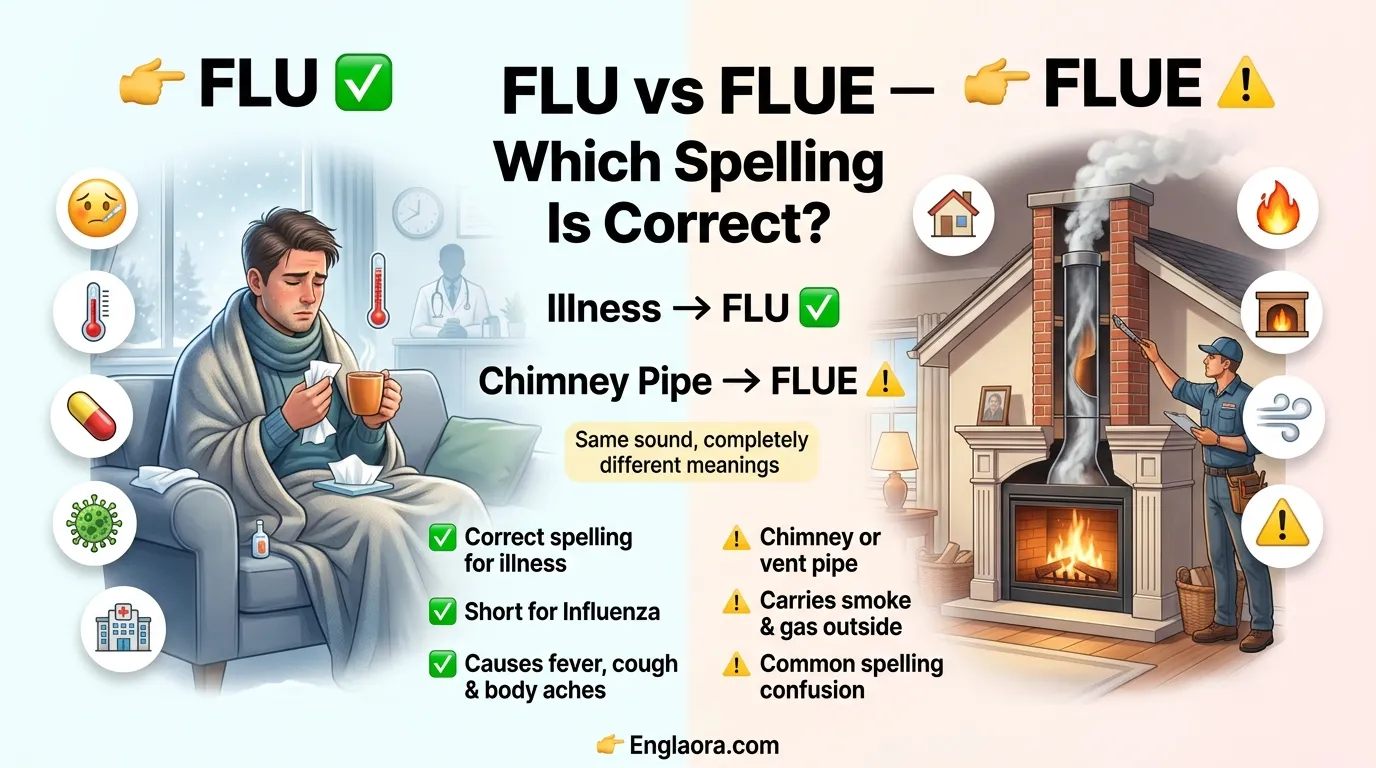
Flu is the illness. It is short for influenza. It is a virus that causes fever, body aches, and tiredness.
Flue is a pipe or channel. It carries smoke or gas out of a building. You find a flue inside a chimney.
Here are quick examples:
“I caught the flu last winter and stayed in bed for five days.”
“The chimney flue was blocked, so smoke filled the room.”
“She tested positive on a flu test at the clinic.”
So which is correct for the illness? Always flu. For the chimney pipe? Always flue.
Flu and flue are two completely different words.
Flu vs Flue: What Is the Difference?
The difference is actually very simple.
Flu
Flu is short for influenza, a contagious viral illness.
It commonly causes:
- Fever
- Body aches
- Coughing
- Fatigue
- Sore throat
Example:
“Many people get the flu during winter.”
Flue
A flue is a duct, pipe, or channel that carries smoke, heat, or gas outside a building.
You usually find a flue:
- Inside a chimney
- In fireplaces
- In heating systems
- In ventilation systems
Example:
“The fireplace flue needed cleaning before winter.”
Quick comparison table
| Word | Meaning | Example |
|---|---|---|
| Flu | Illness (influenza) | She caught the flu. |
| Flue | Chimney or ventilation pipe | The flue was blocked. |
The origin of flu or flue
The word flu is a short form of influenza. That word came from Italian in the 1700s. It originally meant “influence of the stars.” People back then believed cold weather and bad stars caused illness. The word entered English around 1839. Over time, people shortened “influenza” to “flu” for everyday use.
The word flue has a different history. It comes from an old Flemish word meaning “to flow.” It entered English in the 1500s. A flue is any channel that allows air, smoke, or gas to flow through. Chimneys have flues. Heating systems have flues. Even some musical instruments have flues inside them.
This is why people get confused. Both words sound the same. But they come from completely different roots and mean completely different things.
Some people also mix up flue and flute. A flute is a musical instrument. A flue is a pipe or channel. They are not the same. Flue is not a flute.
British English vs American English spelling
Here is good news. There is no spelling difference between British and American English for these words.
Both countries spell the illness as flu.
Both countries spell the chimney pipe as flue.
However, there are small usage differences:
In American English, people say “I have the flu” or “I got the flu.”
In British English, people sometimes say “I have flu” without the article “the.” Both are correct.
For the chimney, both countries use “flue” the same way.
Can we say “a flu”? Technically yes, but it sounds informal. “I had a flu last month” is acceptable in casual speech. In formal writing, “I had the flu” or “I had influenza” is better.
| Word | Meaning | Region | Example |
|---|---|---|---|
| Flu | Influenza illness | Global | She has the flu. |
| Flue | Chimney pipe or channel | Global | Clean the chimney flue. |
| Influenza | Full medical term | Formal/Medical | Influenza causes fever and fatigue. |
| Flute | Musical instrument | Global | She plays the flute. |
| Cold | Different illness | Global | Is it a cold or flu? |
Which spelling should you use?
The rule is simple.
Use flu when you are talking about the illness. It does not matter if you are in the US, UK, or anywhere else. Flu is always the correct spelling for the sickness.
Use flue when you are talking about a pipe, duct, or channel. This is common in home improvement, construction, and fireplace topics. Chimney flu or flue? Always flue. Chimney flu is a spelling mistake.
Use influenza in medical or professional writing. It is the full scientific name for the flu virus.
If someone asks “which is correct, flu or flue?” the answer depends on what you mean. For the illness, flu is correct. For the chimney, flue is correct.
Is it spelled flu or flue? For the sickness, it is always flu. Never flue.
Common mistakes with flu or flue
People make these errors all the time. Here are the most common ones with corrections.
| Wrong ❌ | Correct ✅ | Reason |
|---|---|---|
| I have the flue. | I have the flu. | Flue is a chimney pipe, not an illness. |
| Clean the chimney flu. | Clean the chimney flue. | Flu is the illness, flue is the pipe. |
| Flue symptoms include fever. | Flu symptoms include fever. | You mean the illness, so use flu. |
| Is flue a virus? | Is flu a virus? | You are asking about the illness. |
| I took a flue test. | I took a flu test. | Flu test checks for influenza virus. |
| She had flue or flute. | She had flu. | Flute is a musical instrument. |
Is fever called flu?
Not exactly. Fever is one symptom of the flu. But flu is the full illness caused by the influenza virus. Fever alone does not mean you have the flu.
Is the flu called COVID?
No. Flu and COVID are different illnesses. Both cause fever and body aches. But COVID is caused by the coronavirus. Flu is caused by the influenza virus. They are separate conditions.
Flu or flue in Everyday Examples
Email example:
“Hi Team, please note that three staff members are out sick with the flu this week. We hope they recover soon.”
Social media example:
“Just got my flu shot today! Stay safe this season everyone. Flu symptoms hit fast so protect yourself early.”
News example:
“Health officials warned that flu or flue confusion is common online. They reminded the public that flu tests are now available at local clinics.”
Home improvement example:
“The contractor inspected the chimney flue and found a blockage near the top. He recommended cleaning the flue before winter.”
Formal writing example:
“Influenza, commonly known as the flu, is a contagious respiratory illness caused by influenza viruses. It spreads through droplets when infected people cough or sneeze.”
Flu symptoms, causes, and treatment
What are the symptoms of flu?
Flu symptoms come on suddenly. The most common ones are:
- High fever (usually above 38°C or 100.4°F)
- Severe body aches and muscle pain
- Headache
- Dry cough
- Sore throat
- Runny or stuffy nose
- Tiredness and weakness
- Some people, especially children, get vomiting and diarrhea
Do I have a cold or flu?
A cold comes on slowly. The flu hits fast and hard. High fever and severe body aches point to flu, not a cold.
What are the 4 types of flu?
- Influenza A (most common, causes major outbreaks)
- Influenza B (seasonal, usually less severe)
- Influenza C (mild, rarely causes epidemics)
- Influenza D (mainly affects cattle, not humans)
What are the stages of flu?
Stage 1 is the incubation period, which lasts 1 to 4 days. You have the virus but no symptoms yet.
Stage 2 is the acute phase, which lasts 3 to 7 days. Symptoms are at their worst.
Stage 3 is recovery, which lasts 1 to 2 weeks. Symptoms fade but fatigue may remain.
Is influenza dangerous?
It can be. Most healthy adults recover in 1 to 2 weeks. But it is dangerous for the older people, young children, pregnant people, and people with weak immune systems. Flu can lead to pneumonia and hospitalization.
Is influenza contagious?
Yes. It spreads very easily through coughs, sneezes, and contact with infected surfaces. A person is contagious from 1 day before symptoms start to about 5 to 7 days after getting sick.
Influenza causes:
The flu is caused by influenza A or B viruses. It spreads through respiratory droplets.
Influenza treatment:
Rest, fluids, and over the counter medicines help most people. Antiviral drugs like oseltamivir (Tamiflu) work best if taken within 48 hours of symptoms starting. See a doctor if symptoms are severe.
Flu or flue – Google Trends and usage data
Search data tells an interesting story.
“Flu symptoms” spikes every year between October and March in the Northern Hemisphere. This is flu season.
“Flu test” searches rise sharply whenever there is a new outbreak or when COVID and flu symptoms overlap.
“Chimney flue” searches peak in autumn when people start using their fireplaces again.
The query “chimney flu or flue” is searched thousands of times monthly. It shows that even in home improvement contexts, people are unsure of the spelling.
“Is it flu or flue” and “which is correct flu or flue” are evergreen grammar queries. People search them year round.
In terms of volume, “flu” is searched millions of times more than “flue.” The illness is far more commonly discussed than the chimney pipe.
Searches for “flue meaning” often come from non native English speakers who encounter the word in a home repair or construction context and are confused.
FAQs
Q1. What is the difference between flu and flue?
Flu is the illness caused by the influenza virus. Flue is a pipe or channel in a chimney or heating system. They sound the same but mean completely different things.
Q2. Which is correct: flu or flue?
For the illness, flu is correct. For the chimney pipe, flue is correct. Both spellings are correct in their own context.
Q3. What does flue mean?
A flue is a duct, pipe, or channel that carries smoke, gas, or hot air out of a building. It is most commonly found inside a chimney.
Q4. Is a flue a virus?
No. A flue is a physical pipe or channel. The flu (without the e) is the viral illness. They are completely different things.
Q5. Is it flue or flute?
They are different words. A flue is a chimney pipe. A flute is a musical instrument. Do not confuse them.
Q6. What is a synonym for flue?
Synonyms for flue include: duct, pipe, chimney shaft, vent, channel, exhaust pipe, and airway.
Q7. What are the symptoms of flu?
Fever, body aches, headache, dry cough, sore throat, fatigue, and sometimes vomiting. Symptoms come on suddenly, which is different from a cold.
Q8. Do I have a cold or flu?
If your symptoms came on fast and include high fever and severe body aches, it is likely flu. If symptoms came on slowly with mostly a runny nose, it is probably a cold.
Q9. What are the 4 types of flu?
Influenza A, B, C, and D. Types A and B cause the seasonal flu outbreaks that most people experience.
Conclusion
Flu and flue are two words that sound exactly the same but mean completely different things.
Flu is the illness. It is short for influenza. Its causes fever, body aches, and coughing. It spreads easily and can be serious for vulnerable people. When you feel sick with a virus, you have the flu. Not the flue.
Flue is the pipe. It lives inside chimneys and heating systems. It channels smoke and gas out of buildings. If you are doing home repairs or talking about your fireplace, you need the flue.
The rule is simple. Illness? Write flu. Chimney pipe? Write flue. Instrument? That is a flute.
This confusion is very common online. Many people write “flue symptoms” or “chimney flu” by mistake. Now you know the difference.
When in doubt, remember: the flu makes you sick. The flue takes smoke away. Keep that picture in your head and you will never mix them up again.

Hi, I’m Emma Caldwell, an expert author at Englaora.com. I share clear insights on language differences and provide readers with reliable, easy-to-understand content.