Canon or Cannon: What’s the Difference and How to Use Them
Hey, I want to share something that happened to me recently involving canon or cannon. I was chatting with a friend online when this word suddenly came up in the conversation.
My friend wrote, “That scene isn’t cannon in the story.” For a moment, I paused and thought, “Wait… is it canon or cannon?” Both words sounded exactly the same, which made things even more confusing.
I did not want to reply with the wrong spelling or sound careless. Questions like “What is the difference between canon and cannon?”, “Is it canon event or cannon event?”, and “Which one is correct in movies or history?” started coming to my mind.
So, I decided to look into canon or cannon properly. Once I understood the meanings, pronunciation, origins, and common mistakes, everything became much clearer.
If you have ever been confused too, this simple guide will explain everything in an easy way.
Canon or Cannon – Quick Answer
The difference is simple:
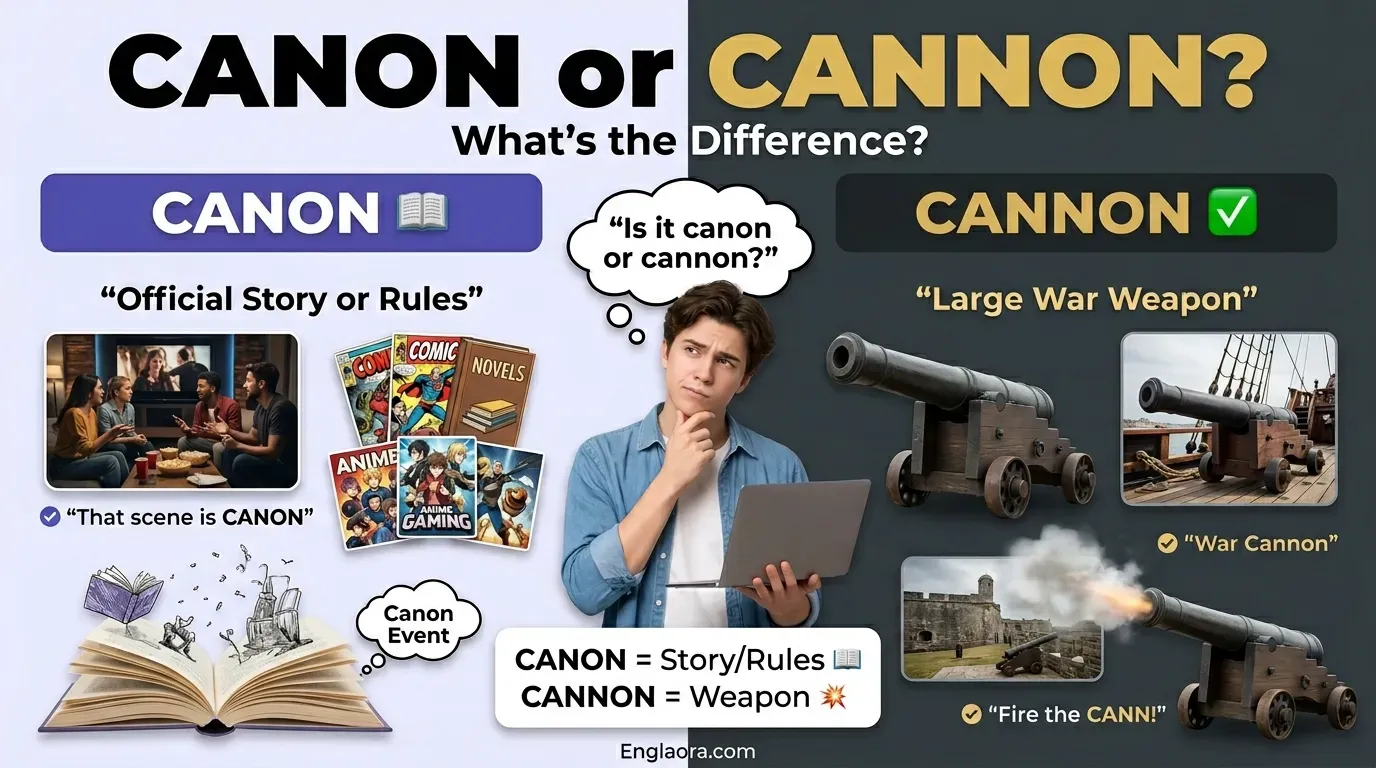
- Canon = Official story, accepted rules, or true events in books, movies, TV shows, religion, or fandoms.
- Cannon = A large heavy gun used in wars and battles.
Quick Examples
✔ “That scene is canon in the movie.”
✔ “The soldiers fired the cannon.”
Simple Rule
Canon = Story or Rules 📖
Cannon = Weapon 💥
What Does Canon Mean?
Canon means something that is officially accepted as true or part of the original story.
It is commonly used in:
- Movies and TV shows
- Books and comics
- Anime and gaming fandoms
- Religion and official texts
Examples
- “This book is part of the official canon.”
- “That scene is not canon in the story.”
- “The church follows biblical canon.”
What Is a Canon Event?
A canon event is an important moment that officially happens in a character’s story.
For example:
“That tragedy was a canon event in the hero’s journey.”
In fandoms, people often talk about canon events when discussing movies, comics, or characters.
What Does Cannon Mean?
A cannon is a large and powerful gun used in wars and battles.
Cannons were commonly placed on:
- Ships
- Forts
- Castles
- Battlefields
Examples
- “The pirate ship fired its cannon.”
- “The museum displayed an old war cannon.”
- “The army used heavy cannons during battle.”
Canon vs Cannon in Different Contexts
Canon or Cannon in Movies and Fandoms
In movies, anime, gaming, or fandom discussions, canon is the correct word.
✔ “That relationship is canon.”
✔ “This episode is not canon.”
Canon or Cannon in Military History
In military or historical topics, always use cannon.
✔ “The soldiers loaded the cannon.”
Canon Event or Cannon Event?
The correct phrase is:
✔ Canon event
❌ Cannon event
This mistake is very common online because both words sound the same.
Canon or Cannon Pronunciation
Both words are pronounced exactly the same:
KAN-uhn (/ˈkæn.ən/)
Because they sound identical, people often confuse the spelling.
This makes canon and cannon examples of homophones — words that sound alike but have different meanings.
The Origin of Canon and Cannon
Even though these words sound the same, they come from different origins.
Canon comes from the Greek word “kanon,” meaning rule, standard, or accepted truth. Over time, it became linked to religion, literature, and official stories.
Cannon comes from the Latin word “canna,” meaning tube or pipe. Later, the word was used for large tube-shaped guns used in battle.
This is why canon and cannon sound alike but mean completely different things.
British English vs American English Spelling
Good news — there is no spelling difference between British and American English.
Both countries use:
- Canon for official stories or rules
- Cannon for weapons
The correct spelling depends on the meaning, not the region.
Canon vs Cannon – Quick Comparison
| Word | Meaning | Used In | Example |
|---|---|---|---|
| Canon | Official story, accepted rule, or truth | Movies, books, religion, fandoms | “That scene is canon.” |
| Cannon | A large heavy gun | Military, history | “The soldiers fired the cannon.” |
| Cannons | More than one cannon | Military | “The fort had many cannons.” |
Which Spelling Should You Use?
Use canon when talking about:
- Official stories
- Movies or books
- Anime and fandom discussions
- Religious texts
- Accepted events
Use cannon when talking about:
- Weapons
- Military history
- Wars and battles
A quick trick:
Canon = Story 📖
Cannon = Gun 💥
If you stop and think about the meaning, choosing the correct spelling becomes easy.
Common Mistakes with Canon or Cannon
Many people mix up these words because they sound exactly the same.
Mistake 1: Using Cannon for a Story
❌ “That scene is cannon.”
✔ “That scene is canon.”
Mistake 2: Using Canon for a Weapon
❌ “The army fired the canon.”
✔ “The army fired the cannon.”
Mistake 3: Writing Cannon Event
❌ “Spider-Man had a cannon event.”
✔ “Spider-Man had a canon event.”
Canon or Cannon in Everyday Examples
Email Example
“Can you confirm if this plot change is canon in the next season?”
Social Media Example
“That plot twist was not canon! I’m disappointed.”
News Example
“Historians restored an old cannon from the 18th century.”
Formal Writing Example
“The biblical canon includes accepted religious texts.”
Why People Confuse Canon and Cannon
Many people confuse canon and cannon because they sound exactly the same.
These words are homophones, which means they have the same pronunciation but different meanings.
The confusion is especially common in:
- Movie and anime fandoms
- Gaming discussions
- Grammar searches
- Military history topics
For example:
❌ “That scene is cannon.”
✔ “That scene is canon.”
❌ “The soldiers fired the canon.”
✔ “The soldiers fired the cannon.”
A simple memory trick is:
Canon = Story or Rules 📖
Cannon = Weapon 💥
FAQs
Q1: What is the difference between canon and cannon?
A: Canon means an official story or accepted rule. Cannon means a large weapon.
Q2: Why do people confuse canon and cannon?
A: Because both words sound exactly the same.
Q3: Is canon used in movies and anime?
A: Yes. Canon means events that are officially part of the story.
Q4: What does cannon mean in history?
A: A cannon is a large artillery gun used in wars.
Q5: What is a canon event?
A: An important moment that officially happens in a character’s story.
Q6: Can cannon mean something other than a gun?
A: Usually, no. In most cases, it refers to a weapon.
Q7: Which is correct: cannon or cannons?
A: Cannon is singular. Cannons is plural.
Conclusion
Even though canon and cannon sound exactly the same, their meanings are completely different.
- Canon = official story, accepted rules, or true events 📖
- Cannon = large weapon used in battles 💥
A simple trick is:
Canon = Story
Cannon = Gun
Once you remember this rule, you will never confuse canon or cannon again.

I’m Samantha Greene, working at Englaora.com to explain language differences and provide readers with easy-to-understand insights on commonly mistaken terms.