Hey, I want to share something that happened to me recently involving eminent or imminent.
I was reading a news article. The writer said a storm was “eminent.” I paused. Something felt off. But I wasn’t 100% sure. So I kept reading. Then my friend texted me: “Is the deadline eminent or imminent?”
Honestly? I froze.
Both words sounded right in my head. Both looked almost the same on paper. But I had a feeling they meant something very different and I didn’t want to give my friend the wrong answer.
So I stopped and looked it up properly.
Turns out these two words are completely different. One is about fame and greatness. The other is about something about to happen very soon.
Mixing them up is a very common mistake. Thousands of people search “eminent or imminent” every month because this confusion is real.
People also ask: What does imminent mean? What is an eminent person? Does imminent mean very soon? What is eminent vs imminent?
This article answers all of it. In simple words. With real examples. By the end, you will never mix these two up again.
Let’s go.
Eminent or imminent – Quick answer
Here is the fast, clear answer:
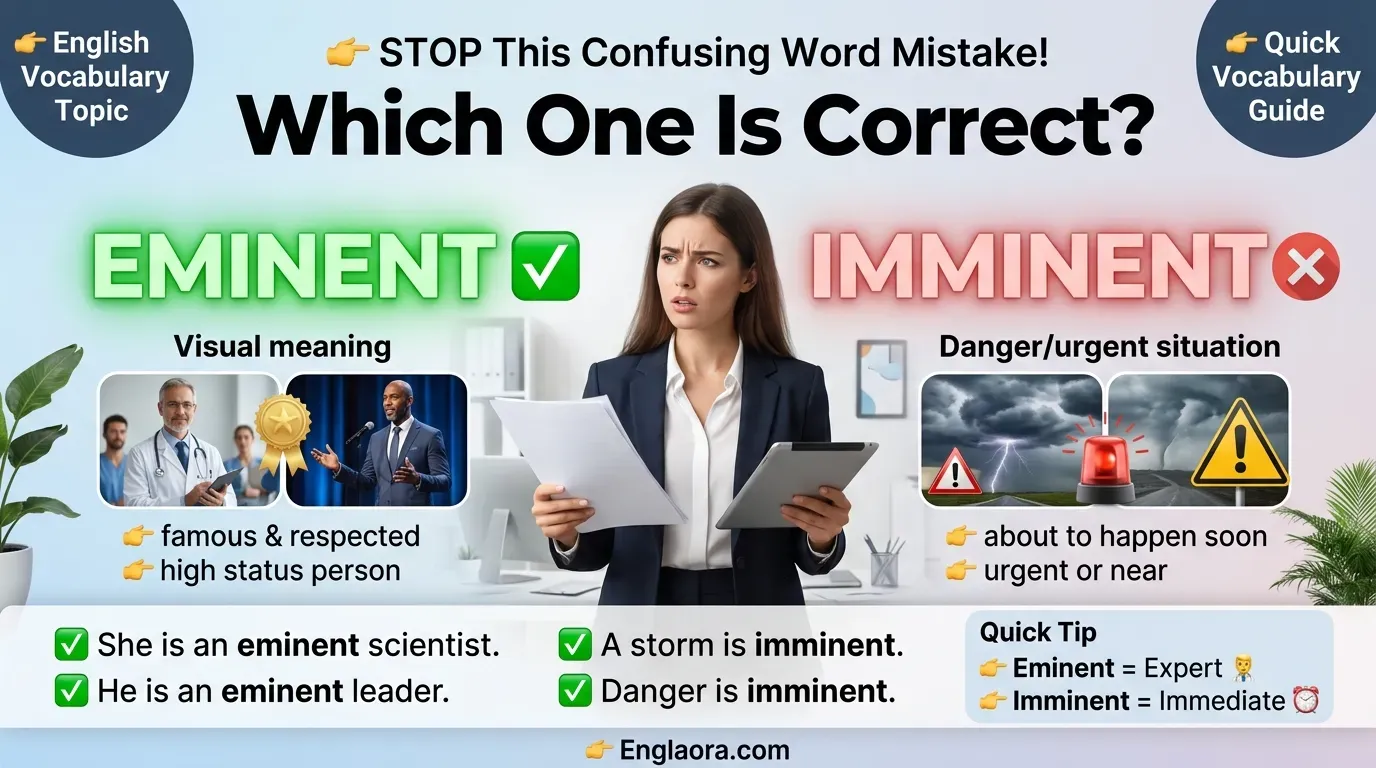
- Eminent = famous, respected, and highly regarded. It describes a person or quality that stands out above others.
- Imminent = about to happen very soon. It describes an event that is coming in a very short time.
Simple trick:
- Think eminent → famous person (like an eminent doctor or scientist)
- Think imminent → arriving any minute (like danger, a deadline, or a storm)
Examples:
- She is an eminent professor at Oxford University.
- The storm is imminent. Please stay indoors.
- He is an eminent surgeon with 30 years of experience.
- A decision is imminent. We expect an announcement today.
One word is about greatness. The other is about timing. That’s the whole difference.
The origin of eminent or imminent
Understanding where these words come from makes it easier to remember them.
Eminent comes from the Latin word eminere, which means to stand out or to project above. It entered English in the 15th century. It was used to describe hills, towers, and eventually great people who “stood above” others in their field.
Imminent comes from the Latin word imminere, which means to overhang or to threaten. It also entered English in the 15th century. It described something looming overhead like a threat, danger, or event hanging right above you, about to fall.
So even in Latin, one word was about height and fame (eminent) and the other was about something hanging over you (imminent).
They look similar because both come from Latin -minere (to project or jut out). But the prefixes change everything:
- E- (from ex) = out, outward → standing out = eminent
- Im- (from in) = on, upon, over → hanging over = imminent
This is also why students search for eminent or imminent pronunciation — the words sound so close that even native speakers pause.
British English vs American English spelling
Great news: there is no spelling difference between British and American English for these two words.
Both countries spell them:
- Eminent ✅
- Imminent ✅
However, there are small usage differences:
- In American English, “imminent” is very common in news, legal, and weather writing. Americans say “imminent threat,” “imminent danger,” and “imminent domain” (though “eminent domain” is the correct legal term — more on that in mistakes!).
- In British English, “eminent” is frequently used in academic and formal contexts. British writers often describe scholars, judges, and officials as “eminent.”
Pronunciation:
- Eminent → EM-ih-nent
- Imminent → IM-ih-nent
They are NOT homophones. The stress and first vowel sound are slightly different. But in fast speech, they can sound almost identical — which is why so many people confuse them.
Comparison Table: Eminent vs Imminent
| Feature | Eminent | Imminent |
|---|---|---|
| Meaning | Famous, respected, outstanding | About to happen very soon |
| Part of Speech | Adjective | Adjective |
| Used for | People, qualities, achievements | Events, threats, deadlines |
| Latin Root | eminere (to stand out) | imminere (to hang over) |
| Pronunciation | EM-ih-nent | IM-ih-nent |
| British Example | An eminent barrister argued the case. | A verdict is imminent. |
| American Example | She is an eminent scientist at MIT. | The hurricane is imminent. |
| Positive/Negative? | Positive ✅ | Neutral (often negative context) |
| Common Synonym | Distinguished, prominent, notable | Impending, approaching, looming |
Which spelling should you use?
Both spellings are the same worldwide — so there is no spelling choice to make. But you do need to choose the right word.
Here is a simple guide:
Use EMINENT when:
- Describing a famous or highly respected person
- Talking about a quality that stands out
- Writing about someone’s achievements or status
Dr. Ahmed is an eminent cardiologist in Lahore.
The university honored its most eminent alumni.
Use IMMINENT when:
- Describing something that is about to happen
- Writing about a threat, danger, deadline, or event
- Using words like “danger,” “threat,” “arrival,” “collapse,” “storm”
The deadline is imminent. Submit your work now.
Doctors warned that a health crisis was imminent.
Global advice: Both words are used the same way in all English-speaking countries. When in doubt, ask yourself: Am I describing a person’s greatness (eminent) or an event about to happen (imminent)?
Common mistakes with eminent or imminent
This is where most people go wrong. Here are the top errors — and how to fix them:
Mistake 1: Using “eminent” when you mean “imminent”
❌ The storm is eminent. Please stay inside.
✅ The storm is imminent. Please stay inside.
A storm is not famous. A storm is about to arrive. Use imminent.
Mistake 2: Using “imminent” when you mean “eminent”
❌ She is an imminent professor at Harvard.
✅ She is an eminent professor at Harvard.
A professor is not “about to happen.” She is highly respected. Use eminent.
Mistake 3: “Eminent domain” vs “Imminent domain”
❌ The government used imminent domain to take the land.
✅ The government used eminent domain to take the land.
This is a very common legal error. “Eminent domain” is the correct legal term — it means the government’s outstanding/superior right to take private property for public use.
Mistake 4: Confusing with “immanent”
There is actually a THIRD word: immanent. It means “existing within” or “inherent.” This is a philosophical term. It is NOT the same as imminent (about to happen) or eminent (famous).
Mistake 5: Pronunciation confusion
Many people say IM-ih-nent for both words in speech. Slow down and notice: eminent starts with EH sound, imminent starts with IH sound. Practice them separately.
Quick Correction Table:
| Wrong ❌ | Correct ✅ | Reason |
|---|---|---|
| The danger is eminent | The danger is imminent | Danger = event, not a person |
| An imminent scientist | An eminent scientist | Scientist = person, not event |
| Imminent domain | Eminent domain | Legal term — always eminent |
| She is an imminent author | She is an eminent author | Author’s fame, not timing |
Eminent or imminent in everyday examples
Let’s see how both words are used in real-life writing.
Email Example:
Subject: Urgent — Decision Imminent
Dear Team, please be advised that a final decision on the merger is imminent. We expect an announcement within 24 hours. Our eminent legal advisor, Mr. Tariq Shah, will brief the board tomorrow morning.
Social Media Example:
Tweet: “A major policy change is imminent. Follow @NewsUpdates for live coverage. Our eminent panel of economists will analyze the impact tonight at 9 PM.”
News Writing Example:
The government warned that a flood is imminent in low-lying areas. Eminent climate scientists have been urging action on this issue for over a decade.
Formal Writing Example:
The committee, chaired by the eminent historian Professor Nadia Malik, concluded that a restructuring of the department was imminent given the current budget crisis.
Notice how in many real-world examples, both words appear together one describing a respected person, the other describing an upcoming event. This is natural. Use them together when your writing calls for it.
Eminent or imminent – Google Trends and usage data
When we look at how people search and use these words, clear patterns appear.
- “Imminent” is searched far more often than “eminent” in everyday queries. This is because “imminent” appears in urgent news, weather, politics, and legal stories.
- “Eminent” spikes in searches related to academics, awards, obituaries, and formal announcements.
- The search query “eminent vs imminent” is one of the top grammar confusion searches in English alongside “affect vs effect” and “accept vs except.”
- In South Asia (Pakistan, India, Bangladesh), both words appear in formal writing and news but are frequently confused in everyday speech.
- “Eminent or imminent pronunciation” is a popular search showing that people are confused not just about meaning, but about how to say these words aloud.
- The phrase “imminent danger” and “imminent threat” are among the most searched collocations globally.
- “Eminent domain” spikes in US legal searches and is frequently misspelled as “imminent domain.”
The data is clear: this is one of the most commonly confused word pairs in English, across all regions and writing levels.
FAQs
Q1. What does “imminent” mean?
Imminent means something will happen very soon. Example: The storm is imminent.
Q2. What does “eminent” mean?
Eminent means famous and highly respected. Example: She is an eminent doctor.
Q3. Eminent vs imminent (simple)?
Eminent = respected person
Imminent = about to happen
Q4. Does imminent mean guaranteed?
No. It means very soon, but it may still be stopped.
Q5. Is impending the same as imminent?
Almost. Imminent = very close. Impending = coming soon.
Q6. Synonyms of eminent?
Distinguished, prominent, renowned, notable, celebrated.
Q7. Synonyms of imminent?
Impending, near, approaching, coming soon.
Q8. What is an eminent person?
A famous and respected person.
Q9. Is “eminent” positive?
Yes. It is a positive word.
Q10. Opposite of eminent?
Unknown, ordinary, insignificant.
Q11. Simple meaning of imminent?
Something about to happen very soon.
Q12. Eminent in a sentence?
He is an eminent scientist.
Q13. Imminent in a sentence?
The deadline is imminent.
Q14. Pronunciation?
Eminent = EM-ih-nent
Imminent = IM-ih-nent
Conclusion
Let’s bring it all together.
Eminent and imminent are two of the most confused words in English — and now you know exactly why. They look similar. They come from the same Latin root. And they both end in -inent. But their meanings are completely different.
Eminent = a famous, respected, outstanding person or quality. Use it to describe great people and achievements.
Imminent = something that is about to happen very soon. Use it to describe upcoming events, threats, and deadlines.
Remember the quick tricks: Eminent sounds like eminence greatness. Imminent sounds like it’s coming any minute urgency.
Never write “the storm is eminent” again. Never call a professor “imminent.” And always remember: it is eminent domain not imminent domain.

I’m Liam Prescott, writing for Englaora.com. I explain the nuances of commonly confused words, making complex topics simple and engaging for readers.