Hey, I want to share something that happened to me recently involving an invoice or bill.
I had just finished a freelance project. My client asked me to send a “bill.” But my accountant told me to send an “invoice.” I sat there thinking aren’t they the same thing?
I Googled it. Some sites said yes, they are the same. Others said no, they are totally different. I didn’t know which format to use, which one to send first, or even what to call it.
Sound familiar?
You are not alone. Every month, thousands of people search for “what is the difference between an invoice and a bill?”
Small business owners, freelancers, students, and even experienced professionals get confused by these two terms.
People search for invoice or bill formats, templates, PDFs, and free tools. They ask: Is invoicing the same as billing? Can an invoice be a bill? What comes first — billing or invoicing?
This article answers all of that. In simple words. With real examples. No confusing jargon.
By the end, you will know exactly when to use an invoice, when to use a bill, and how to create one — fast.
Let’s get started.
Invoice or bill – Quick answer
Here is the short answer:
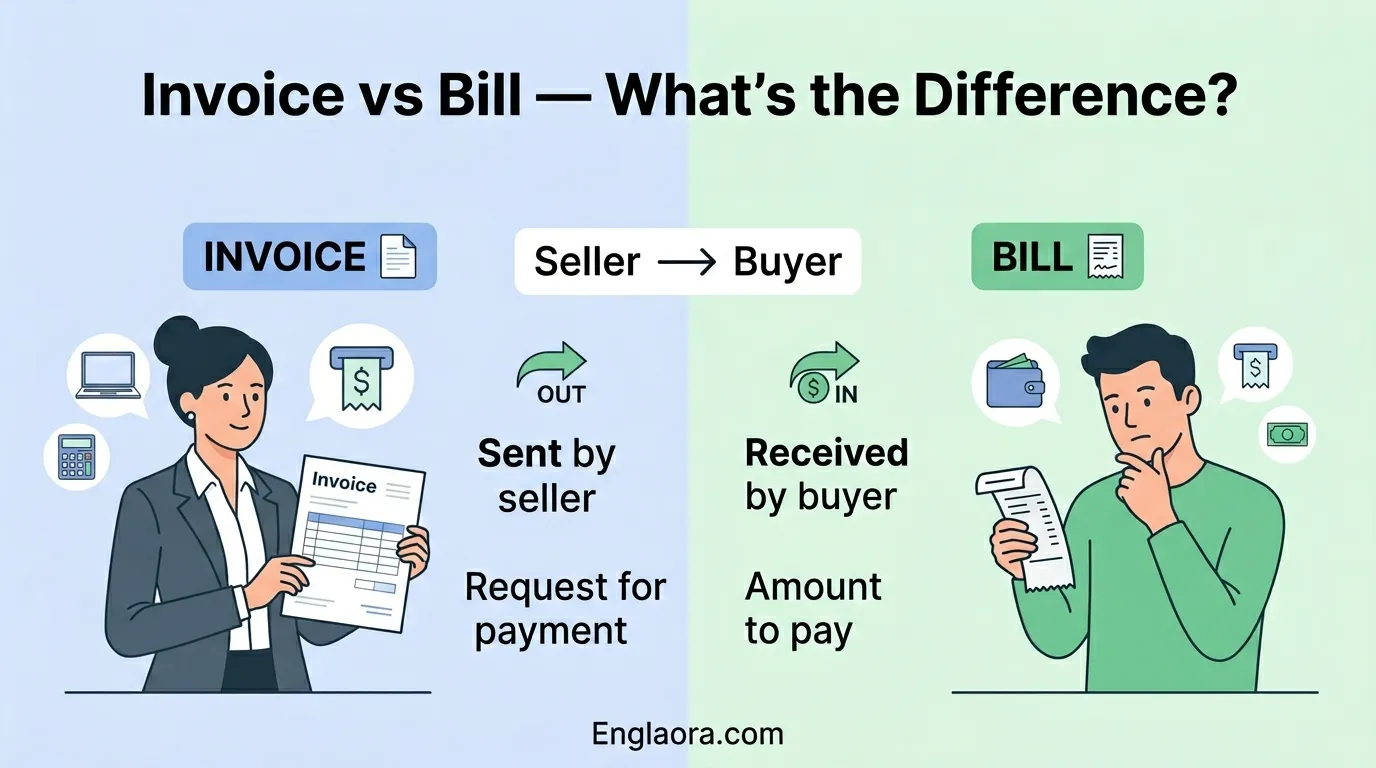
- An invoice is sent by the seller. It asks the buyer to pay.
- A bill is received by the buyer. It tells them what they owe.
Same document. Different perspective.
Examples:
- You finish a job. You send your client an invoice.
- Your client receives it. For them, it is a bill.
- You go to a restaurant. The waiter brings your bill.
- The restaurant recorded it as an invoice in their system.
Think of it this way:
Invoice = “Please pay me.”
Bill = “You need to pay this.”
Both refer to the same payment document. The difference is just who is holding it and why.
The origin of invoice or bill
Where did “Invoice” come from?
The word invoice comes from the French word envoi, meaning “to send.” It entered English in the 16th century. Merchants used it to describe a list of goods sent to a buyer, along with the price.
Over time, it became a formal business document. Today it is used in accounting, freelancing, retail, and trade worldwide.
Where did “Bill” come from?
The word bill comes from the Latin word bulla, meaning a sealed document or official paper. In medieval times, a bill was any written notice. Over centuries, it came to mean a written demand for payment.
Today “bill” is the everyday word most people use. You get a phone bill, electric bill, or hospital bill.
Why do both words exist?
They developed in different business contexts:
- Invoice = professional, B2B (business-to-business), accounting term
- Bill = consumer-facing, everyday term used in shops, restaurants, and utilities
This is also why people search for “invoices or invoice’s” — wondering about the correct plural. The answer: invoices (no apostrophe). “Invoice’s” is only used for possession, like “the invoice’s total.”
British English vs American English spelling
The good news: both “invoice” and “bill” are spelled the same in British and American English. No spelling differences here.
But there are usage differences:
| Term | British English | American English |
|---|---|---|
| Invoice | Common in business/formal writing | Common in business/formal writing |
| Bill | Used in everyday life (phone bill, gas bill) | Same — but also used in restaurants |
| Check | Not common for restaurant payment | Americans say “check” instead of “bill” at a restaurant |
| Receipt | Used after payment | Used after payment |
Examples:
- 🇬🇧 British: “Can I have the bill, please?” (at a restaurant)
- 🇺🇸 American: “Can I have the check, please?” (at a restaurant)
- Both say: “I’ll send you an invoice by end of day.” (business context)
So for invoices and billing in business — both countries use the same language. The difference only shows up in casual, everyday situations.
Which spelling should you use?
Since spelling is the same worldwide, the real question is: which word should you use?
Use “invoice” when:
- You are a seller sending a payment request
- You are in a B2B (business-to-business) situation
- You are using accounting software like QuickBooks
- You are a freelancer billing a client
- You need a formal, trackable document with an invoice number
Use “bill” when:
- You are a customer receiving a payment request
- You are talking about utility bills (phone, electric, water)
- You are in a restaurant or retail setting
- You are speaking casually about money owed
Global advice: In international business, always use “invoice.” It is the universal professional term. “Bill” is understood everywhere but sounds informal in B2B communication.
Common mistakes with invoice or bill
Here are the most common errors — and the fixes:
| Mistake ❌ | Correction ✅ |
|---|---|
| “Send me a bill” (in professional B2B context) | “Send me an invoice” |
| “Invoice’s are due on Friday” | “Invoices are due on Friday” |
| Confusing invoice with receipt | Invoice = before payment. Receipt = after payment. |
| Thinking a bill is always final | A bill can be a proforma (estimate) or a final demand |
| Using “bill” in QuickBooks for a vendor document | In QuickBooks, “bill” = what YOU owe a vendor. “Invoice” = what a customer owes YOU. |
The QuickBooks difference is important. Many people search for “difference between bill and invoice in QuickBooks” because the software uses both terms with specific meanings:
- Invoice in QuickBooks = money coming IN (from customers)
- Bill in QuickBooks = money going OUT (to vendors/suppliers)
Do not mix these up in your accounting software. It will affect your books.
Invoice or bill in everyday examples
Email Example (sending an invoice):
Subject: Invoice #1042 – Web Design Project
Dear Sarah,
Please find attached Invoice #1042 for the website redesign project completed on May 1st. Total amount due: $1,500. Payment is due within 30 days.
Thank you,
Ahmed
Social Media Example:
Posted on LinkedIn:
“Freelancers — stop saying you’ll ‘send a bill.’ Start saying you’ll ‘send an invoice.’ It sounds more professional and helps you get paid faster. 📄 #Freelancing #InvoiceTips”
News/Formal Writing Example:
“The contractor submitted an invoice for $45,000 to the city council for road repair services completed in March.”
Restaurant/Casual Example:
“Excuse me, could we please have the bill? We are ready to leave.”
Invoice Bill Book Example:
Many small businesses in South Asia use a physical invoice bill book — a printed booklet with duplicate/triplicate pages. One copy goes to the customer. One stays with the seller. This is common in markets, small shops, and delivery businesses.
Invoice or bill – Google Trends and usage data
When we look at search patterns, a clear picture emerges:
- “Invoice” is searched more in professional and business contexts. High traffic from freelancers, accountants, and small business owners.
- “Bill” is searched more for everyday utilities — phone bills, electricity bills, hospital bills.
- “Invoice template”, “invoice generator”, and “invoice free” are among the top related searches — showing that people don’t just want to understand the concept, they want tools to create invoices fast.
- “Invoice app” and “invoice online” searches have grown massively as more people work freelance and remote.
- Searches for “invoice template Word” and “invoice or bill PDF” are high among small business owners who prefer offline tools.
- “Invoice or bill format” is especially popular in South Asia (India, Pakistan, Bangladesh) where small business invoicing is rapidly growing.
The most popular free tools people look for:
- Invoice generator (free online tools)
- Invoice app (mobile invoicing)
- Invoice template Word (editable Word format)
- Invoice free PDF (downloadable blank templates)
Full comparison table – Invoice vs bill vs receipt
| Feature | Invoice | Bill | Receipt |
|---|---|---|---|
| Who creates it | Seller / Service provider | Seller / Utility company | Seller (after payment) |
| Who receives it | Buyer / Client | Customer | Customer |
| When it is issued | Before or after service | When payment is due | After payment is made |
| Purpose | Request for payment | Demand for payment | Proof of payment |
| Has invoice number? | Yes | Sometimes | Yes (receipt number) |
| Used in accounting? | Yes (formal record) | Yes | Yes (expense record) |
| Example | Freelancer sends client invoice | Utility company sends monthly bill | Shop prints receipt after purchase |
| In QuickBooks | Money coming IN | Money going OUT (to vendor) | Not a separate document |
Types of invoices – Quick overview
People often ask: What are two types of invoices? Here are the main ones:
- Proforma Invoice — An estimate sent before work begins. Not a final bill. Used to get buyer approval.
- Final Invoice — Sent after work is complete. Requests actual payment.
Other common types:
- Commercial Invoice — Used in international trade and customs
- Credit Invoice — Issued when a refund or discount is given
- Recurring Invoice — Sent regularly (monthly subscriptions, retainers)
- Bill of Entry — A customs document. It is NOT the same as a regular invoice, though related to import/export billing.
What is 3-way invoicing?
3-way invoicing (or 3-way matching) is an accounting process where three documents are matched before payment:
- Purchase Order (PO)
- Delivery Receipt (Goods Received Note)
- Invoice
All three must match before the accounts payable team approves the payment. It prevents fraud and errors.
How to make an invoice bill
Many people ask: “How do I make an invoice bill?”
Here is a simple step-by-step:
- Add your business name and contact info at the top
- Write “INVOICE” clearly as the title
- Add an invoice number (e.g., INV-001) — this is the “invoice no in a bill”
- Add the date and payment due date
- Add client name and address
- List services or products with quantity and price
- Add subtotal, taxes, and total
- Add payment instructions (bank details, PayPal, etc.)
- Add a thank-you note (optional but professional)
Free tools to create invoices:
- Invoice generator — free online at sites like Invoice-generator.com
- Invoice template Word — search Microsoft Office templates
- Invoice free PDF — downloadable from Google
- Invoice app — Wave, Zoho Invoice, PayPal Invoicing (all free)
- Invoice online — create and send directly from browser
FAQs
Q1. What is the difference between an invoice and a bill?
An invoice is sent by the seller to ask for payment. A bill is what the buyer receives. Both are the same document, but the names change based on who is looking at it.
Q2. Is invoicing the same as billing?
They are very similar. Invoicing means creating and sending invoices. Billing means charging customers for products or services. In daily use, people often use both words the same way.
Q3. Can an invoice be a bill?
Yes. When a seller sends an invoice, it becomes a bill for the buyer. So, it is the same document, just seen from a different side.
Q4. Can an invoice be a final bill?
Yes. A final invoice is the final bill after all work is done. But a proforma invoice is only an estimate and not a final payment request.
Q5. What is an invoice number?
An invoice number is a unique ID given to each invoice. It helps track payments and records. Example: INV-001 or 2025-45.
Q6. What comes first — billing or invoicing?
In most cases, invoicing comes first. The seller sends an invoice, the buyer receives it as a bill, then payment is made, and finally a receipt is given.
Q7. Is a bill a receipt or an invoice?
A bill is closer to an invoice because both are given before payment. A receipt is given after payment as proof that money was received.
Q8. Is a bill of entry an invoice?
No. A bill of entry is a customs document used for imported goods. It is different from a sales invoice.
Q9. What is another name for an invoice?
Common names include bill, statement, payment request, or sales invoice. In daily use, “bill” is the most common word.
Conclusion
Let us wrap it all up.
An invoice and a bill are essentially the same document — but seen from different sides of the transaction. The seller sends an invoice. The buyer receives it as a bill. After payment, a receipt is issued as proof.
In everyday life, “bill” is the casual word — your phone bill, electricity bill, restaurant bill. In business and accounting, “invoice” is the professional term — especially in B2B transactions, freelancing, and accounting software like QuickBooks.
Remember: in QuickBooks, invoices are for money coming IN, and bills are for money going OUT. Getting this right in your accounting keeps your books clean and accurate.
If you need to create an invoice today, use a free invoice generator, download an invoice template Word file, or try a free invoice app. Make sure every invoice has a clear invoice number, date, itemized list, and payment instructions.
If you call it an invoice or a bill — what matters most is that it is clear, correct, and gets you paid on time.
Bookmark this article. Share it with a fellow freelancer or small business owner. Good billing habits start with knowing the right words.

Hi, I’m Ethan Hawkes, writing for Englaora.com. I provide clear, reliable content to help users understand the differences between commonly confused words.