Hey, I want to share something that happened to me recently involving then vs than.
I was texting a friend and wrote: “You are smarter then me.” She replied with a laughing emoji and said, “Do you mean THAN?” I stared at my phone. Wait — is it then or than? Both look the same to me. Both sound almost the same too.
I felt embarrassed. But honestly? I was not alone. Thousands of people make this exact mistake every single day.
Whether you are writing in English, learning grammar, or even translating then vs than in Urdu — this confusion is super common.
People search for this topic in many ways. Some ask “when to use then or than?” Others type “i love you more then or than” or “less than vs then” or “okay then or than
.” Students look for “then vs than worksheet” to practice. And beginners often need “then vs than meaning” explained in simple words.
This article will end your confusion forever. I will explain both words clearly. You will see real examples. I will cover common mistakes.
And I will answer every question you have — including then vs than in Urdu, then vs than pronunciation, and much more.
By the end, you will never mix up these two words again. Let’s go!
Then vs than – Quick answer
Here is the simplest way to remember:
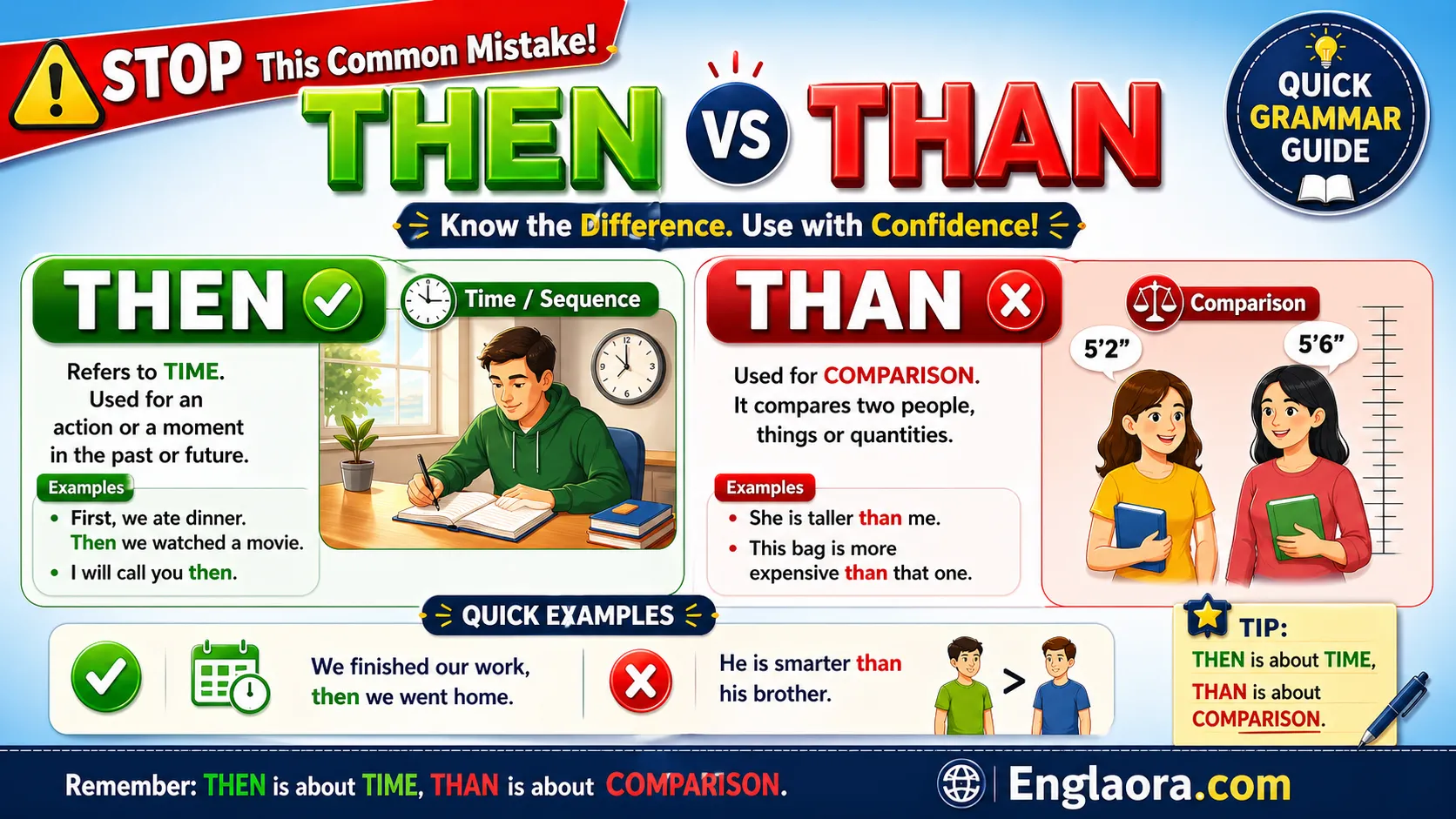
- THAN is used for comparisons. It connects two things being compared.
- THEN is used for time or sequence. It shows what happens next or as a result.
💡 Memory trick: THAN has the letter A — like “compAre.” THEN has the letter E — like “timE.”
Quick examples:
| Word | Example |
|---|---|
| THAN | She runs faster than I do. |
| THEN | I finished work, then went home. |
| THAN | He earns more than her. |
| THEN | If you study hard, then you will pass. |
| THAN | I love you more than anything in the world. |
| THEN | Okay then, let’s start the meeting. |
The origin of then vs than
Both “then” and “than” come from Old English. In fact, they were once the same word: þonne (pronounced “thon-neh”). Yes — one single word did the job of both!
Over centuries of use, the two meanings separated. By the 18th century, writers and grammarians began using “than” specifically for comparisons and “then” specifically for time. Before that, mixing them was perfectly normal in English writing.
This history explains why so many people — even native speakers — still confuse them. Their shared origin is baked into the language.
Then vs than in Urdu — explained:
| English Word | Urdu Meaning | Urdu Example |
|---|---|---|
| THAN (comparison) | سے زیادہ / کے مقابلے میں | وہ مجھ سے ذہین ہے (She is smarter than me) |
| THEN (time/sequence) | پھر / اس کے بعد | پہلے کھانا کھایا، پھر سو گیا (I ate, then slept) |
Understanding this history — and the Urdu equivalents — makes it much easier to remember which word to use.
British English vs American English usage
Good news: “then” and “than” are spelled and used the same way in both British and American English. There is no spelling difference.
However, there are some usage nuances:
- In American English, informal writing sometimes uses “then” incorrectly for “than” — this is a very common casual mistake online.
- In British English, both words are used correctly more consistently in formal writing.
- In spoken English — both US and UK — “than” and “then” can sound almost identical in fast speech, which is why the confusion spreads.
Examples by region:
| Region | Sentence | Correct? |
|---|---|---|
| American (casual) | She’s smarter then him, for sure. | ❌ Wrong |
| American (correct) | She’s smarter than him, for sure. | ✅ Correct |
| British (formal) | The results were better than anticipated. | ✅ Correct |
| Both regions | We had a meeting, then lunch. | ✅ Correct |
Then vs than pronunciation:
- THAN rhymes with “pan” (short A sound) in careful speech
- THEN rhymes with “pen” (short E sound) in careful speech
- In rapid speech, both can sound like “thun” — which is exactly why the confusion happens even among native speakers
Regional Usage Table:
| Context | Word to Use | Region | Example |
|---|---|---|---|
| Comparison | than | Global | Better than before. |
| Time / sequence | then | Global | First this, then that. |
| OK then (casual) | then | US / UK / Global | Okay then, see you. |
| If-then logic | then | Formal / Global | If A, then B. |
| More / less / older | than | Global | Less than expected. |
Which word should you use?
💡 Simple Rule: Ask yourself — am I COMPARING something, or showing a TIME/SEQUENCE?
Use THAN when:
- You compare two things: bigger than, smarter than, more than, less than, better than
- You use: older than, younger than, faster than, slower than
- You say: “I love you more than…” or “less than expected”
- You compare feelings, numbers, sizes, speeds, or ages
Use THEN when:
- You show time order: first… then… finally
- You show cause and result: If X, then Y
- You use it casually: “Okay then,” or “What to do then?”
- You mean “at that time”: Back then, life was simpler.
- You mean “in that case”: If you’re sure, then go ahead.
Common phrases to memorize:
| Phrase | Word | Reason |
|---|---|---|
| More ___ | than | Comparison |
| Less ___ | than | Comparison |
| Older ___ | than | Comparison |
| Better ___ | than | Comparison |
| Okay ___ | then | “In that case” |
| Back ___ | then | Time reference |
| First…___ | then | Sequence |
| If…___ | then | Result/consequence |
- “I love you more then or than” → Always MORE THAN. You are comparing your love. THAN is the comparison word.
- “Okay then or than” → Always OKAY THEN. “Then” means “in that case.” No comparison happening.
- “Less than vs then” → Always LESS THAN. Less is a comparison word.
- “Is it older than or older then” → Always OLDER THAN. Age comparison always uses THAN.
Common mistakes with then vs than
These mistakes show up everywhere — text messages, social media, emails, and even published articles.
| Mistake Type | Wrong ❌ | Correct ✅ |
|---|---|---|
| Comparison | She is taller then me. | She is taller than me. |
| Time sequence | I had dinner than watched TV. | I had dinner then watched TV. |
| More than/then | I love you more then anything. | I love you more than anything. |
| Less than/then | He earns less then her. | He earns less than her. |
| Older than/then | She is older then him. | She is older than him. |
| Okay then/than | Okay than, let’s go. | Okay then, let’s go. |
| If…consequence | If you’re tired, than rest. | If you’re tired, then rest. |
The single biggest mistake: Using “then” for comparisons. If you see words like MORE, LESS, BETTER, WORSE, OLDER, YOUNGER, FASTER, SMARTER — always follow them with THAN.
The second biggest mistake: Using “than” after “okay” or “if.” These always need THEN.
📝 Then vs than worksheet tip: Practice by underlining every comparison word (more, less, better, worse) in a paragraph — each one needs THAN after it.
Then vs than in everyday examples
📧 Email Example:
Subject: Project Update
Dear Team, The new process is faster than the old one. First, review the document, then send your feedback by Friday. If you have questions, then reply to this email.
📱 Social Media Example (Instagram caption):
“This view is more beautiful than any picture I’ve seen. We hiked for two hours, then sat here in silence. Worth it more than I can say. 🏔️”
📰 News / Formal Writing Example:
The government reported that inflation was lower than expected in Q3. Analysts then revised their forecasts upward for the final quarter.
📝 Formal / Academic Example:
If the sample size is greater than 100, then a normal distribution can be assumed. Results smaller than the threshold value were then excluded from analysis.
💬 Casual Conversation Example (Gen Z style):
Person A: “I can’t come tonight.” Person B: “Okay then, no worries.” ✅ (NOT “okay than”) Person A: “You’re a better cook than me, honestly.” ✅
Notice: Every comparison uses THAN. Every time, sequence, or “in that case” uses THEN. This pattern is 100% consistent in correct English.
Then vs than – Google Trends and usage data
Search data tells an interesting story about how often people get confused between then and than.
- “Then vs than” is one of the top 20 most searched grammar confusion topics globally on Google.
- Searches spike during school exam seasons — showing that students worldwide struggle with this distinction.
- “Then vs than in Urdu” is frequently searched in Pakistan, India, and other South Asian countries, confirming that ESL learners especially need clear explanations.
- “I love you more then or than” is searched thousands of times a month — mostly by people writing romantic messages who want to get it right.
- “Less than vs then” and “okay then or than” are two of the most common phrase-specific confusion searches.
- “Then vs than worksheet” spikes in September and January — the start of school terms in many countries.
- “Then vs than pronunciation” is heavily searched by ESL learners who notice the words sound the same in fast speech.
Usage patterns from large English text databases show that THAN is used more frequently in formal writing — because comparisons appear in nearly every type of writing (academic, business, journalism), while THEN is more common in narrative and instructional writing.
Bottom line: This is one of the most universally confused word pairs in English. If you got it wrong before, you were in very good company.
Complete comparison table – Then vs than
| Word | Role | Meaning | Example |
|---|---|---|---|
| THAN | Conjunction | Used for comparisons | She is smarter than him. |
| THEN | Adverb | Used for time or sequence | I ate, then I slept. |
| THAN | Conjunction | Comparison of quantity | He earns more than me. |
| THEN | Adverb | Consequence / result | If you study, then you pass. |
| THAN | Conjunction | Comparing feelings | I love you more than words. |
| THEN | Adverb | Casual “in that case” | Okay then, let’s go. |
FAQs
Q1. When to use then or than?
Use THAN for comparisons (better than, more than, less than). Use THEN for time or sequences (first…then, if…then, okay then). Ask yourself: am I comparing? If yes → than. If time/result → then.
Q2. Do you say “OK then” or “OK than”?
Always: OK THEN. “Then” here means “in that case.” There is no comparison happening, so “than” is wrong. Example: “Okay then, let’s do it.” Never “Okay than.”
Q3. Is it “I love you more then or than”?
It is: I love you more THAN. “More than” is a comparison phrase. You are comparing your love to something else. Always use THAN after “more.”
Q4. What is then vs than in Urdu?
- THAN (comparison) = سے زیادہ or کے مقابلے میں → وہ مجھ سے ذہین ہے (She is smarter than me)
- THEN (time) = پھر or اس کے بعد → میں نے کھانا کھایا، پھر سو گیا (I ate, then slept)
Q5. Is it “less than” or “less then”?
Always: LESS THAN. “Less” is a comparison word. All comparison words (more, less, better, worse, older, younger) are followed by THAN. Example: The price is less than I expected.
Q6. Is it “older than” or “older then”?
Always: OLDER THAN. Age comparisons always use THAN. Example: She is two years older than her sister. Never use “older then.”
Q7. How to remember than and then?
Memory trick:
- THAN has the letter A → think “compAre” (A for comparison)
- THEN has the letter E → think “timE” (E for events in time)
Another way: THAN = comparison. THEN = time/sequence.
Q8. What are 5 sentence examples with then and than?
- She is taller than her brother. (comparison — than)
- I finished my homework, then watched TV. (sequence — then)
- This movie is better than the last one. (comparison — than)
- If you are ready, then we can leave. (result — then)
- He earns more than I expected. (comparison — than)
Q9. Does then mean now?
No. “Then” means at another time — either in the past or future, not now. Example: “Back then, phones did not exist.” Or: “Finish this, then we will talk.” “Now” is present. “Then” is another time.
Q10. What to do then or than?
“What to do then?” is correct. Here “then” means “in that case” or “so what happens next.” Example: “If the plan fails, what do we do then?” There is no comparison, so “than” would be wrong.
Q11. How to say OK in Gen Z way?
Gen Z uses phrases like: “Okay then,” “bet,” “slay,” “it’s giving,” “understood the assignment,” or just “ight” (alright). Note: It is always “okay then” — never “okay than” in any style, formal or Gen Z.
Q12. Then vs than pronunciation — are they the same?
In careful, slow speech:
- THAN = “thaN” (rhymes with “pan”)
- THEN = “thEN” (rhymes with “pen”)
In fast speech, both can sound like “thun.” This is why even native speakers confuse them in writing.
Conclusion
Let us wrap it all up. Then vs than is one of the most common grammar confusions in the English language — and now you have a complete guide to fix it forever.
The rule is simple: THAN is for comparisons. THEN is for time, sequence, and results. Every time you want to compare two things — bigger, smaller, faster, slower, more, less, older, younger — use THAN. Every time you show what happens next, or say “in that case,” or describe a time in the past — use THEN.
Remember the key phrases: “more than,” “less than,” “better than,” “older than” — all comparisons, all use THAN. “Okay then,” “first…then,” “if…then,” “back then” — all time or consequence, all use THEN.
If you are writing a love message (“I love you more than anything”), a formal email, a school essay, or just texting a friend — now you know exactly which word to use. The confusion between then vs than in Urdu and in English is cleared up. The pronunciation difference is noted. The common mistakes are shown with corrections.
Save this article. Share it with a friend who always gets confused. And next time you write — you will get it right on the first try.
✅ THAN = Compare. THEN = Time. That is all you need to remember.

I’m Liam Prescott, writing for Englaora.com. I explain the nuances of commonly confused words, making complex topics simple and engaging for readers.