Hey, I want to share something that happened to me recently involving compliment vs complement.
I was writing a thank-you card for my friend’s dinner party. Our family wanted to say that her cooking was amazing.
I wrote: “The wine complements the food perfectly.” But then I paused. Was that right? Or did I mean “compliments the food”?
I sat there for five minutes. Confused. Both words looked right. Both sounded almost the same. I had no idea which one to use.
Sound familiar? You are not alone. People search “compliment vs complement” over 10,000 times every month. It is one of the most common grammar mistakes in the English language.
Some people ask: “Is it complimentary coffee or complementary coffee?” Others wonder: “Is free food complimentary or complementary?” And many ask: “What is the difference between praise and compliment?”
These are all great questions. And the answers are simpler than you think.
In this article, you will learn the exact difference between compliment and complement. You will see real examples.
You will never mix them up again.
Let us get started.
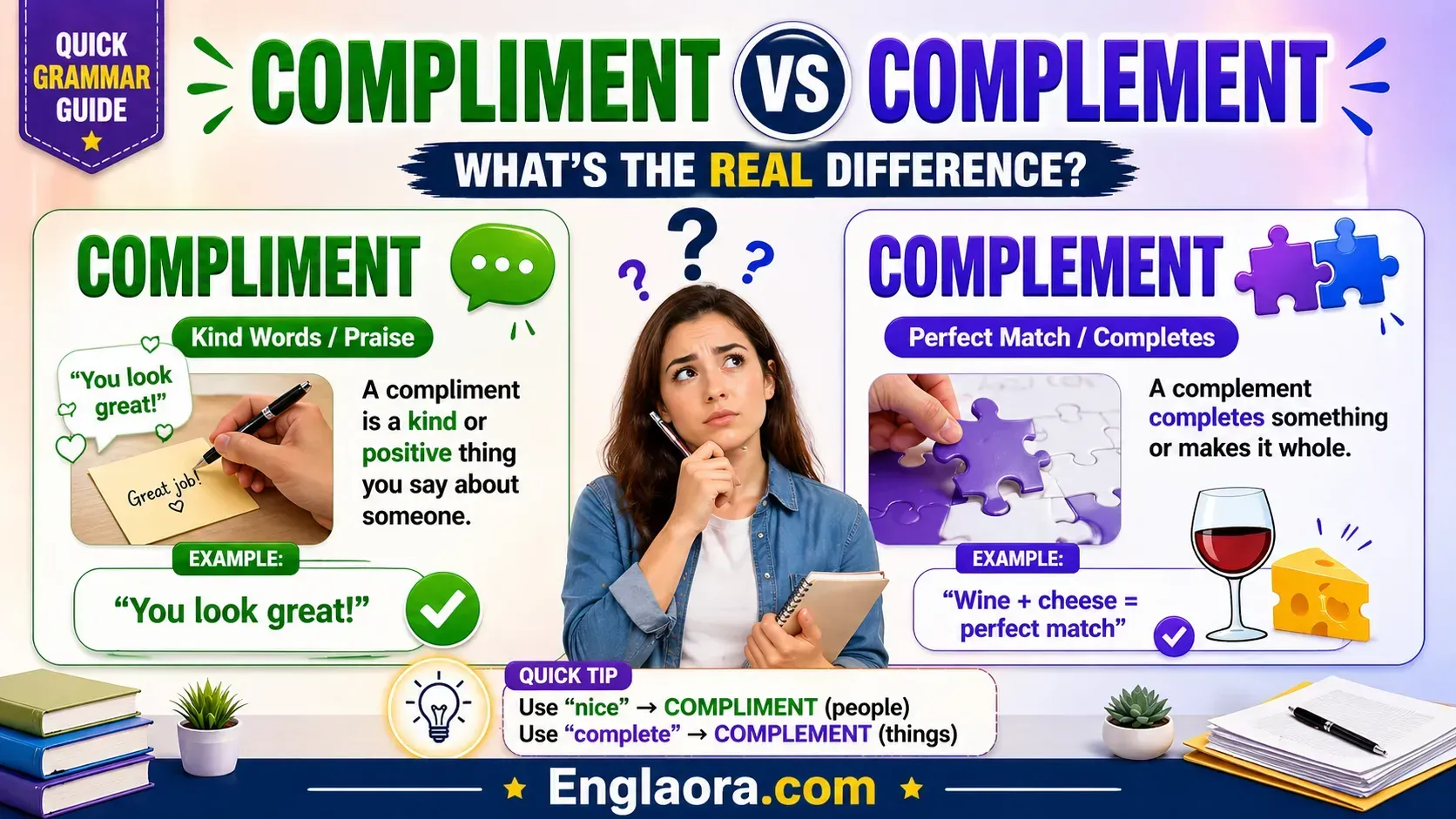
Compliment vs complement – Quick answer
Here is the fast, simple answer:
- Compliment = saying something nice to someone (praise)
- Complement = something that goes well with something else (to complete or match)
Think of it this way:
Compliment = kind words 💬 Complement = a perfect match 🔗
Examples:
- She gave me a compliment on my dress. (praise)
- The red shoes complement the blue dress. (they match well)
- He complimented her cooking. (he praised it)
- The sauce complements the pasta perfectly. (they go great together)
One word is about people and praise. The other is about things that match or complete each other.
The origin of compliment vs complement
Both words come from the same Latin root — but they took different paths.
Complement comes from the Latin word complementum, meaning “that which fills up or completes.” It entered English around the 1300s. It was used to describe something that made something else whole or complete.
Compliment came later. It came from the Spanish word cumplimiento and the Italian complimento, both meaning “an expression of courtesy.” It entered English in the 1600s through French.
So at their core:
- Complement = completing something
- Compliment = a courteous expression
Both words passed through French before entering English — and both ended up spelled almost the same way. That is exactly why writers have confused them for over 400 years.
The word “complement” is also related to the word “complete” — and this is a key memory trick. If complement and complete both start with “comple”, they share the idea of completing or filling something.
British English vs American English spelling
Great news: there is no spelling difference between British and American English for these two words.
Both compliment and complement are spelled the same way everywhere in the world.
However, the usage patterns differ slightly:
- In American English, “complimentary” often means free (as in complimentary coffee or a complimentary breakfast at a hotel).
- In British English, “complimentary” is also used to mean free, but “complementary” is more commonly used in formal and medical contexts (e.g., complementary medicine).
Examples by region:
| Word | American English | British English |
|---|---|---|
| Complimentary | Complimentary tickets (free tickets) | Complimentary remarks (kind words) |
| Complementary | Complementary colors in design | Complementary therapy (alternative medicine) |
| Compliment | He paid her a compliment. | He paid her a compliment. |
| Complement | The wine complements the meal. | The wine complements the meal. |
Pronunciation note:
Both words sound almost identical:
- Compliment = KOM-pli-ment
- Complement = KOM-pli-ment
Yes — they are pronounced the same way! That is why so many people mix them up when speaking and writing.
Which spelling should you use?
Here is a simple guide:
Use “compliment” when:
- You are saying something nice to someone
- You are praising a person or their work
- You want to express admiration
- Example: Do you give compliments or complements to your team? → Compliments!
Use “complement” when:
- Two things work well together
- Something adds to or completes another thing
- You are talking about matching colors, flavors, or styles
- Example: The appetizer complements the main course beautifully.
The easy memory trick:
complEment = E for Enhance or E for complEte complIment = I for I like your… (a personal compliment)
This trick works for both US, UK, and global writers. The spelling is the same everywhere — only the context changes.
Common mistakes with compliment vs complement
These are the most common errors — and how to fix them:
| Mistake Type | Wrong ❌ | Correct ✅ |
|---|---|---|
| Praise context | He complemented her singing. | He complimented her singing. |
| Matching context | The sauce compliments the pasta. | The sauce complements the pasta. |
| Free item | Complementary breakfast included. | Complimentary breakfast included. |
| Perfect match | They are a perfect compliment. | They are a perfect complement. |
| Coffee | Is it complimentary or complementary coffee? | Free coffee = complimentary coffee |
The most asked question:
“Is it complimentary coffee or complementary coffee?”
If the coffee is free — it is complimentary. If the coffee goes well with the cake — it is complementary.
“Is it a compliment or a perfect complement?”
If you are talking about two things that match each other perfectly — use complement. Example: “They are a perfect complement to each other.”
“Is complimenting flirting?”
Not always! Giving a compliment is a kind act. It becomes flirting only when the tone and context suggest romantic interest. Many people on Reddit discuss this under compliment vs complement reddit threads — but the grammar answer is clear: compliment = praise, always.
Compliment vs complement in everyday examples
Let us see how both words appear in real life.
Email Example (compliment):
Dear Sarah, I wanted to take a moment to compliment you on the outstanding presentation yesterday. Your research was thorough and your delivery was excellent.
Email Example (complement):
The new marketing strategy will complement our existing sales approach perfectly, helping us reach a wider audience.
Social Media Example:
Posted on Instagram: “This mango salsa is the perfect complement to grilled chicken 🍗🥭 #FoodPairing #SummerRecipes”
Posted on Twitter/X: “Someone just complimented my shoes on the subway and honestly it made my whole day ☀️”
News/Formal Writing Example:
The government announced that the new infrastructure bill would complement existing urban development plans.
The mayor received numerous compliments from residents following the successful cleanup campaign.
Practical Example — Use compliment and complement in a sentence (both together):
She received a compliment on her outfit, which was chosen to complement her skin tone.
This is a great sentence to remember. It shows both words used correctly in the same context.
Compliment vs complement – Google Trends and usage data
When we look at search data, a clear picture appears.
- “Compliment vs complement” is searched over 10,000 times per month — making it one of the top grammar confusion topics globally.
- Searches peak during school exam seasons and professional writing courses.
- “Complementary vs complimentary” is a top related search — especially around hospitality, hotels, and health topics.
- In the United States, confusion between “complimentary breakfast” and “complementary breakfast” is extremely common in hotel and travel writing.
- The phrase “complement vs complete” shows that many people connect complement with the idea of completing — which is actually the correct instinct.
- Searches like “compliment vs complement means free” confirm that the “free” meaning of complimentary is widely misunderstood.
The data confirms: this is a universal grammar challenge, not just for non-native speakers. Even native English speakers get confused.
Full comparison table – Compliment vs Complement
| Feature | Compliment | Complement |
|---|---|---|
| Meaning | Praise or kind words | Something that matches or completes |
| Part of Speech | Noun / Verb | Noun / Verb |
| Related word | Complimentary (free or praising) | Complementary (matching or alternative) |
| Memory trick | “I” — I like your… | “E” — Enhance / complEte |
| Example (noun) | She gave him a compliment. | The color is a great complement. |
| Example (verb) | He complimented her work. | The shoes complement the outfit. |
| Used for people? | Yes | Rarely |
| Used for things? | Rarely | Yes |
| Free meaning? | Complimentary = free | Complementary ≠ free |
| Gen Z usage | “No cap, your fit is fire 🔥” | Not commonly used casually |
FAQs
Q1. What is the difference between compliment and complement?
Compliment = saying something nice (praise). Complement = two things that go well together. Example: She complimented his tie, which complemented his suit.
Q2. Is free food complimentary or complementary?
Free food is complimentary. If a hotel offers free breakfast, it is a complimentary breakfast. Complementary means it matches or pairs well with something.
Q3. Is it complimentary coffee or complementary coffee?
If the coffee is free → complimentary coffee. If the coffee goes well with the pastry → complementary coffee. Context decides the word.
Q4. Is it complementary or complimentary breakfast?
Hotel free breakfast = complimentary breakfast. Many hotel websites make this mistake. Remember: free = complimentary.
Q5. What does “you complement me” mean?
It means you complete me or make me better. Example: “You complement me perfectly” = we are a great match together.
Q6. What is the difference between praise and compliment?
Praise is broader and often more formal. A compliment is personal and direct. Both are positive, but compliments are more casual and one-on-one.
Q7. Is complimenting flirting?
Not always. A compliment is simply a kind remark. Flirting involves romantic intent. Context and tone determine the difference.
Q8. How to reply for a compliment?
Simply say: “Thank you so much!” or “That’s really kind of you!” Accepting a compliment graciously is a social skill.
Q9. How to compliment in Gen Z way?
Gen Z uses: “No cap, you killed it,” “You’re lowkey amazing,” “That fit goes hard,” or “You’re a vibe.”
Q10. What are the four types of complements?
Subject Complement, Object Complement, Adverbial Complement, and Predicative Complement. These are grammar terms used in sentence structure.
Conclusion
Let us wrap it all up.
Compliment vs complement is one of the most searched grammar questions in the world — and now you know exactly why people get confused. These two words look alike, sound identical, and even share the same Latin roots. But their meanings are completely different.
Compliment is about people and praise. You compliment someone when you say something kind. The complimentary breakfast at your hotel is free. When someone says “compliments of the chef,” they are offering a gift or kind gesture.
Complement is about things that match, enhance, or complete each other. The wine complements the meal. The shoes complement the outfit. Complementary colors look great together.
The simplest memory trick: complEment = complEte. If something fills a gap or makes something whole — use complement.
Now you can confidently answer: Is it complimentary coffee or complementary coffee? (Free = complimentary.) Is it a compliment or a perfect complement? (Perfect match = complement.)
Use this guide, share it with a friend who always gets these mixed up, and never second-guess yourself again.

I’m Liam Prescott, writing for Englaora.com. I explain the nuances of commonly confused words, making complex topics simple and engaging for readers.