Hey, I want to share something that happened to me recently involving anticlimactic or anticlimatic.I was writing a movie review for my blog.
I wanted to say the ending felt flat and disappointing. I typed the word and then stopped. Was it “anticlimactic” or “anticlimatic”? Both looked right to me. I stared at the screen for a full minute.
I even typed both versions into Google just to check. Honestly, I was surprised by what I found.
Turns out, thousands of people search this exact question every month. Some write “anticlimatic” thinking it is correct.
Others are not sure if it is even a real word. Many people also confuse it with words related to weather or climate. That makes it even more confusing.
So I did the research. I read grammar guides, checked dictionaries, and looked at real usage data.
In this article, I will tell you exactly which spelling is right, what the word means, how to say it, and how to use it correctly in writing.
I will also answer common questions like “Is anticlimactic a word?” and “Does anticlimactic mean disappointing?”
Let us clear this up once and for all.
Anticlimactic or anticlimatic – Quick answer
Here is the short answer:
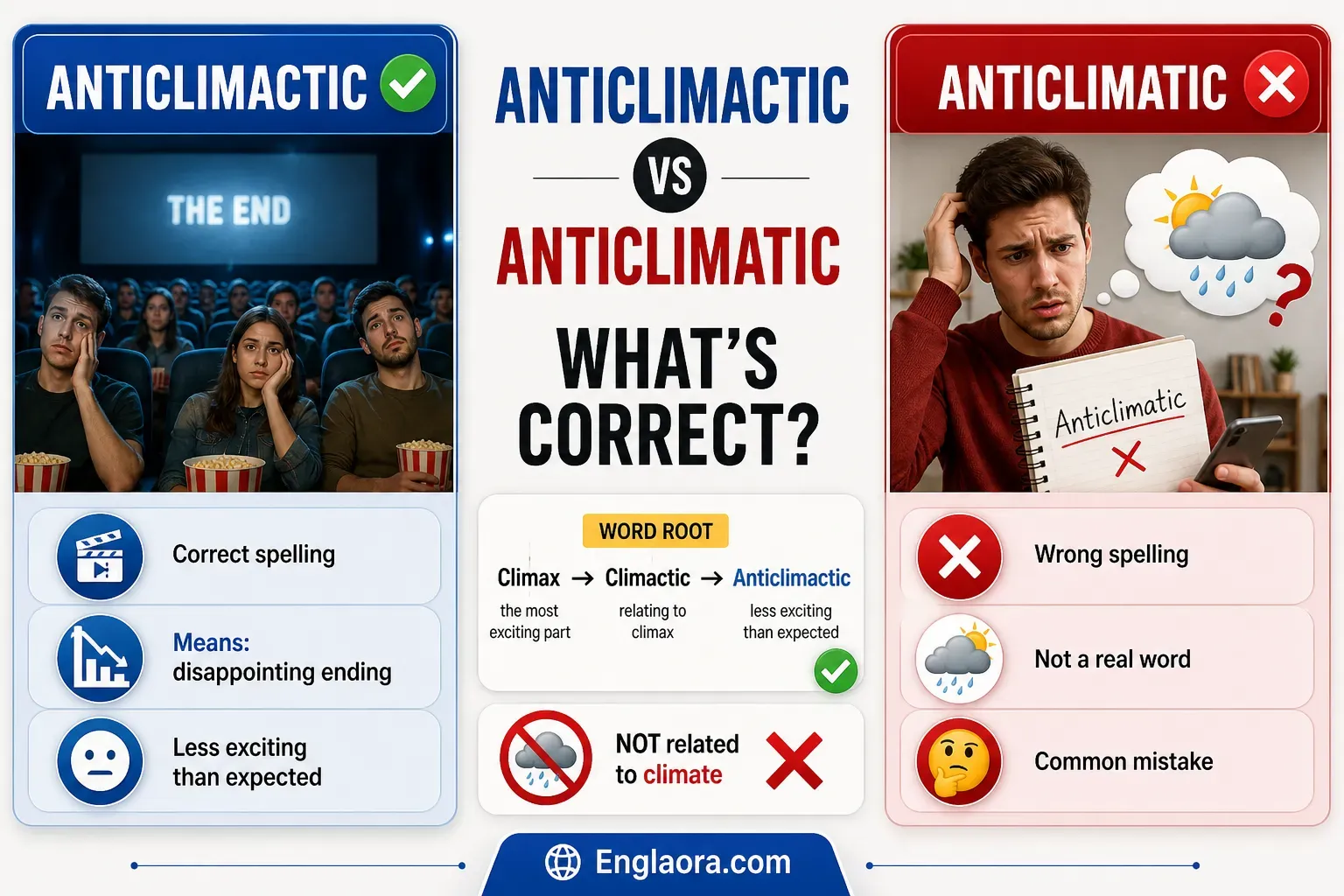
The correct spelling is: ANTICLIMACTIC.
“Anticlimatic” is a common misspelling. It is not a standard word in any dictionary.
The confusion happens because people think the word comes from “climate.” But it does not. It comes from “climax.” The correct adjective form is climactic, not “climatic.”
- Climax → Climactic → Anticlimactic ✅
- Climate → Climatic → Anticlimatic ❌
Examples:
- The season finale was anticlimactic. Nothing exciting happened.
- After months of buildup, the announcement felt anticlimactic.
- Winning the small prize was anticlimactic after expecting the jackpot.
Simple rule: If you mean disappointing or less exciting than expected, always use anticlimactic.
Anticlimactic vs Anticlimatic: What’s the Difference?
This is one of the most common spelling confusions in English. The difference is actually very simple.
The main difference:
- Anticlimactic = ✅ Correct word
- Anticlimatic = ❌ Wrong spelling
Why “anticlimactic” is correct
The word comes from climax.
- Climax → Climactic → Anticlimactic
It means something that feels disappointing or less exciting than expected.
Examples:
- The movie ending was anticlimactic.
- The final match felt anticlimactic after all the hype.
Why “anticlimatic” is wrong
Many people think the word comes from climate, but that is incorrect.
- Climate → Climatic (weather-related word)
“Anticlimatic” mixes the wrong root word, so it does not make sense. That is why it is not accepted in standard English.
Side-by-side comparison
| Feature | Anticlimactic | Anticlimatic |
|---|---|---|
| Correct spelling | Yes | No |
| Used in dictionaries | Yes | No |
| Meaning | Disappointing, less exciting than expected | No meaning |
| Root word | Climax | Climate (wrong connection) |
| Example | The ending was anticlimactic. | ❌ Not used |
Easy memory trick
Think of the word climax:
👉 climax → climactic → anticlimactic
If there is no “x” idea, the word is probably wrong.
Final takeaway
- Always use anticlimactic
- Never use anticlimatic
- If you mean “disappointing ending,” the correct word is anticlimactic
Pronunciation Guide
The word anticlimactic may look long, but it is easy to say once you break it down.
Correct pronunciation:
👉 an-tee-kly-MAK-tik
Break it into parts:
- an → like an
- tee → like tea
- kly → like climb (without “mb”)
- MAK → strong stress (this part is important)
- tik → like tick
Stress pattern:
The stress is on MAK:
👉 an-tee-kly-MAK-tik
Common pronunciation mistake:
❌ anti-kly-MAT-ik (wrong)
✅ anti-kly-MAK-tik (correct)
People often confuse it with climatic, which is pronounced:
👉 kly-MAT-ik (related to climate)
Quick tip:
If you remember the word climax, it becomes easier:
👉 climax → climactic → anticlimactic
The “mac” sound comes from cli-MAX.
Simple example sentences:
- The ending was anticlimactic.
- The match felt anticlimactic after all the hype.
The origin of anticlimactic or anticlimatic
Understanding where the word comes from makes the spelling easy to remember.
“Anticlimactic” is built from three parts:
| Part | Meaning |
|---|---|
| Anti | Against or opposite |
| Climax | The most exciting moment |
| tic | Adjective form |
The word climax came into English in the 1500s. It came from the Greek word meaning ladder or staircase. In storytelling, a climax is the peak or the highest point.
Climactic means related to a climax.
Anticlimactic means the opposite of that peak. It describes a moment that feels like a letdown.
Now look at this:
- Climactic relates to a story or event
- Climatic relates to weather or environment
That is why “anticlimatic” is wrong. It mixes up two completely different word families.
British English vs American English spelling
There is no difference between British and American English for this word.
Both use: anticlimactic
Examples:
American English: The game ended in an anticlimactic way.
British English: The ending of the film felt anticlimactic.
Global usage: The product launch was anticlimactic because everything was already leaked.
Comparison Table
| Version | Correct? | Meaning |
|---|---|---|
| Anticlimactic | Yes | Less exciting than expected |
| Anticlimatic | No | Not a real word |
| Climactic | Yes | Related to a climax |
| Climatic | Yes | Related to weather |
| Anticlimax | Yes | A disappointing ending |
Which spelling should you use?
This is simple. Always use anticlimactic.
Use it when something:
- Feels disappointing
- Does not match expectations
- Falls flat after buildup
Never use “anticlimatic.” It is incorrect everywhere.
Memory trick:
Think:
Climax → Climactic → Anticlimactic
Common mistakes with anticlimactic or anticlimatic
Here are the most common mistakes:
1. Wrong spelling
- Wrong: The speech was anticlimatic.
- Correct: The speech was anticlimactic.
2. Climatic vs climactic
- Wrong: It was the climatic moment.
- Correct: It was the climactic moment.
3. Using for weather
- Wrong: Anticlimactic conditions caused floods.
- Correct: Climatic conditions caused floods.
4. Noun vs adjective confusion
- The ending was anticlimactic.
- The ending was an anticlimax.
Anticlimactic in everyday examples
Email Example:
Hi Team,
After all the preparation, the client feedback felt anticlimactic. They simply said “looks fine.” We expected more detailed input.
Social Media Example:
Waited 3 hours for the new phone launch. Honestly, anticlimactic. It is just a new color. 😐
News Example:
The summit ended on an anticlimactic note. Leaders failed to reach a final agreement.
Film Review Example:
Despite a strong buildup, the ending was anticlimactic and left viewers unsatisfied.
Anticlimactic – usage insights
Search data shows:
- “Anticlimactic” is widely used across the world
- “Anticlimatic” is mostly searched as a mistake
- Google autocorrect fixes it instantly
- Usage is common in movies, sports, and news
People often hear the word first and then guess the spelling. That is why mistakes happen.
FAQs
Q1. Is anticlimactic a word?
Yes. It is a correct English word found in all major dictionaries.
Q2. Is it anticlimactic or anticlimatic?
Always anticlimactic. The other version is incorrect.
Q3. Does anticlimactic mean disappointing?
Yes. It means something did not meet expectations.
Q4. How do you pronounce anticlimactic?
an-tee-kly-MAK-tik
Q5. What are synonyms of anticlimactic?
Disappointing, underwhelming, flat, deflating, unsatisfying.
Q6. What is the opposite of anticlimactic?
Climactic, exciting, thrilling, dramatic.
Q7. What is anticlimax?
It is a noun. It means a disappointing ending.
Q8. How to avoid being anticlimactic in writing?
Build proper tension, deliver strong endings, and match expectations.
Conclusion
Let us wrap it up.
The correct spelling is anticlimactic. The word “anticlimatic” is always wrong.
The word comes from “climax,” not “climate.” That is why the spelling includes “climactic.”
Use anticlimactic when something feels disappointing or less exciting than expected.
Key points to remember:
- Anticlimactic is correct
- Anticlimatic is incorrect
- It means disappointing
- It comes from climax
- The opposite is climactic
Now you can use this word with full confidence in any situation.

I’m Liam Prescott, writing for Englaora.com. I explain the nuances of commonly confused words, making complex topics simple and engaging for readers.