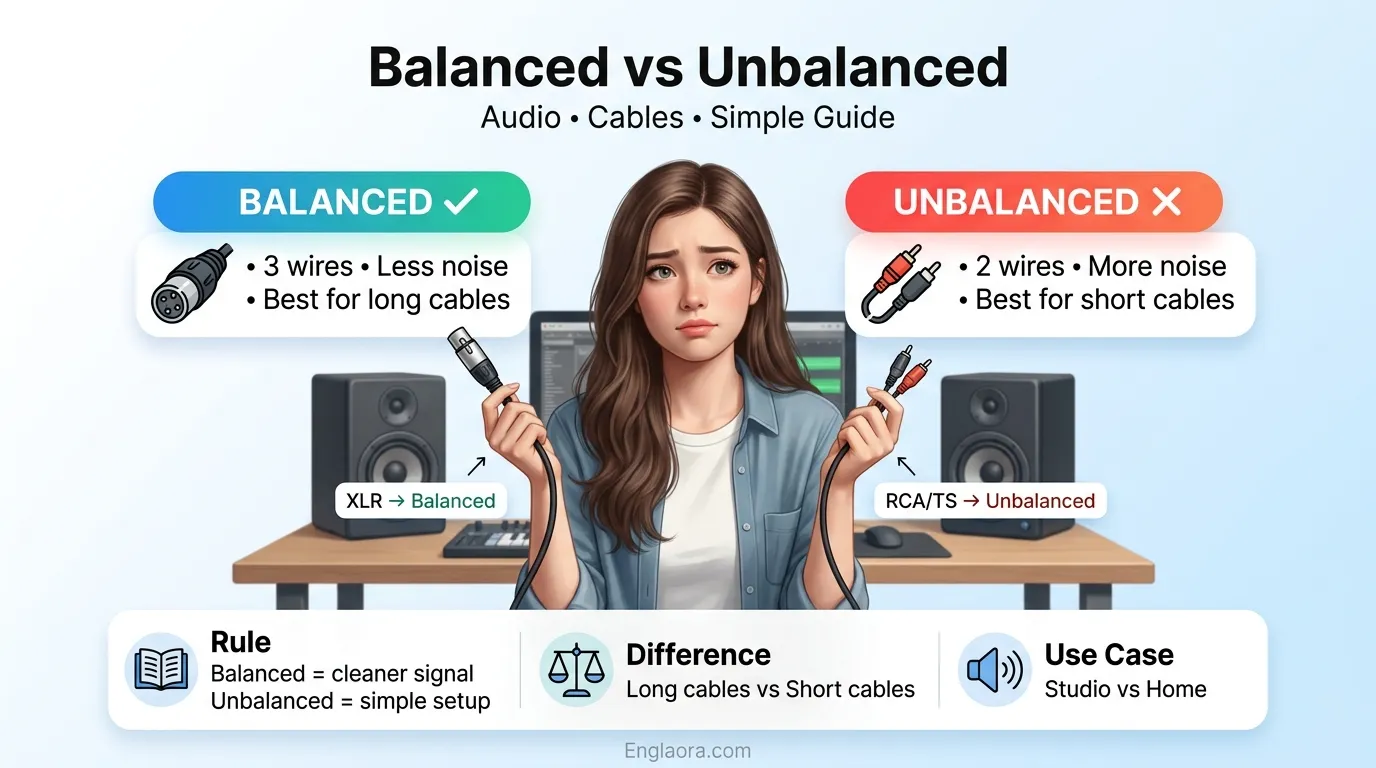
Hey, I want to share something that happened to me recently involving balanced vs unbalanced.
I was setting up a small home studio. My friend told me to use a “balanced cable” for my speakers. I nodded like I knew what he meant.
But inside? Total confusion. I kept thinking — is my current cable balanced or unbalanced? Does it even matter?
I went home and stared at my cables. One had two pins. One had three. I had no idea which was which.
And when I searched online, I got hit with terms like XLR, TRS, RCA, 3.5mm, 6.3mm — my head was spinning.
So I decided to properly research balanced or unbalanced — what it means, why it matters, and when to use each one.
Turns out, millions of people ask the same questions every month. Searches like “balanced vs unbalanced cable,” “is RCA balanced or unbalanced,” “is XLR balanced or unbalanced,” and “balanced or unbalanced audio” are among the most searched audio topics online.
This article clears it all up. Whether you are a musician, a student, a gamer, or just someone who wants better sound this guide is for you. Let us get started.
Balanced or unbalanced – Quick answer
Here is the simple answer:
- Balanced = a cable or signal that uses 3 wires (positive, negative, ground). It cancels out noise. It is used in professional audio.
- Unbalanced = a cable or signal that uses 2 wires (signal, ground). It can pick up noise. It is used in everyday audio.
Think of it this way:
Balanced = cleaner signal, less noise, better for long cables. Unbalanced = simpler, cheaper, fine for short cables.
Quick examples:
- An XLR cable is balanced. It is used by microphones and studio gear.
- An RCA cable is unbalanced. It is used by home stereos and TVs.
- A standard guitar cable (TS) is unbalanced. A TRS cable can be balanced.
What balanced and unbalanced actually mean
The words come from electrical engineering — not from everyday English.
Balanced refers to a signal carried on two wires with equal but opposite voltages, plus a third ground wire. When the signal reaches the destination, any noise picked up along the way is cancelled out. This is called Common Mode Rejection (CMR).
Unbalanced means the signal travels on just one wire, with a ground wire. Any noise that enters the cable stays in the signal. You might hear it as a hum or buzz.
The term “unbalanced” does NOT mean something is broken or wrong. It just describes the type of connection.
This is also where the term connects to balanced or unbalanced forces in physics. In physics:
- Balanced forces = two equal forces acting in opposite directions. The object does not move.
- Unbalanced forces = forces that are NOT equal. The object moves.
For example — is kicking a soccer ball balanced or unbalanced? It is unbalanced. The kick applies more force than friction, so the ball moves.
Balanced vs unbalanced cables – The full breakdown
This is the section most people need. Let us go through every common cable type.
XLR Cable
Is XLR balanced or unbalanced?
XLR is balanced. It has 3 pins: positive, negative, and ground. It is the standard cable for microphones, PA systems, and professional audio gear. XLR cables can run very long distances (50+ feet) with no noise issues.
TRS Cable (3.5mm and 6.3mm)
Is TRS balanced or unbalanced?
It depends on how it is used. TRS stands for Tip-Ring-Sleeve — it has 3 conductors, so it can carry a balanced signal. When used as a stereo headphone cable, it is unbalanced stereo. When used between balanced pro-audio gear, it is balanced mono.
Is 3.5mm balanced or unbalanced?
A standard 3.5mm jack is usually unbalanced. It is used in headphones, phones, and laptops. Some high-end headphone amplifiers use a special 2.5mm or 4.4mm balanced connection.
Is a 6.3mm cable balanced or unbalanced? A 6.3mm (1/4 inch) TRS cable can be balanced when used with balanced equipment. A 6.3mm TS (two conductors) cable is always unbalanced.
RCA Cable
Is RCA balanced or unbalanced?
RCA is unbalanced. It only has 2 conductors. It is the red and white cable used in home stereos, TVs, and DVD players. This is fine for short distances but picks up noise over longer runs.
Guitar Cables
Are guitar cables balanced or unbalanced?
Guitar cables are unbalanced. They use a TS (Tip-Sleeve) connector only 2 conductors. This is fine for short stage runs. But for long runs, unbalanced cables can pick up hum from lights and other electronics.
Why don’t guitars use balanced cables?
Guitars have a high-impedance signal. Balanced connections work best with low-impedance signals. A guitar’s electronics are not designed for balanced output. That is why guitarists use DI (Direct Injection) boxes to convert the signal to balanced before sending it through long cables.
2.5mm and 4.4mm Balanced Jacks
Is 2.5mm balanced?
Yes. The 2.5mm TRRS connector is used as a balanced output on some portable audio players (like FiiO and Astell&Kern devices).
Why is 4.4mm called balanced?
The 4.4mm Pentaconn connector was designed as a balanced headphone output. It has 5 poles, carrying two separate balanced stereo channels. It is becoming the standard for high-end portable audio.
Balanced or unbalanced audio – Which sounds better?
Which is better, balanced or unbalanced audio?
In professional settings — balanced is better. Here is why:
| Feature | Balanced | Unbalanced |
|---|---|---|
| Noise rejection | Excellent ✅ | Poor ❌ |
| Cable length | Up to 300 feet | Best under 15 feet |
| Connectors | XLR, TRS | RCA, TS, 3.5mm |
| Common use | Studios, live sound | Home audio, consumer gear |
| Cost | Higher | Lower |
Is balanced or unbalanced louder?
Balanced signals can be up to 6dB louder than unbalanced signals at the same settings. This is because of how the signal is doubled and processed. However, loudness is not the main advantage noise reduction is.
Does balanced output sound better?
Yes if you are using long cables or professional gear. For a 3-foot cable at home, you likely will not hear a difference.
Balanced or unbalanced speakers and studio monitors
Balanced or unbalanced speakers — which should you use?
For studio monitors, always use balanced cables if possible. Studio monitors are designed for critical listening. Even a small hum can ruin a mix.
Balanced or unbalanced cables for studio monitors:
Use a balanced TRS or XLR cable from your audio interface to your studio monitors. This gives the cleanest signal. If your interface only has unbalanced outputs (RCA), use short cables to minimize noise.
Balanced or unbalanced speakers for home use:
For casual home listening, unbalanced (RCA) cables are perfectly fine. The distances are short, and the noise difference is not noticeable.
Common mistakes with balanced or unbalanced
Here are the most common errors people make:
| Mistake | Wrong ❌ | Correct ✅ |
|---|---|---|
| Assuming TRS is always balanced | Using TRS as balanced with unbalanced gear | Check if BOTH ends support balanced |
| Long unbalanced cable runs | 30-foot RCA cable on a PA system | Use XLR balanced cables for long runs |
| Thinking balanced = louder always | Turning up gain to match unbalanced level | Adjust levels properly at the source |
| Using guitar cable for balanced output | Plugging a TS cable into a balanced output | Use a TRS or XLR cable instead |
| Assuming 3.5mm is always unbalanced | Standard 3.5mm on phones = unbalanced | High-end DAPs may use 2.5mm or 4.4mm balanced |
Balanced or unbalanced in everyday examples
Email example (studio setup):
“Hi, I’m setting up my home studio. Should I use balanced or unbalanced cables for studio monitors? My interface has TRS outputs and my monitors have XLR inputs.” Answer: Use a TRS-to-XLR balanced cable. This gives you the cleanest signal.
Social media example:
Posted on Reddit (r/audiophile): “Just switched from RCA to XLR on my studio monitors. The hum is completely gone. Balanced cables are worth it!”
News/review example:
“The new FiiO M15S features a 4.4mm balanced output alongside a standard 3.5mm unbalanced jack, giving audiophiles the option for both connection types.”
Formal/technical writing example:
“For professional audio installations, balanced connections via XLR are recommended for all cable runs exceeding 10 feet. Unbalanced RCA connections should be limited to inter-device connections within the same rack unit.”
Balanced or unbalanced forces – Physics context
This keyword also applies to physics and science.
What is the difference between balanced and unbalanced forces?
- Balanced forces: Equal forces acting in opposite directions. Net force = zero. Object stays still or moves at constant speed.
- Unbalanced forces: Forces that are NOT equal. Net force ≠ zero. Object accelerates or changes direction.
Examples:
- A book sitting on a table = balanced forces (gravity down, table pushes up).
- A car speeding up = unbalanced forces (engine force > friction).
- Is kicking a soccer ball balanced or unbalanced? → Unbalanced. The kick force is greater than friction, so the ball moves.
What is another word for unbalanced?
In physics: asymmetric, unequal, net force present. audio: single-ended, asymmetric, noise-prone. In general English: lopsided, one-sided, unstable, off-balance.
Balanced or unbalanced – Google Trends and usage data
Search data shows clear patterns:
- “Balanced vs unbalanced cable” is one of the top searched audio questions globally.
- Searches spike during home studio setup seasons (January–March and September).
- “Is RCA balanced or unbalanced” and “is XLR balanced or unbalanced” are among the top 10 related queries.
- The physics version — “balanced or unbalanced forces” — is heavily searched during school exam periods worldwide.
- In the US and UK, “balanced audio” searches have grown 40%+ over the past 5 years as home studio culture has expanded.
- Reddit threads on “balanced or unbalanced” regularly get thousands of upvotes — showing this is a topic that confuses even experienced audio enthusiasts.
Full comparison table – Balanced vs unbalanced cables
| Cable/Connector | Balanced or Unbalanced | Conductors | Common Use |
|---|---|---|---|
| XLR | ✅ Balanced | 3 | Microphones, PA, studio |
| TRS (used with balanced gear) | ✅ Balanced | 3 | Studio monitors, headphones |
| TS (guitar cable) | ❌ Unbalanced | 2 | Guitars, instruments |
| RCA | ❌ Unbalanced | 2 | Home stereos, TVs |
| 3.5mm standard | ❌ Unbalanced | 2–3 | Phones, laptops, headphones |
| 2.5mm TRRS (DAPs) | ✅ Balanced | 4 | High-end portable audio |
| 4.4mm Pentaconn | ✅ Balanced | 5 | Audiophile headphone amps |
| 6.3mm TRS | ✅ Balanced (if used correctly) | 3 | Pro audio, studio gear |
| 6.3mm TS | ❌ Unbalanced | 2 | Guitars, instruments |
FAQs
Q1. What is the difference between balanced and unbalanced?
Balanced cables use 3 wires and cancel out noise. Unbalanced cables use 2 wires and can pick up interference. Balanced is better for professional and long-distance audio. Unbalanced is fine for home use and short cable runs.
Q2. Which is better, balanced or unbalanced audio?
Balanced is better in professional settings — especially for long cable runs. For short home setups, unbalanced (like RCA) works perfectly fine.
Q3. Is RCA balanced or unbalanced?
RCA is unbalanced. It has only 2 conductors. It is common in home stereos, TVs, and consumer electronics.
Q4. Is XLR balanced or unbalanced?
XLR is balanced. It has 3 pins and is the standard for professional microphones and studio gear.
Q5. Is TRS balanced or unbalanced?
TRS can be either. When used with balanced equipment (like studio monitors), it is balanced. When used as a stereo headphone cable, it carries an unbalanced stereo signal.
Q6. Are guitar cables balanced or unbalanced?
Guitar cables are unbalanced (TS connectors). Guitars have high-impedance signals that are not suited for balanced connections without a DI box.
Q7. Is 3.5mm balanced or unbalanced?
Standard 3.5mm is unbalanced. Some high-end audio devices use special 2.5mm or 4.4mm connectors for balanced output.
Q8. Why is 4.4mm called balanced?
The 4.4mm Pentaconn connector has 5 poles, allowing it to carry a fully balanced stereo signal. It was designed specifically for high-end audio as a balanced alternative to standard headphone jacks.
Conclusion
Now you know the full story about balanced or unbalanced.
In audio, the difference is simple. Balanced cables use 3 wires and cancel noise. They are best for studios, long cable runs, and professional gear. Unbalanced cables use 2 wires. They are fine for home use and short connections.
XLR is balanced. RCA is unbalanced. Guitar cables are unbalanced. TRS can be either — it depends on the gear. And headphone users looking for the best quality should look for 4.4mm or 2.5mm balanced outputs on premium devices.
In physics, the concept is just as clear. Balanced forces cancel out and nothing moves. Unbalanced forces create motion. Kicking a soccer ball? That is unbalanced force in action.
The key takeaway: use balanced cables whenever you can for professional audio. They cost a little more, but the noise-free signal is worth every penny. For home listening and short runs, unbalanced is totally fine.
Whether you are building a studio, setting up speakers, buying headphones, or studying physics you now have a clear, complete answer to the balanced or unbalanced question.
Bookmark this guide. Share it with anyone who is confused. And next time someone asks you “is XLR balanced or unbalanced?” you will know the answer instantly.

Hi, I’m Emma Caldwell, an expert author at Englaora.com. I share clear insights on language differences and provide readers with reliable, easy-to-understand content.