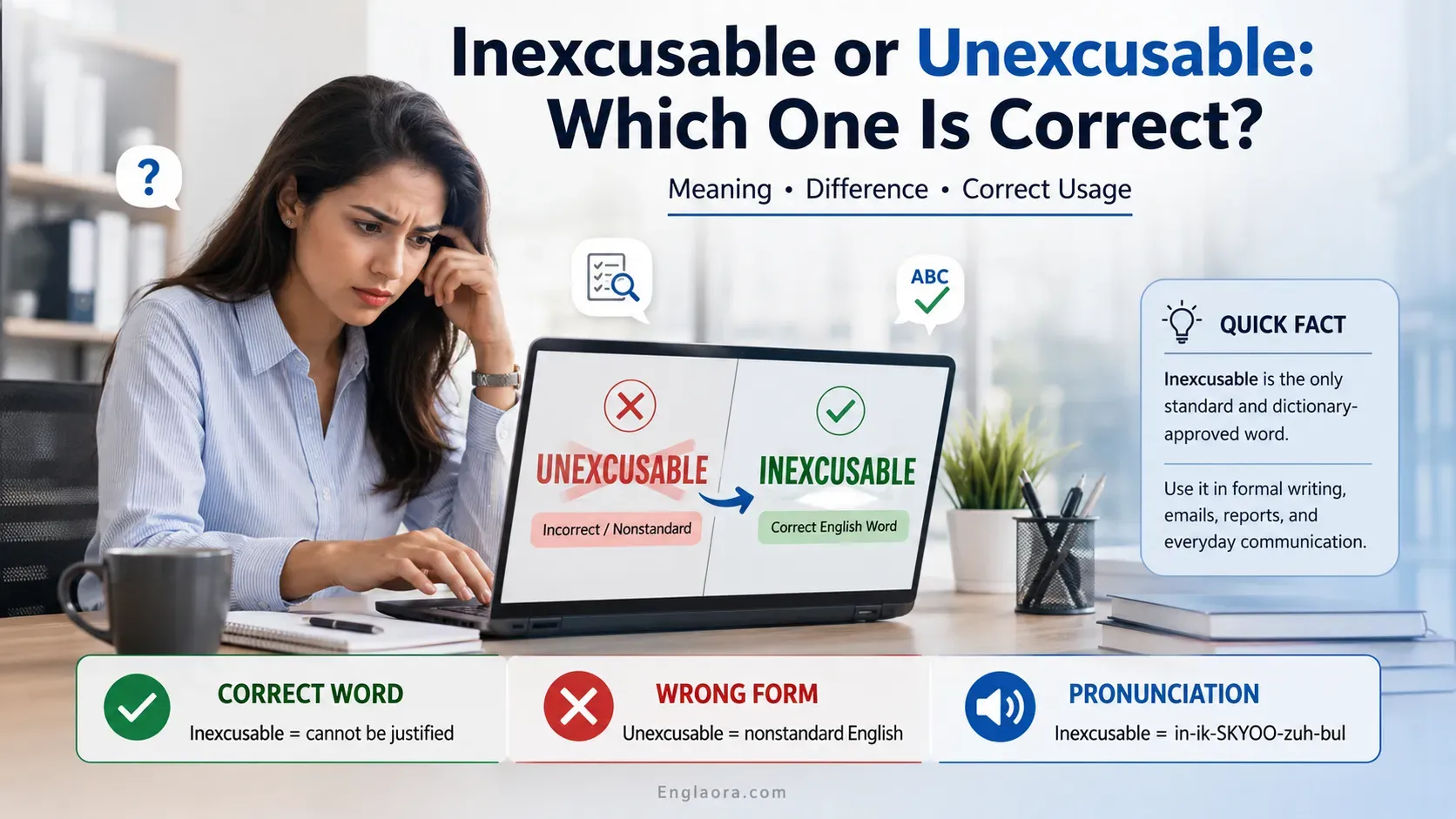
Hey, I want to share something that happened to me recently involving inexcusable or unexcusable.
I was writing a complaint email at work. A coworker had made a serious mistake, and I wanted to describe it strongly. So I typed: “This behavior is unexcusable.”
Then I paused.
Something looked wrong. Was it unexcusable or inexcusable? Both sounded correct in my head. I checked Google. I asked a friend. Nobody seemed fully sure.
If this sounds familiar, you are not alone. Thousands of people search “inexcusable or unexcusable” every month because the two words sound like they should both exist.
But only one is actually correct.
This guide explains which spelling is right, why people confuse them, how to use the word correctly, common mistakes, and simple examples you can remember easily.
Let us get started.
Inexcusable or unexcusable – Quick answer
The correct word is inexcusable.
Unexcusable is not considered a standard English word and should be avoided in formal writing.
Correct examples
- His behavior was inexcusable.
- Missing the deadline without warning was inexcusable.
- Lying to customers is completely inexcusable.
If you are wondering “is it inexcusable or unexcusable?” the answer is always:
✅ Inexcusable
❌ Unexcusable
The origin of inexcusable
The word excuse comes from the Latin word excusare, meaning “to free from blame.”
English usually adds the prefix in- to many Latin-based words:
- incorrect
- incapable
- incomplete
- inexcusable
That is why inexcusable is correct.
The prefix un- is more common with native English words:
- unhappy
- unclear
- unfair
Because excuse comes from Latin, English naturally formed the negative version as inexcusable, not unexcusable.
Difference Between Inexcusable and Unexcusable
This is the easiest way to understand the difference:
| Word | Correct or Incorrect? | Meaning | Used in Standard English? |
|---|---|---|---|
| Inexcusable | ✅ Correct | Something that cannot be justified or forgiven | Yes |
| Unexcusable | ❌ Incorrect / Nonstandard | Intended to mean the same thing | No |
Simple explanation
- Inexcusable is the proper dictionary word.
- Unexcusable may appear online or in casual writing, but it is not accepted in formal English.
Correct examples
- His behavior was inexcusable.
- The delay was completely inexcusable.
- Ignoring safety rules is inexcusable.
Incorrect examples
- ❌ His behavior was unexcusable.
- ❌ The mistake was unexcusable.
Easy memory trick
Words from Latin often use in- instead of un-.
Since excuse comes from Latin, the correct form is inexcusable.
Inexcusable or Unexcusable Pronunciation
Both words are pronounced very similarly, which is one reason people confuse them.
Inexcusable pronunciation
Inexcusable → in-ik-SKYOO-zuh-bul
IPA: /ˌɪnɪkˈskjuːzəbəl/
Breakdown:
- in
- ik
- SKYOO
- zuh
- bul
Unexcusable pronunciation
Unexcusable → un-ik-SKYOO-zuh-bul
IPA: /ˌʌnɪkˈskjuːzəbəl/
Even though people may pronounce it, it is still considered nonstandard in formal English.
Pronunciation tip
The biggest sound difference is the first syllable:
- Inexcusable → starts with “in”
- Unexcusable → starts with “un”
But remember:
Only inexcusable is correct in proper English writing.
British English vs American English
There is no spelling difference here.
Both British English and American English use:
✅ inexcusable
Neither standard British nor American dictionaries accept unexcusable as correct formal English.
Examples
| Region | Example |
|---|---|
| American English | The mistake was inexcusable. |
| British English | His conduct was entirely inexcusable. |
| Global English | That level of negligence is inexcusable. |
Which spelling should you use?
The answer is simple:
Always use inexcusable
Use it when describing:
- behavior that cannot be justified
- serious mistakes
- morally wrong actions
- unacceptable conduct
Examples
- Cheating on the exam was inexcusable.
- Ignoring safety rules is inexcusable.
- The delay was completely inexcusable.
Avoid using unexcusable
Even if you see it online or on social media, it is still considered incorrect in standard English.
Is “inexcusable” a strong word?
Yes. Very strong.
Calling something inexcusable means:
- there is no good reason for it
- it cannot be defended
- it should not be forgiven easily
It is often used in:
- workplaces
- news articles
- legal writing
- serious conversations
Common mistakes with inexcusable
| Wrong ❌ | Correct ✅ |
|---|---|
| His actions were unexcusable. | His actions were inexcusable. |
| That mistake is inescusable. | That mistake is inexcusable. |
| Her behavior was not excusable at all. | Her behavior was inexcusable. |
Another common mistake
Some people think adding un- always creates the opposite meaning of a word. But English does not always work that way.
For example:
- incorrect ✅
- uncorrect ❌
The same rule applies here:
- inexcusable ✅
- unexcusable ❌
Inexcusable in everyday examples
Email example
Sending incorrect financial data to the client was inexcusable. Please review all reports carefully before submission.
Social media example
Ignoring customer complaints for weeks is absolutely inexcusable.
News example
The judge described the officer’s conduct as inexcusable.
Academic example
Plagiarism is considered inexcusable in academic writing.
Synonyms for inexcusable
Here are some strong alternatives:
| Synonym | Meaning |
|---|---|
| Unforgivable | Too bad to forgive |
| Unjustifiable | Cannot be defended |
| Indefensible | Impossible to support |
| Unpardonable | Too serious to pardon |
| Reprehensible | Deserving criticism |
| Shameful | Morally wrong |
Example
- The error was unforgivable.
- His actions were indefensible.
Full comparison table
| Feature | Inexcusable | Unexcusable |
|---|---|---|
| Real English word? | ✅ Yes | ❌ No |
| In dictionaries? | ✅ Yes | ❌ No |
| Formal writing | ✅ Correct | ❌ Incorrect |
| Used in professional emails | ✅ Yes | ❌ Avoid |
| British English | ✅ Yes | ❌ No |
| American English | ✅ Yes | ❌ No |
| Example | The mistake was inexcusable. | ❌ The mistake was unexcusable. |
FAQs
Q1. Is the correct word inexcusable or unexcusable?
The correct word is inexcusable.
Q2. Is unexcusable a real word?
It appears occasionally online, but it is not considered standard English.
Q3. What does inexcusable mean?
It means something cannot be justified, forgiven, or defended.
Q4. Is inexcusable a strong word?
Yes. It expresses strong disapproval.
Q5. What is inexcusable behavior?
Behavior that is completely unacceptable or impossible to justify.
Q6. What is another word for inexcusable?
Unforgivable, unjustifiable, indefensible, or unpardonable.
Q7. Can I use unexcusable in casual writing?
You may see it online, but it is still considered incorrect. Use inexcusable instead.
Q8. Why do people confuse inexcusable and unexcusable?
Because English uses both in- and un- prefixes, so both forms sound possible.
Q9. Is “inexcusable mistake” correct?
Yes.
- That was an inexcusable mistake.
Q10. Is “inexcusable behavior” correct?
Yes.
- Bullying employees is inexcusable behavior.
Conclusion
The difference between inexcusable and unexcusable is actually very simple.
✅ Inexcusable is the correct and accepted English word.
❌ Unexcusable is considered nonstandard and should be avoided.
Use inexcusable whenever you want to describe something that cannot be justified, forgiven, or defended.
Whether you are writing:
- a professional email,
- an essay,
- a complaint,
- or a social media post,
inexcusable is always the right choice.
The easiest thing to remember is this:
If it cannot be excused, it is inexcusable.
Now you never have to second guess this word again.

I’m Liam Prescott, writing for Englaora.com. I explain the nuances of commonly confused words, making complex topics simple and engaging for readers.