Hey, I want to share something that happened to me recently involving loveable or lovable. I was chatting with a friend when this term suddenly popped up, and honestly, I had no idea which spelling was correct.
For a moment, I kept thinking, “Am I missing something here?” It was confusing, and I didn’t want to reply the wrong way or sound clueless.
So, I decided to look into loveable or lovable to understand the correct meaning and proper usage. Once I figured it out, everything made sense, and I realized how important it is to know the difference to avoid awkward moments in conversations.
Now, whenever I see loveable or lovable in chats, emails, or on social media, I feel confident responding the right way. This article will clear all confusion, show proper usage, and help you write confidently whether you are using British or American English.
Loveable or Lovable – Quick Answer
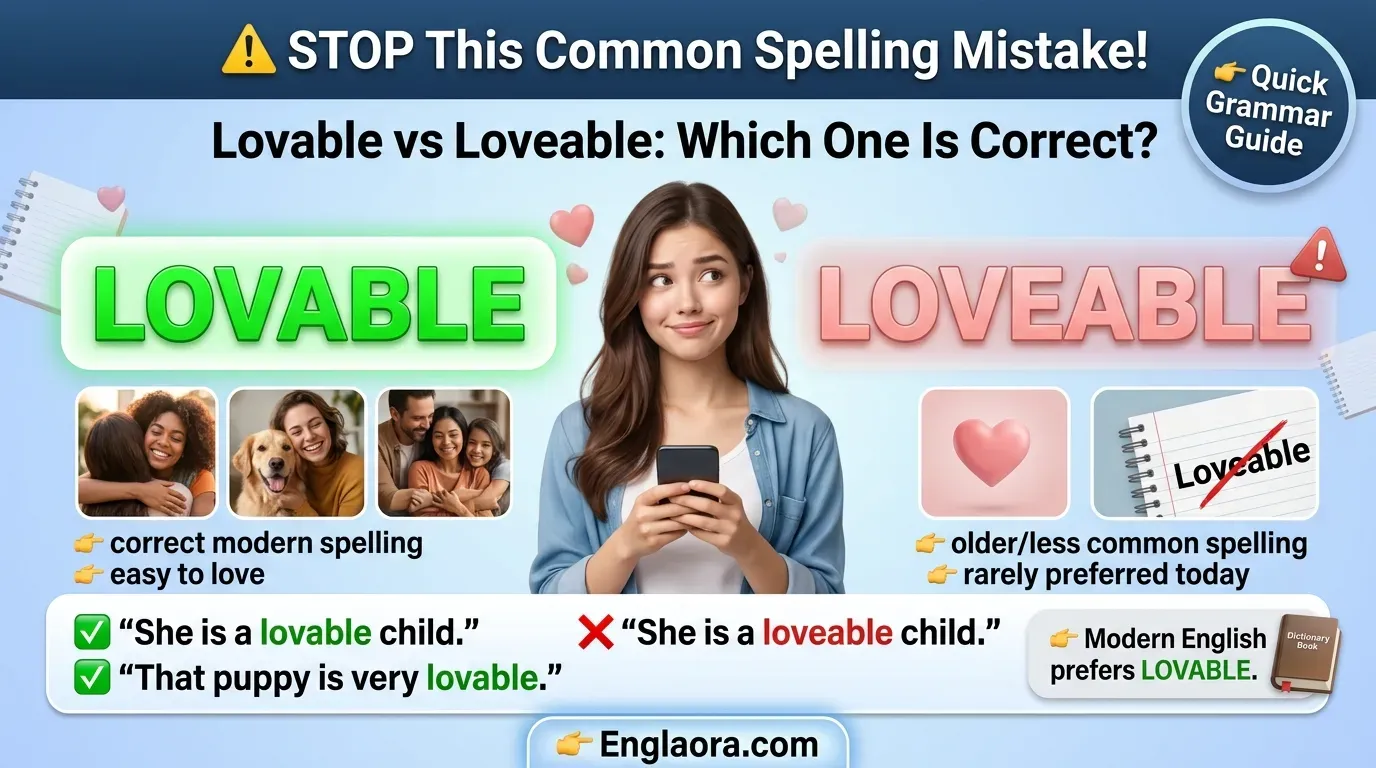
Quick Answer: The correct spelling is lovable.
Example:
- She is a lovable character in the story.
Which One Is Correct, Lovable or loveable?
The correct spelling is lovable. While loveable is sometimes seen, it is less common and considered non-standard in most dictionaries.
Example:
- Correct: She is a very lovable person.
- Less common: She is a very loveable person.
Most style guides, including American English dictionaries, prefer lovable.
Is There A Word Loveable?
Yes, loveable exists, but it is rarely used. It is understood by readers but may be flagged as a spelling variation in formal writing.
Tip: Always use lovable in professional or academic writing.
What Does Being Loveable Mean?
Being lovable means someone or something is easy to love, attractive, kind, or endearing.
Examples:
- Puppies are naturally lovable.
- His sense of humor makes him lovable.
It is used to describe both people and things that evoke affection.
Is It Loveable or Lovable in British English?
In British English, both loveable and lovable are understood. However, most dictionaries, like Oxford, recommend lovable.
Example:
- British English: The kitten was incredibly lovable.
- American English: The kitten was incredibly lovable.
Tip: Using lovable is safe for both British and American audiences.
What’s The Difference Between Lovable and Loveable?
- Lovable → Preferred spelling in American and British English.
- Loveable → Acceptable but uncommon; may appear in informal writing.
Comparison Table:
| Variation | Usage | Region |
|---|---|---|
| Lovable | Standard, formal | US & UK |
| Loveable | Informal, less common | UK mostly |
How Do You Say “I Love You” in British?
The phrase “I love you” is the same in both British and American English. The spelling lovable is consistent across both forms of English.
Example:
- You are so lovable, I can’t stop thinking about you.
Loveable or Lovable Meaning
Lovable means:
- Attractive or endearing
- Easy to love or admire
- Evoking affection
Example:
- Her lovable nature makes everyone smile.
Loveable or Lovable Synonyms
- Endearing
- Adorable
- Charming
- Cute
- Likeable
Example:
- He has a charming and lovable personality.
Loveable or Lovable Examples
- She gave a lovable smile.
- The lovable puppy followed him everywhere.
- His lovable personality won everyone’s heart.
Loveable or Lovable UK
- In the UK, lovable is standard.
- Loveable can be seen in casual texts but is not preferred in formal writing.
Lovable Person Meaning
A lovable person is someone who is friendly, charming, or easy to like.
Example:
- He is a lovable person who always helps others.
Lovable Person Synonyms
- Friendly
- Charming
- Kind-hearted
- Endearing
- Pleasant
The Origin of Loveable
- Comes from the word love + suffix -able, meaning “able to be loved.”
- Historical texts show lovable has been standard since the 1800s.
- The variation loveable appeared as a non-standard spelling.
British English vs American English Spelling
| Feature | American English | British English |
|---|---|---|
| Preferred spelling | lovable | lovable |
| Alternative | loveable (rare) | loveable (informal) |
| Use | Professional, academic | Professional, casual |
Which Spelling Should You Use?
- US audience: Always use lovable.
- UK audience: Use lovable in formal writing; loveable is okay informally.
- Global audience: Stick with lovable to avoid confusion.
Common Mistakes With Loveable
- Using loveable in formal essays or business emails.
- Confusing lovable with likeable (they are similar but not identical).
- Misspelling as lovebel or lovabel.
Loveable in Everyday Examples
- Email: “You are such a lovable colleague.”
- Social Media: “This puppy is so lovable!”
- Formal writing: “The novel’s main character is lovable.”
Loveable – Google Trends & Usage Data
- Searches for lovable peak around Valentine’s Day.
- Most popular in US, UK, Canada, and Australia.
- Loveable appears rarely and mostly in informal texts.
Keyword Variations Comparison Table
| Keyword | Correctness | Usage Frequency |
|---|---|---|
| lovable | ✅ Correct | High |
| loveable | ⚠ Rare | Low |
FAQs
1. Can I use loveable?
Yes, but it’s informal. Lovable is preferred.
2. Is lovable British or American?
It’s standard in both.
3. What is the meaning of lovable?
Someone or something easy to love or endearing.
4. Are lovable and likeable the same?
Similar, but lovable focuses on affection; likeable is about being pleasant.
5. How do you spell it in professional writing?
Always use lovable.
6. Can I say “That puppy is loveable”?
Yes, it’s understandable but not preferred formally.
7. Is loveable wrong?
Not wrong, just uncommon and less formal.
Conclusion
Understanding the difference between lovable and loveable helps you write confidently and avoid confusion. While both spellings are recognized, lovable is the standard and widely accepted in dictionaries, professional writing, and formal communication. Loveable is informal and rarely used but understood by readers.
Remember, knowing proper spelling improves your credibility in emails, social media, articles, and professional documents. Always choose lovable for clarity, correctness, and universal understanding. Using the right form avoids awkward situations and shows attention to detail. If describing a person, pet, movie, or character, lovable communicates affection clearly and professionally.

I’m Liam Prescott, writing for Englaora.com. I explain the nuances of commonly confused words, making complex topics simple and engaging for readers.