Hey, I want to share something that happened to me recently involving has or had.
I was writing a message to my manager. I wanted to say a report was finished. But I stopped. Should I write “She has completed the report” or “She had completed the report”? Both sounded correct. But only one matched the situation.
I stared at the screen for two minutes.
You are not alone. Thousands of people search has or had meaning, has or had examples, and when to use has and had every day.
The confusion happens because both words come from the same verb: have. But they are used in different tenses.
Using the wrong one changes the meaning of a sentence completely.
This guide explains everything simply. You will learn the rules, examples, common mistakes, and easy tricks to remember the difference.
Let us start.
Has or had – Quick answer
Here is the simple answer:
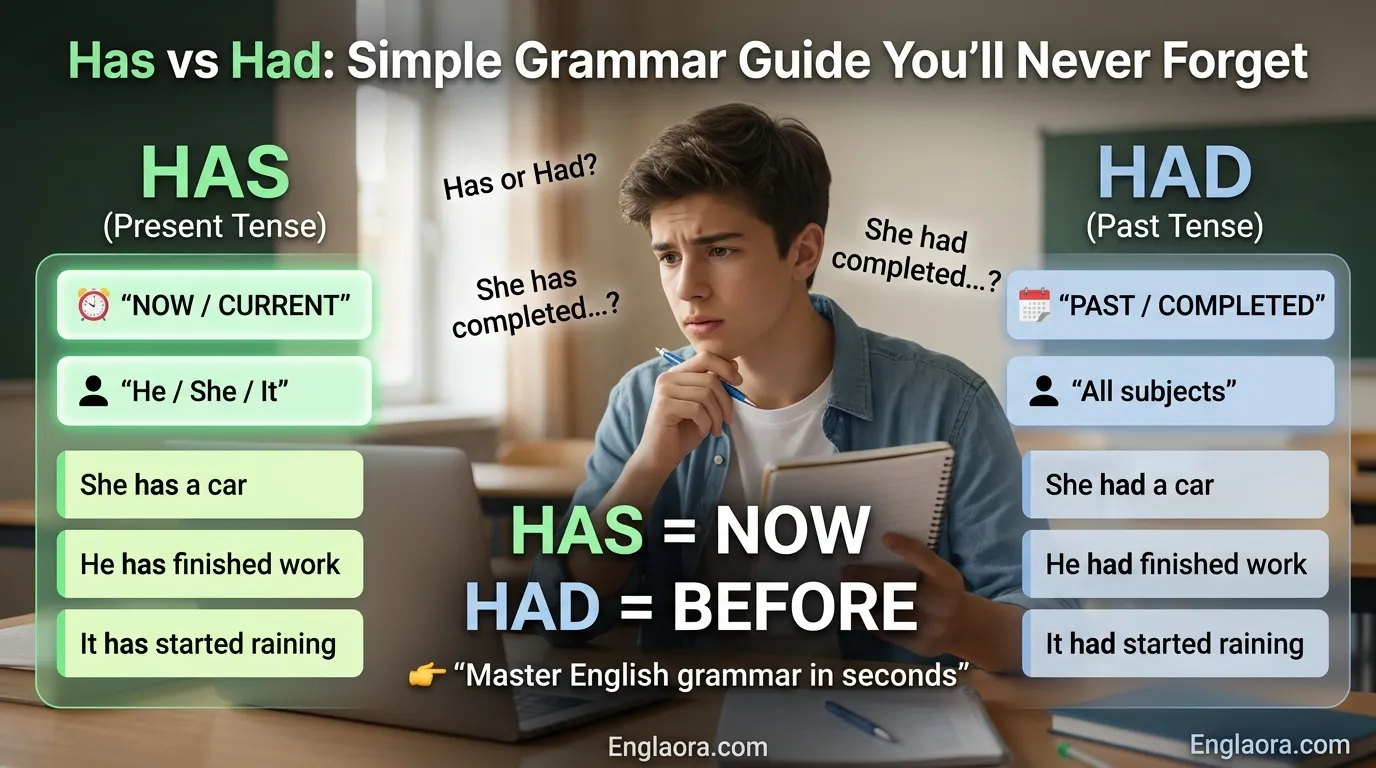
- Has = present tense
- Had = past tense
Both come from the verb have.
| Word | Tense | Use |
|---|---|---|
| Have | Present | I/You/We/They |
| Has | Present | He/She/It |
| Had | Past | Everyone |
Quick examples
- She has a new phone.
- She had a phone last year.
- He has finished the work.
- He had finished before I arrived.
Easy memory trick
Has = now
Had = before
The origin of has or had
Both words come from the Old English verb habban, which meant “to hold” or “to possess.”
Over time:
- hæfþ became has
- hæfde became had
English kept these irregular forms for hundreds of years. That is why we say has and had instead of regular forms like haves or haved.
This is also why many learners find has or had grammar confusing at first.
British English vs American English
Good news: there is no spelling difference between British and American English.
Both use:
- has
- had
- have
The only small difference is usage style.
British English
- She has just arrived.
American English
- She just arrived.
Both are correct.
Which form should you use?
Use HAS when:
- Talking about the present
- Using he, she, it, or singular nouns
- Using present perfect tense
Examples
- She has a meeting today.
- The company has a new policy.
- He has finished his homework.
Use HAD when:
- Talking about the past
- Referring to something before another past action
- Using past perfect tense
Examples
- She had a meeting yesterday.
- They had left before we arrived.
- I had no idea.
Common mistakes with has or had
| Wrong ❌ | Correct ✅ |
|---|---|
| He had a fever today. | He has a fever today. |
| I has a question. | I have a question. |
| She has visited Paris in 2010. | She visited Paris in 2010. |
| The company have a new rule. | The company has a new rule. |
Is “he has had” correct?
Yes. It is completely correct.
Examples
- He has had three surgeries.
- She has had a busy week.
This structure is called present perfect.
Has or had in everyday examples
Email example
The client has approved the design. We had sent the first draft last week.
Social media example
This café has the best coffee ever. I had never heard about it before!
News example
The government has announced new policies. Officials said the old system had many problems.
Have, has, and had – Full comparison
| Form | Subject | Tense | Example |
|---|---|---|---|
| Have | I/You/We/They | Present | I have a bike. |
| Has | He/She/It | Present | She has a bike. |
| Had | Everyone | Past | They had a bike. |
V1 V2 V3 forms of “have”
| Form | Word |
|---|---|
| V1 | Have / Has |
| V2 | Had |
| V3 | Had |
| V4 | Having |
| V5 | Has |
This is why phrases like has had and had had are grammatically correct.
FAQs
Q1. When should I use has or had?
Use has for present tense. Use had for past tense.
Q2. When do we use has or have?
Use has with he/she/it. Use have with I/you/we/they.
Q3. Which is correct: she had or she has?
Both are correct depending on time.
- She has a cold. = now
- She had a cold. = before
Q4. Is “he has had” correct?
Yes. Example: He has had many opportunities.
Q5. Who do we use “has” for?
For he, she, it, and singular nouns.
Q6. Can I use “has” for female?
Yes.
- She has a new job.
Q7. How do I use “had” in a sentence?
- I had dinner at 8.
- They had finished before noon.
Q8. What are examples of “has”?
- She has a car.
- He has completed the task.
- The dog has eaten.
Q9. Who has or had the highest IQ?
Use has for living people and had for people who are no longer alive.
Q10. Who has had more crashes: Boeing or Airbus?
“Has had” is correct because it refers to records up to the present.
Q11. Who has or who had?
- Who has the keys? = present
- Who had the keys yesterday? = past
Q12. When do we use has or had in grammar?
Has = present. Had = past.
Q13. How can teachers teach has and have?
Start with:
- I/You/We/They = have
- He/She/It = has
- Everyone in past = had
Then practice with quizzes and worksheets.
Conclusion
The difference between has and had is simple once you focus on time.
- Has talks about the present.
- Had talks about the past.
Use has with he, she, and it for things happening now. Use had for things that already happened before.
The easiest trick is this:
Has = now
Had = before
Once you remember that, choosing the correct word becomes much easier.
If you are writing emails, studying grammar, or practicing English, you now know exactly when to use has or had correctly.

Hi, I’m Ethan Hawkes, writing for Englaora.com. I provide clear, reliable content to help users understand the differences between commonly confused words.