Hey, I want to share something that happened to me recently involving here or hear.
I was watching a British parliamentary debate on YouTube when a group of members suddenly started shouting something that sounded like “here here!” or maybe “hear hear!” I honestly could not tell.
I paused the video and replayed it a few times. Then I searched Google: “is it here here or hear hear?” I was surprised to learn that thousands of people search this exact question every month.
The confusion is understandable. Here and hear sound exactly the same, but they have different spellings and meanings.
They are homophones, and mixing them up is one of the most common English mistakes.
Some people search for “when to use here and hear,” while others want to know “here or hear pronunciation” or “hear hear vs here here meaning.”
This guide explains everything in simple English so you can use both words correctly with confidence.
Here or hear: Quick answer
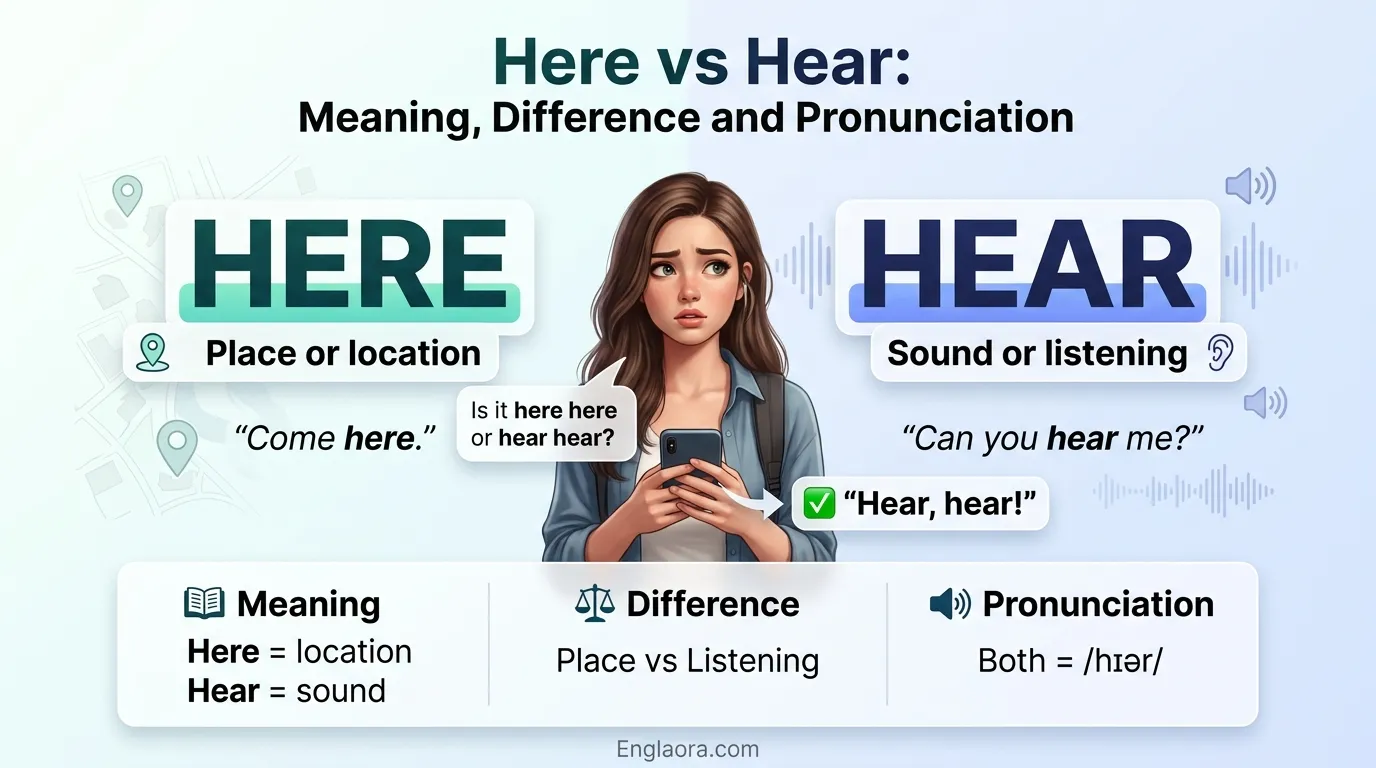
These two words sound the same, but they have different meanings.
- Here = a place or location
- Hear = to listen or receive sound
A simple memory trick:
HEAR contains the word EAR.
If the sentence is about sound or listening, use hear. If it is about a place, use here.
Quick examples
- Come over here.
- Did you hear that noise?
- I am here at the station.
- I can hear you clearly.
- Here is your coffee.
- Can you hear me now?
The origin of here or hear
Both words come from Old English.
Here comes from the Old English word hēr, meaning in this place. It has existed in English for more than 1,000 years.
Hear comes from the Old English words hīeran and hēran, meaning to perceive sound.
Because both words come from the same language family, they ended up sounding very similar in modern English.
Over time, English spelling became more fixed. Here kept the meaning of place, while hear kept the meaning of sound. But because they sound identical, people still confuse them today.
That is why here or hear appears in so many grammar books as a classic example of homophones.
British English vs American English spelling
Good news. There is no spelling difference between British and American English.
- Here is spelled the same everywhere.
- Hear is also spelled the same everywhere.
But there is one famous phrase that causes confusion.
Hear, hear vs here, here
One of the most searched questions is:
Is it “here here” or “hear hear”?
The correct phrase is:
Hear, hear!
This phrase is used in the British Parliament and other formal meetings to show agreement or approval.
It originally came from:
“Hear him, hear him!”
It means:
“Listen to this person. They are speaking well.”
Many people write “here here” because that is what it sounds like when spoken quickly. But the correct form has always been hear, hear.
Examples
- British Parliament: “Hear, hear!” ✅
- Common mistake: “Here, here!” ❌
Comparison table
| Feature | HERE | HEAR |
|---|---|---|
| Part of speech | Adverb / Noun | Verb |
| Meaning | In this place | To perceive sound |
| Memory trick | Place | Contains EAR |
| British spelling | here | hear |
| American spelling | here | hear |
| Example | Come here. | Did you hear that? |
| Common phrase | Here you go | Hear me out |
Which spelling should you use?
Use HERE when:
- Talking about a place
- Pointing something out
- Saying someone is present
- Using phrases like right here or over here
Use HEAR when:
- Talking about sound
- Listening with your ears
- Asking someone to listen
- Using phrases like hear me out or hear from someone
For the phrase “hear hear”
Always write:
Hear, hear!
That is the only correct form when expressing agreement.
Easy memory trick
If the sentence involves ears or sound, use hear.
Everything related to place or location uses here.
Common mistakes with here or hear
| Mistake Type | Wrong ❌ | Correct ✅ |
|---|---|---|
| Sound vs location | I can here you. | I can hear you. |
| Location vs sound | Come over hear. | Come over here. |
| Famous phrase | Here, here! | Hear, hear! |
| Pointing something out | Hear is the report. | Here is the report. |
| Listening context | Did you here that? | Did you hear that? |
| Presence/location | I am hear at the office. | I am here at the office. |
The most common mistake is:
❌ I can here you
✅ I can hear you
Another common mistake is:
❌ Here, here!
✅ Hear, hear!
Remember the EAR trick:
hEAR = sound and listening
Here or hear in everyday examples
Email example using HERE
Hi Sarah, I am here at the conference venue. The meeting room is right here on the second floor. Please come over when you arrive.
Email example using HEAR
Dear Team, I was glad to hear that the project was approved. Please let me know if you hear any updates from the client.
Social media example
“Just got here at the concert 🎶 Can you hear that bass?”
News example
“The minister arrived here in the capital on Tuesday. She said she wanted to hear directly from the people affected by the policy.”
Parliamentary example
Cries of “Hear, hear!” echoed across the chamber as members showed approval.
Is “this here” correct?
You may hear phrases like:
“This here is my truck.”
This is informal regional English, mostly in Southern American dialects. In formal writing, simply say:
“This is my truck.”
Here or hear Pronunciation
Both words are pronounced exactly the same:
/hɪər/
They rhyme with:
- near
- fear
- ear
There is no pronunciation difference between here and hear. That is why they are called homophones.
Here or hear meaning
Meaning of Here
Here means in this place or at this location.
Examples:
- I am here.
- Come here.
- Here is your bag.
Hear meaning
Hear means to receive sound through your ears.
Examples:
- I hear music.
- Did you hear the bell?
- Can you hear me?
Here or hear Difference
The difference is simple:
| Word | Meaning |
|---|---|
| Here | A place or location |
| Hear | Sound or listening |
Easy rule
- Place = here
- Sound = hear
Full comparison table
| Word | Type | Meaning | Common Phrase | Example |
|---|---|---|---|---|
| Here | Adverb/Noun | In this place | Come here | I am here. |
| Hear | Verb | To perceive sound | Hear me out | Did you hear that? |
| Hear, hear | Phrase | Expression of agreement | Parliamentary phrase | “Hear, hear!” |
| Here, here | Mistake | Incorrect spelling | Do not use | ❌ |
FAQs
Q1. When should I use here and hear?
Use here for location. Use hear for sound or listening.
Q2. Is it “here here” or “hear hear”?
The correct phrase is “Hear, hear!”
Q3. Why do people write “here here”?
Because both words sound the same when spoken.
Q4. Are here and hear pronounced the same?
Yes. Both are pronounced /hɪər/.
Q5. How do I use hear in a sentence?
- I hear music.
- Did you hear the news?
Q6. How do I use here in a sentence?
- Please come here.
- Here is your phone.
Q7. What does “this here” mean?
It is informal regional English. In formal writing, use “this is” instead.
Q8. Are here and hear homophones?
Yes. They sound the same but have different meanings and spellings.
Q9. What is the easiest memory trick?
Look for EAR inside hEAR. Ears hear sounds.
Q10. What does “Hear, hear!” mean?
It means “I agree” or “Listen to this person.”
Conclusion
Here and hear sound exactly the same, but they mean very different things.
Use here for place and location. Use hear for sound and listening.
The easiest memory trick is:
EARS hear sounds.
And remember:
Hear, hear! is the correct phrase
Not “here, here.”
Now you can confidently use both words correctly in writing and conversation.

Hi, I’m Toby Kellan, writing for Englaora.com. I provide clear, reliable content to help users understand the differences between commonly confused words.