Important Disclaimer:
This article is for informational purposes only and is not a substitute for professional medical advice. ADHD and anxiety can only be properly diagnosed by a qualified doctor, psychiatrist, or psychologist. If you’re struggling, please consult a healthcare professional.
Many people get confused between ADHD and Anxiety because their symptoms often feel very similar — restlessness, trouble focusing, racing thoughts, and feeling overwhelmed.
If you’re searching “ADHD or anxiety quiz”, “do I have ADHD or anxiety”, or “ADHD vs anxiety in women”, you’re not alone. The overlap makes it really hard to tell what’s going on.
This guide explains the clear differences, where they overlap, how they show up in adults, women, children & teens, and what you should do next.
Quick Answer
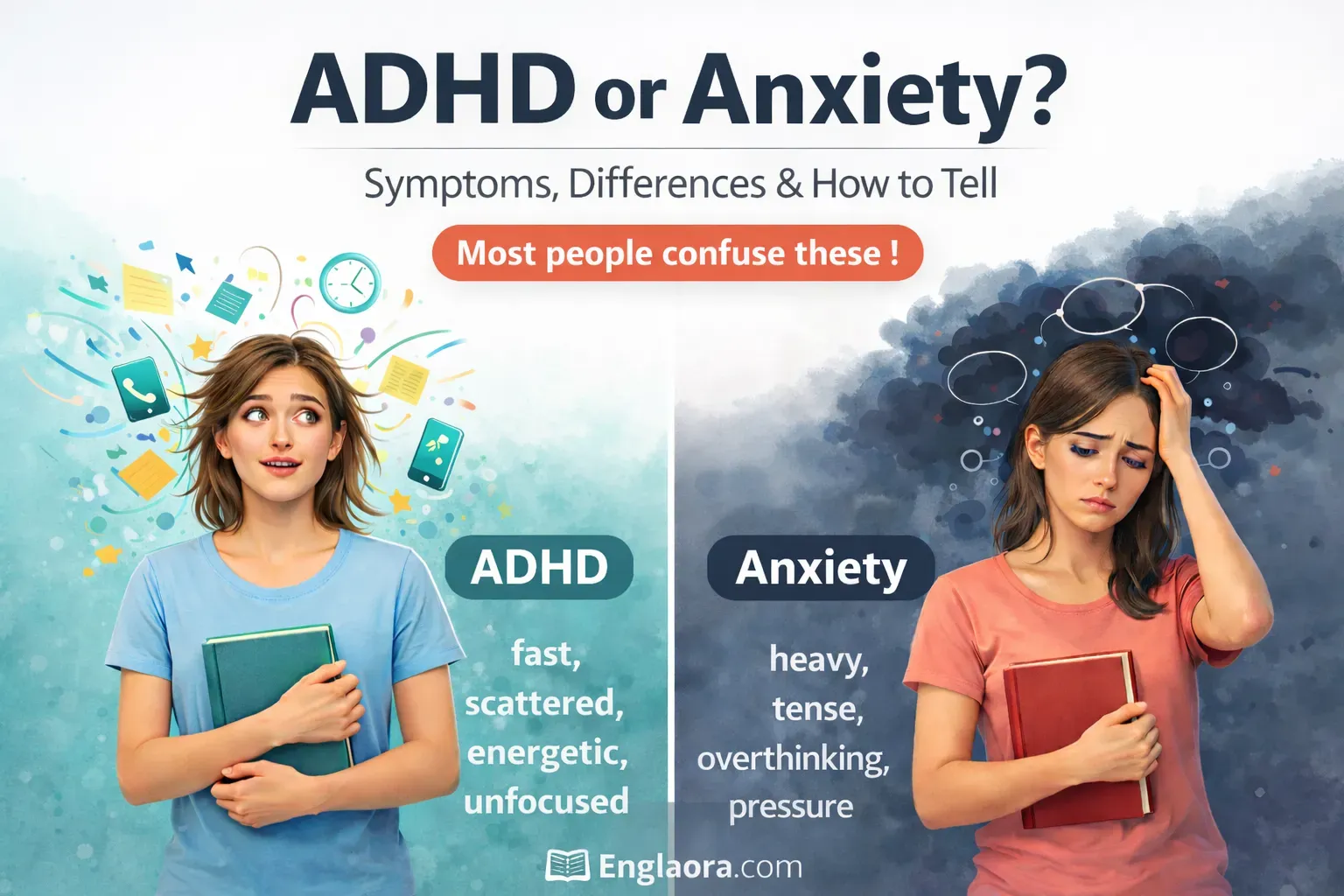
ADHD is a neurodevelopmental condition that affects attention, organization, and impulse control. Anxiety involves excessive worry, fear, or physical stress responses.
Key Difference:
- ADHD: Difficulty focusing even when calm.
- Anxiety: Focus issues mainly appear when worry or fear is present.
They often overlap and can co-exist (up to 50% of people with ADHD also have anxiety).
Examples:
- ADHD: Forgetting deadlines no matter how relaxed you feel.
- Anxiety: Can’t concentrate before an important meeting due to “what if” thoughts.
- Both: Racing thoughts, restlessness, and trouble sleeping.
Common ADHD Symptoms
- Short attention span and easy distraction
- Chronic forgetfulness (keys, appointments, deadlines)
- Difficulty organizing tasks or finishing projects
- Restlessness or fidgeting (even when not stressed)
- Impulsivity (interrupting, risky decisions)
- Hyperfocus on interesting things, but struggle with boring tasks
Types: Inattentive, Hyperactive-Impulsive, and Combined.
Common Anxiety Symptoms
- Persistent worry or feeling of dread
- Restlessness tied to specific fears
- Physical symptoms: racing heart, sweating, stomach issues, shortness of breath
- Avoidance of triggering situations
- Overthinking and trouble sleeping due to worries
Quick Coping Tool – The 3-3-3 Rule: Name 3 things you see, 3 things you hear, and move 3 parts of your body. This grounding technique helps bring you back to the present moment.
ADHD vs Anxiety – Clear Comparison
| Symptom | ADHD | Anxiety | Both Possible? |
|---|---|---|---|
| Trouble Concentrating | Even when calm | Mainly during worry/fear | Yes |
| Restlessness | Constant, boredom-driven | Tied to specific fears | Yes |
| Forgetfulness | Chronic and frequent | Only when overwhelmed | Sometimes |
| Worry | About consequences of unfinished tasks | Excessive about many things | Yes |
| Impulsivity | Common | Rare (more avoidance) | No |
| Physical Symptoms | Less common | Racing heart, sweating, tension | Sometimes |
ADHD vs Anxiety in Adults & Women
Many adults (especially women) wonder: “Do I have ADHD or anxiety?”
- ADHD in adults: Often shows as chronic disorganization, procrastination, and feeling overwhelmed. Women tend to have inattentive type and “mask” symptoms, appearing as perfectionism or high-functioning anxiety.
- Anxiety in adults: More situational and tied to specific worries.
- Women with ADHD are frequently misdiagnosed with anxiety first.
High-functioning anxiety can hide underlying ADHD.
ADHD or Anxiety in Children & Teens
- Children: ADHD → constant hyperactivity and interrupting across all settings. Anxiety → clinginess, school avoidance, stomachaches before events.
- Teens: ADHD → impulsive or rebellious behavior. Anxiety → social withdrawal or panic before exams/events.
Symptoms overlap heavily during school stress. Professional evaluation is essential.
Can They Be Mistaken for Each Other?
Yes — very common, especially in girls and women. Many people get treated for anxiety for years before discovering ADHD (or both). Comorbidity Rate: 25–50% of people with ADHD also have an anxiety disorder.
Treating only one may not fully resolve symptoms. Integrated treatment (therapy, medication, coaching) often works best.
ADHD or Anxiety Quiz / Self-Assessment
Free screening tools can help you prepare for a doctor visit:
- ADHD: Adult ADHD Self-Report Scale (ASRS)
- Anxiety: GAD-7
Important: Online quizzes are not diagnostic. They are only a starting point. A full evaluation includes detailed history and clinical interview.
How People with ADHD Act When Stressed
They may procrastinate more, hyperfocus on worries, have emotional outbursts, or enter a burnout cycle (exhaustion + shame → more anxiety).
Common Mistakes People Make
- Self-diagnosing based only on TikTok/Reddit
- Treating anxiety while ignoring ADHD (or vice versa)
- Assuming symptoms are “just stress”
FAQs
Q1: How do I know if it’s ADHD or just anxiety?
Look at focus issues: If they happen even when calm → more likely ADHD. If only during worry → more likely anxiety.
Q2: Can you have both?
Yes. Up to 50% of people with ADHD also have anxiety.
Q3: Is it common to mistake ADHD for anxiety?
Very common, especially in women and high-achievers.
Q4: How are adults tested for ADHD?
Through clinical interviews, symptom checklists, and ruling out other conditions. No single blood test or brain scan.
Q5: What should I do next?
Talk to a mental health professional. Early diagnosis can significantly improve quality of life.
Conclusion
ADHD and anxiety share many symptoms, but their root causes differ. ADHD is about brain wiring for attention and regulation, while anxiety centers on fear and worry. Many people have both — and that’s okay. Getting the right diagnosis opens the door to effective support, whether it’s therapy, medication, coaching, lifestyle changes, or a combination.
You’re not alone. If you’re struggling with focus, restlessness, or worry, reach out to a doctor or therapist. Clarity brings relief — and the right help can change everything.

I’m Liam Prescott, writing for Englaora.com. I explain the nuances of commonly confused words, making complex topics simple and engaging for readers.